
Article: Bengal: size, temperament, cost in the UK, and what a cat this active needs at home
Bengal: size, temperament, cost in the UK, and what a cat this active needs at home
The Bengal was made by crossing the Asian leopard cat with domestic cats, bred in the United States from the 1960s. In Great Britain, a first-generation cross still needs a licence under the Dangerous Wild Animals Act. The Bengal in a UK home is bred from Bengals, and in law it is an ordinary domestic cat. The registry says it "will need to be kept engaged and amused with toys and cat activity centres including boxes, tunnels and high level shelves."
I sell posts, trees, tunnels, three harness sets and one litter box. Every Bengal within the registry's weight ranges sits under the Snow Dome's 7kg rating and the Expandable carrier's 7.5kg, so the sections below say what fits rather than whether.
Key facts
- Lifespan: 12 to 16 years by the registry; in UK vet records, Bengals that died in 2019 had a life expectancy at birth of 8.5 years across all causes (73 deaths)
- Weight: females 3.6 to 5.4kg, males 4.5 to 6.8kg
- Coat: short, dense, soft; spotted or marbled; a light brush and comb once a week
- Indoor suitability: indoors or with contained outdoor space; the registry advises against free roaming
- Typical UK price: Cats Protection's £800 to £2,000 for pedigree cats such as British Shorthairs, Maine Coons and Ragdolls (checked November 2026); no charity, vet or registry gives a Bengal figure
- Legal: first-generation crosses need a Dangerous Wild Animals licence in Great Britain
- Recognised by: GCCF (preliminary recognition 1997)
What to know before buying a Bengal cat?
The GCCF registered 86 Bengals in 2025, 21st of its breeds, against 5,873 British Shorthairs and 3,111 Ragdolls out of 17,464 pedigree cats. A Bengal is a domestic breed descended from crosses between the Asian leopard cat and domestic cats. Ask the breeder for the generation on the pedigree and for both parents' PK deficiency and PRA-b DNA results; since June 2016 a Bengal goes on the GCCF's Active Register, the breeding register, only if it or both its parents have tested normal for both. Kittens leave at 13 weeks. A Bengal imported and registered with the GCCF must show a four-generation pedigree of Bengals only, with no F1, F2 or F3 cross from an Asian leopard cat.
The registry stopped registering F1 crosses in 2002 and F3 crosses in 2008. The government's advisory committee on animal welfare, in an opinion published in December 2024, noted that no commercially available genetic test can prove which generation a hybrid cat is, so the pedigree is the buyer's evidence. What a kitten needs on day one is in the new kitten checklist.
Can you own a Bengal cat in the UK?
Yes. A Bengal bred from Bengals is an ordinary domestic cat in law. The Dangerous Wild Animals Act 1976 schedule lists the Asian leopard cat; a first-generation cross between a listed species and a domestic cat also needs a licence from the local authority in England, Wales and Scotland. The 2007 order took out hybrids where one parent is a domestic cat and the other is itself a first-generation hybrid, and cats descended exclusively from those excepted crosses and domestic cats. On that reading, a Bengal bred from Bengals for generations is one of the excepted cats, not a licensed animal.
The registry's import policy requires every imported Bengal to carry a four-generation pedigree showing only Bengals. A freedom of information request reported by the government's advisory committee found 187 Dangerous Wild Animals licences for cats held across 48 local authorities in 2023, covering six leopard cats and one Bengal.
How expensive is a Bengal cat?
Cats Protection says pedigree cats like British Shorthairs, Maine Coons or Ragdolls can cost anything from £800 to £2,000 (checked November 2026). The page does not name the Bengal, and no UK charity, vet or registry source gives a Bengal-specific figure. The same charity puts running costs at over £1,000 a year and insurance at around £25 to £50 a month.
What the money buys from a registered breeder is sourced. A Bengal kitten leaves the breeder at 13 weeks, by the registry's guidance, with its pedigree. Both parents should be DNA-tested clear of PK deficiency and Bengal PRA, and both tests have been required for the GCCF Active Register since June 2016. Those two tests and a four-generation pedigree are the checks worth asking for before any asking price. The new kitten checklist covers what the kitten needs on day one.
What is the lifespan of a Bengal cat?
The registry gives 12 to 16 years. In a 2024 study of cats that died in 2019 in UK vet records, Bengals had a life expectancy at birth of 8.5 years across all causes, calculated from 73 deaths, against 11.7 for all cats. The study's authors single out the Bengal and Sphynx as having "a particularly short life expectancy."
The short average has a shape. In our count from the study's open data, 23 of the 73 Bengals died before their third birthday, about one in three, against one cat in eight overall and about one purebred in five. Of those 23 young deaths, 17 were cats still recorded as entire. The 42 Bengals recorded as neutered had a median age at death of 10.5 years, and only three of them died before three. Twenty-four of the 73 reached the age of 12.
The bounds on those figures matter. Neuter status in the vet record is the last value recorded, so a kitten that dies before neutering age is recorded as entire, and the concentration of early deaths among entire cats is partly that age effect. This is a pattern in one year of deaths in 73 cats, not a forecast for one cat. The study's own finding across all breeds points the same way: entire cats had 4.29 times the odds of dying before three.
What is the behaviour of a Bengal cat like?
The registry describes the Bengal as "confident, active, curious, athletic and energetic," "very sociable," and "very vocal," adding that vocal "shouldn't be confused with aggression." It says the breed needs "toys and cat activity centres including boxes, tunnels and high level shelves," and that Bengals "also seem to like using cat exercise wheels." Playing with water, the registry notes, is "widely reported."
The registry's breeding policy adds that the Asian leopard cat is "essentially a timid cat that is more likely to run away than to attack" and that good temperament in the breed is "of paramount importance." The breed club recommends a second cat if nobody is home during the day. Best cat toys covers what my range holds for that list and what it does not.
What health problems do Bengal cats have?
The registry says "there are no diseases specific to the breed." The two inherited conditions breeders test for are pyruvate kinase deficiency, which causes chronic anaemia, and Bengal progressive retinal atrophy, which causes progressive vision loss with signs noted as early as nine weeks. Both DNA tests have been tied to the GCCF Active Register since June 2016: a Bengal may be registered on it only if tested normal for both, or if both parents are. Hypertrophic cardiomyopathy occurs in some Bengal lines and has no DNA test in the breed; the registry recommends echocardiography of breeding cats, noting that many do not show detectable changes until middle or old age. Flat-chested kittens and patellar luxation are the two anatomical conditions the registry names, with the incidence of luxation now much lower.
Ask the breeder for both parents' PK and PRA results, or the kitten's Active Register status. Ask whether the parents' hearts have been scanned. For the cat itself: a vet, insurance, and a neutering plan agreed with that vet.
Are Bengal cats indoor cats?
A Bengal can live indoors on the conditions any indoor cat needs: things to climb, daily play, and essentials per cat plus a spare. The registry advises against free roaming and says Bengals "can be trained to walk on a harness." The government's advisory committee on animal welfare, in an opinion published in December 2024, goes further: it says hybrid breeds including the Bengal "are not suited to life as pets in small indoor dwellings."
The breed club recommends enclosed outdoor access, noting that Bengals "do not have very good road sense." Cats Protection's indoor guide notes that the indoor environment predisposes to obesity, and for a breed the registry describes as athletic and energetic, I would not call a flat without height or a daily play routine the right home. The decision is easier made with a kitten than reversed later. Keeping a cat in a flat covers the tray, the space and the smell.
Are Bengal cats hypoallergenic?
No. A 2024 review found no scientific evidence for a hypoallergenic cat breed: every cat produces Fel d 1, the main cat allergen, including hairless breeds. The amount varies between individual cats, and on average unneutered males produce more than females. The Bengal's coat needs only a light weekly brush, but minimal grooming is not the same as low allergen production. The Ragdoll guide carries the full source.
How big do Bengal cats get?
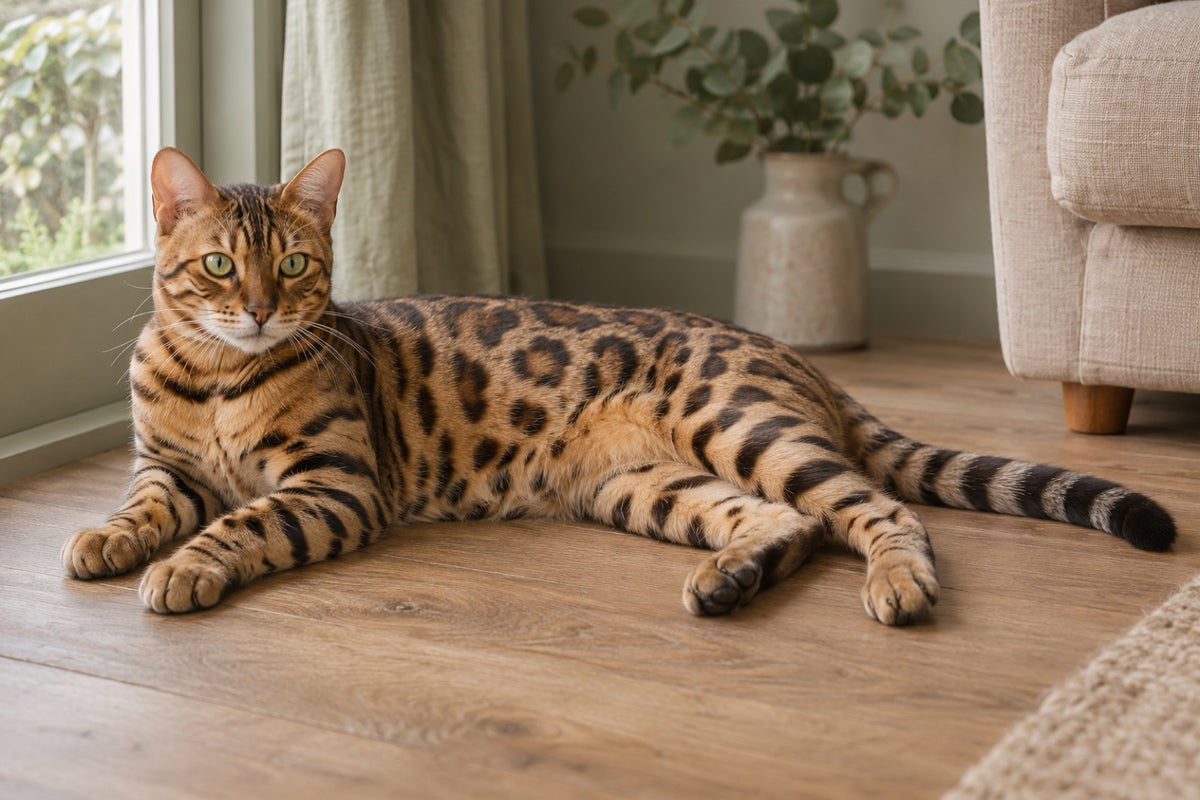
Females weigh 3.6 to 5.4kg, males 4.5 to 6.8kg, by the registry's figures. The breed is described as "a medium to large cat of foreign type with a strong, muscular athletic body." The body is long and sleek, with muscular legs, the hind legs slightly longer, and large rounded paws. The coat is short to medium in length, dense, and "unusually soft to the touch."
No registry publishes a body length for the Bengal. For anything you are buying to fit the cat, measure from the nose to the base of the tail.
Coat, colours and grooming
Bengals come in two coat patterns, spotted and marbled. The spotted pattern may include rosettes, rings of colour around a lighter centre. Brown Bengals carry the most familiar look; in light the coat shows gold dusting or a glitter effect. Snow Bengals carry the Siamese or Burmese colour restriction on ivory to cream or tan grounds, with a pearl dusting. Silver Bengals carry a silver ground under a spotted or marbled pattern, and the standard also lists blue, blue snow and blue silver varieties.

A light brush and comb once a week keeps the coat in condition. The short, dense coat needs no specialist routine.
What a Bengal needs at home
The registry names the kit: toys, boxes, tunnels, high-level shelves, an exercise wheel, a harness. My range covers some of those and not others.
Climbing and play
A Bengal wants height and movement. In a survey of 4,331 cat owners, cats scratched most on a simple upright post or a tree with two or more levels at least 90cm tall.

The zeze Farmhouse tree is 138cm tall on a 70 by 60cm footprint with jute-wound uprights and a solid wood house. Where the ceiling says smaller, the zeze Deluxe 3-in-1 stands at 118cm on 68 by 65cm with rope-wrapped posts, the zeze Happy Farm at 105cm on 60 by 53cm, and the zeze 3-in-1 at 102cm on 72 by 52cm, described on its page as suited to multi-cat households. The zeze Cream Three-Layer Cake at 110cm is plush over MDF with no rope, so it is a den and a perch and needs a post beside it.
For play, the pidan bouncy ball and feather set is a 3-pack with undyed feathers; supervise play. The zeze Tulip teaser wand and Caterpillar wand are both 123cm. The zeze Forest Snake tunnel gives a hiding and ambush spot. I sell no exercise wheel and no wall shelves, and for this breed that is a gap worth filling from elsewhere. The rest is in toys, and best cat tree covers the full tree range.
Scratching

The tallest single posts I sell are the zeze Shy Tulip, large at 85cm of jute on a 39cm weighted base, the zeze Trophy at 85cm on a 43cm base, and the zeze Two-Tier Arch at 86cm on 45 by 45cm with rope-wrapped posts. All three sit just under the survey's 90cm line. The zeze Cactus at 65cm on a 35cm base is shorter but wound in linen and sisal rope. On the floor, the zeze Big Ramen Bowl at 48 by 48cm gives a jute surface and a place to curl up. Choosing a cat scratcher has the survey behind the 90cm line, and the full range is in scratchers and trees and beds.
Harness and lead

The registry says Bengals "can be trained to walk on a harness, by introducing the cat to a harness initially, and then attaching the lead, although this training may take time." Cats Protection and the veterinary charities take a different position: walking a cat on a harness and lead "is not recommended", because cats "will usually find being walked on a lead very stressful."
For an owner who does it, the charities' conditions: a harness made for cats, never a collar; start as a kitten, indoors first; do not leave the harness on unattended; keep walks short; keep the lead slack and let the cat lead; and microchip, which since June 2024 is a legal requirement for all cats in England. The three sets I sell are sized by chest girth, measured just behind the front legs: the pidan Cat Harness Set in M (chest 26 to 43cm) and L (chest 34.6 to 58cm, multicolour only), the zeze Pet Leash and Harness Set (chest 32 to 56cm), and the zeze Plaid set (chest 29 to 44cm). No registry or veterinary source gives a Bengal's chest girth, so which set fits depends on measuring the cat, not on the breed. The full range is in collar and harness.
The tray
The rule of thumb is a tray one and a half times the cat's length from nose to the base of the tail. No registry publishes a Bengal body length, so measure the cat.

The pidan Snow Dome is 54.8cm across on the outside, with a round basin that holds about 4 to 5cm of litter and a grated entrance corridor. Its page rates it for cats under 7kg. On the listed figures, every Bengal in the registry's weight ranges is under the rating. By the 1.5x rule, the dome suits a cat of at most about 36.5cm from nose to tail base, and less inside because the basin is narrower, though its measurement is not published.
Two cats need three trays by a widely used rule, though the veterinary nurse who published it was careful to note it is "not based on hard evidence." The litter box collection holds one product, the Snow Dome, so a second or third tray is another dome or an open tray from elsewhere.
The litter
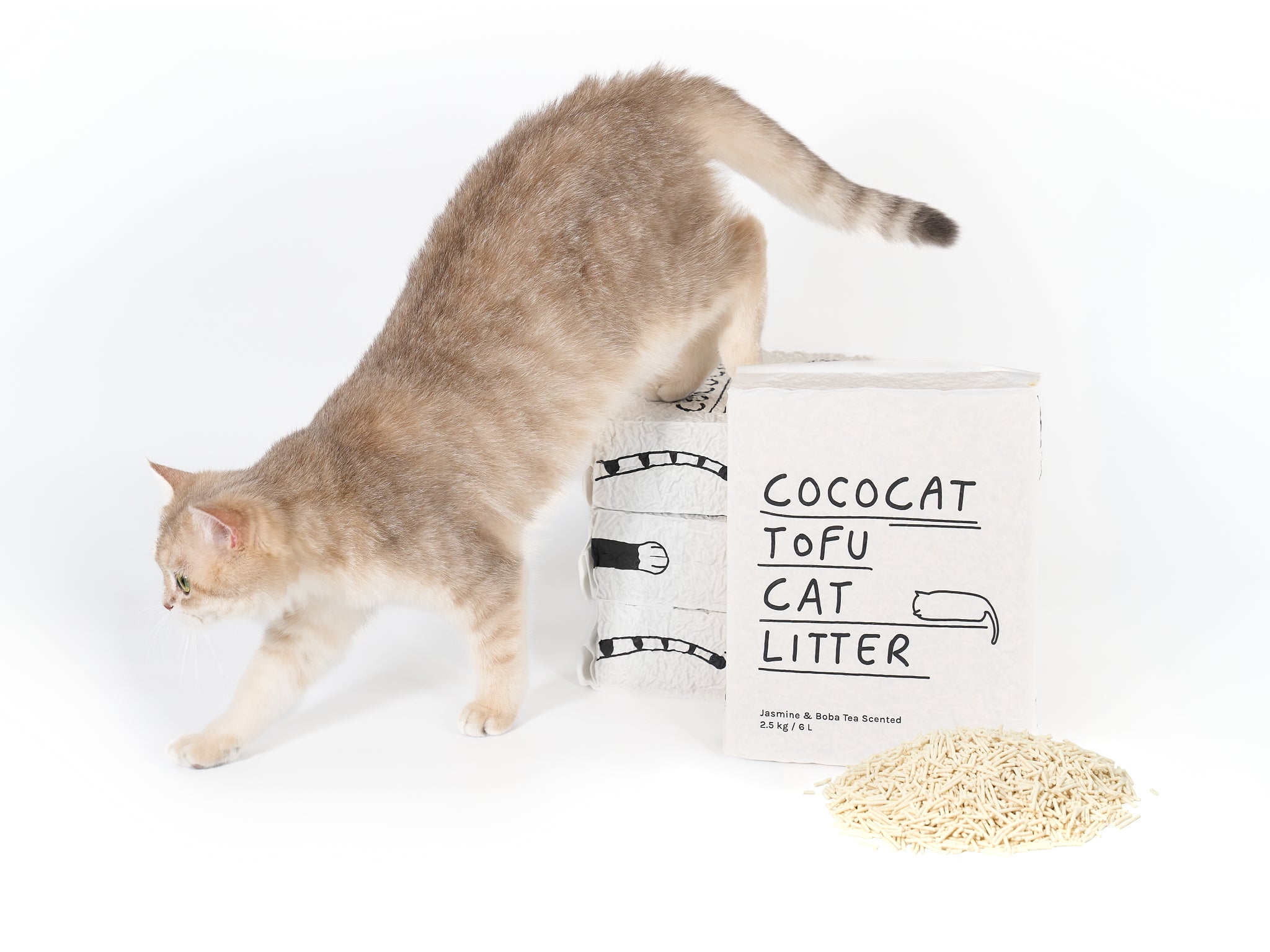
CocoCat tofu litter is pea fibre, corn starch, guar gum and plant-based enzymes, pressed into pellets about 1.5mm across. It clumps, so you scoop and top up. It has a Jasmine bubble tea scent, and there is no unscented version. It tracks: a light pellet rides out on paw fur.
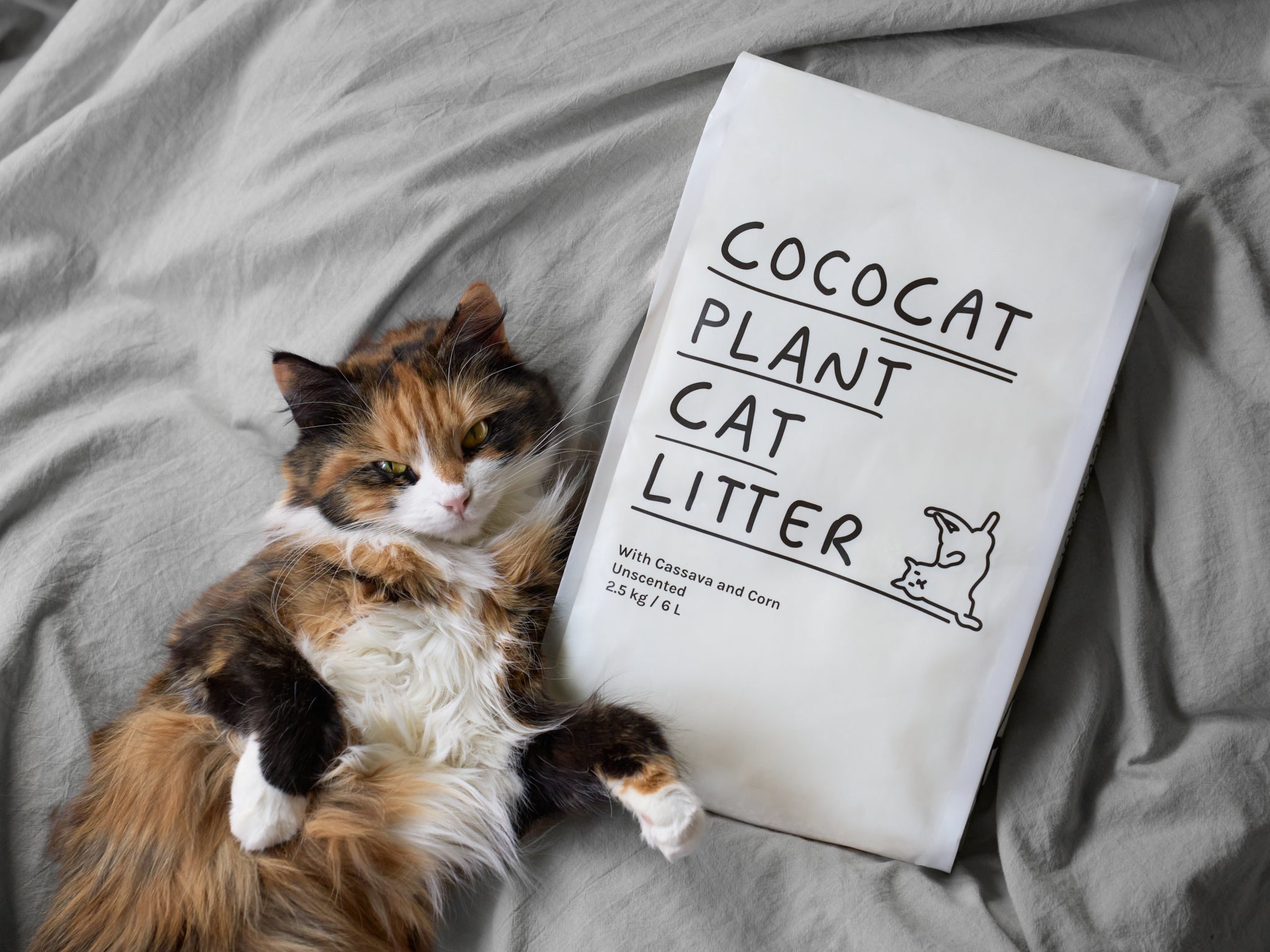
CocoCat cassava litter is cassava flour with corn starch, corn flour and guar gum, unscented. Fill to 5 to 7cm. It is not flushable. It suits a household running an automatic litter box or one where scent is unwelcome.
The registry notes that Bengal kittens "very quickly learn to use a litter tray." There is no breed reason to prefer one litter over another. Both bags are in the cat litter collection. How often to change it has the routine, and the disadvantages piece covers tracking in more detail.
The carrier

The pidan Expandable Travel Habitat is a backpack, 38 by 28.5 by 40.5cm, that unzips to 38 by 38 by 58cm with a foldable litter tray inside. It weighs 2.2kg and is rated for pets under 7.5kg: on the listed figures, every Bengal in the registry's ranges is within it. The zeze Cloud shoulder bag is a sling at 57 by 60cm with a harness clip inside; it carries no weight rating. Cat backpacks and carriers covers carrier choice, and the full range is in the carrier collection.
Which household suits a Bengal
A Bengal suits a household with ceiling height to give, time for daily play, company during the day or a second cat, and an outdoor plan that is contained rather than free roaming. It lives well indoors with the right space and routine.
The government's advisory committee says plainly that hybrid breeds including the Bengal are not suited to small indoor homes, and I would not argue with that. Anyone wanting a sedentary cat in a small flat is looking at the wrong breed. The British Shorthair is the breed the registry describes as suited to indoor life, if that is what the household needs.
The harness sets, scratchers and trees above are in collar and harness, scratchers and trees and beds. If you would like the next breed guide when it is written, the newsletter box is at the foot of this page.
Related posts
- Choosing a cat scratcher: height, base, rope and the survey behind the 90cm line
- Best cat toys for indoor cats
- Keeping a cat in a flat: the tray, the smell and the space
Sources
- Bengal, Governing Council of the Cat Fancy
- Dangerous Wild Animals Act 1976, Schedule
- Opinion on the welfare implications of current and emergent feline breeding practices, Animal Welfare Committee, 2024
- Life tables of annual life expectancy and risk factors for mortality in cats in the UK, Journal of Feline Medicine and Surgery, 2024
- Should I walk my cat on a harness and lead?, Cats Protection, 2024

