Article: The best cat toys, and ten minutes a day with an indoor cat
The best cat toys, and ten minutes a day with an indoor cat
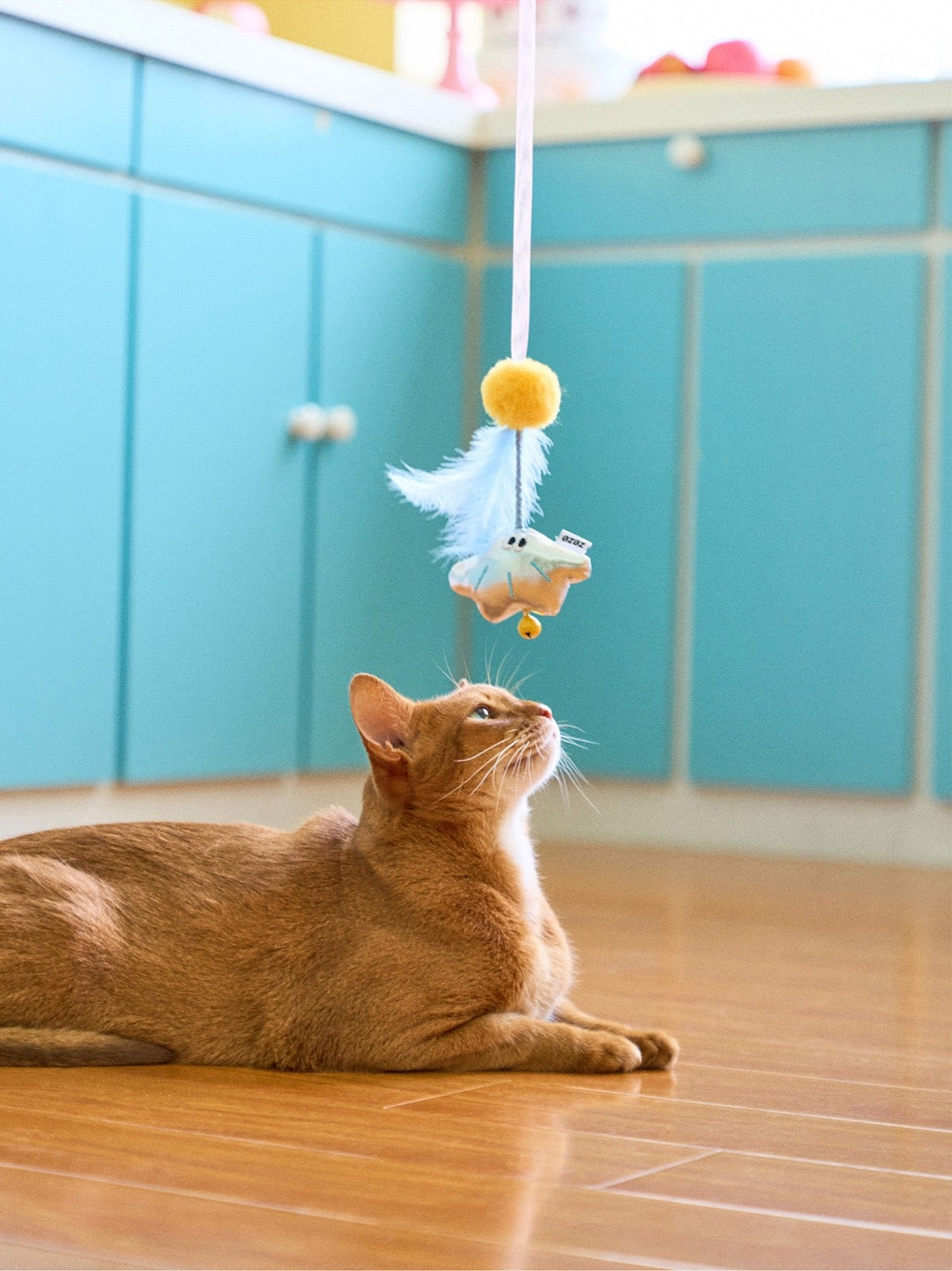
Pull a feather lure across the floor and a cat drops to a crouch, ears forward, back legs loaded. That is the hunting sequence starting: search, stalk, chase, pounce, catch. The toy decides which parts of the sequence the cat gets to practise. A wand in someone's hand gives the full run from stalk to catch. A ball gives chase and pounce. A tunnel gives the ambush. A kicker gives the kill. A toy that never lets the cat catch it frustrates the cat; a toy left on the floor since Tuesday is furniture. This page sorts the toys by the part of the hunt each one serves, gives the listed sizes, and ends with a short daily routine built from the charities' play figures.
What kind of toys do cats enjoy?
Toys that let the cat complete its hunting sequence. International Cat Care describes play as search, stalk, chase, pounce, catch and manipulate: something to follow and stalk (a lure on a wand), something to chase and bat (a ball), something to hide inside and ambush from (a tunnel), and something to grab, bite and kick (a catnip or silvervine kicker). A game that never lets the cat catch the toy frustrates it, which is the charity's own word for it. Rotate toys rather than leaving them all out, so each session starts with something the cat has not seen for a while.
Within the sequence, two kinds of prey drive two kinds of wand play. A lure swooped through the air mimics a bird: the cat tracks, leaps and catches in the air. A lure dragged along the floor in straight lines mimics something running: the cat goes low and covers ground. The difference is in the person's hand, not the toy.
How do I keep my indoor cat entertained?
Interactive play is one of five needs, not the whole answer. The veterinary environmental-needs guidelines published in 2013 set out five pillars for a cat's wellbeing: a safe place, resources in more than one location, play and predatory behaviour, consistent human contact, and an environment that respects the cat's sense of smell. For the play pillar, the guidelines say to hide food in several locations, scatter or toss kibble for cats to chase, and use puzzle feeders. A home-made feeder from a stack of empty toilet-roll tubes does the same job; it is the guidelines' own example.
I sell no puzzle feeder, no circuit toy and no treat-dispensing ball. The tree piece covers height. The scratcher piece covers something to scratch. Keeping a cat in a flat covers the room. What I sell is the wand-and-kicker end of the sequence, and this page covers that.
Wand toys: the one you play with together
A wand keeps hands out of the game and lets the cat stalk, chase and catch a lure at the end. The 2013 guidelines are direct: move the lure like prey, let the cat catch it at the end of each game, and never use hands or feet. Put the wand away when you are not playing; anything with string is a tangle risk.

I stock eight wands. The three ground-prey wands, the zeze Tulip Teaser Wand, the zeze Caterpillar Teaser Wand and the zeze Dachshund Teaser Wand, are each listed at L123 x W7cm with plush crinkle lures that drag along the floor; the Tulip also contains catnip. Three flying-prey wands, the zeze Little Yellow Star Feather Wand, the zeze Shimmer Shell Feather Wand and the zeze Silky Butterfly Wand, are listed at 97 x 10cm with feather or ribbon lures that fly. The zeze Iridescent Tassel Wand at a listed 78 x 7cm and the zeze Dreamy Feather Wand at 53cm are the shorter pair; the Dreamy Feather's page notes that 53cm is a manual measurement with 1 to 3cm margin. The listed lengths run from 53cm to 123cm, and the difference matters: the longer the rod, the further the lure from your hand.
Balls, and the one that rolls on its own
A ball gives chase and pounce: the cat bats it, the ball moves, the cat follows. For a catch, the ball needs to be small enough to hold between two paws.

The pidan Bouncy Ball and Feather Set is a 3-pack of 30mm balls with feather tails of 80 to 100mm in undyed natural chicken feathers. As the page describes it, the ball springs off at an angle the cat cannot predict and the tail slows it down so it is less likely to disappear under the sofa. This is a consumable toy; replace a ball when the feathers wear. The page says to supervise play and remove the toy if the cat starts chewing off pieces.
The zeze Heart Smart Electric Rolling Cat Ball is listed at 38mm in silicone and ABS; its name is the only description of its movement the page gives, so I call it an automatic cat toy and leave it there. Its page says to supervise play, check the toy regularly and remove it if damaged. Neither ball replaces the wand session; a rolling ball fills the gaps between sessions, with someone in the room.
Do cats like tunnels?
A tunnel gives cover and a way out: a hiding place that doubles as a launching point. The 2013 guidelines ask for private, secure places where a cat can get away from things it finds stressful, and a tunnel adds the ambush point to the stalk end of the play sequence. The cat disappears inside, watches through a peek hole, and springs at whatever passes the opening.

The zeze Felt Cat Tunnel is listed at L61.5 x W45.5 x H50cm in flannel with round cut-outs along its length, for cats and kittens. The zeze Forest Snake Spiral Cat Tunnel is L29 x W29 x H78cm on a steel-wire spiral in plush with catnip inside. The zeze Spring Flower Spiral Cat Tunnel is a third spiral in long plush with crinkle paper and catnip; its page lists no dimensions. The zeze Spiral Snake Cat Toy, listed at L19 x W19 x H28cm on an engineered-wood base, is a standing toy to bat at rather than a tunnel to run through.
Do all cats react to catnip?
No. In a test on 100 cats, about one in three did not respond to catnip. Almost 80 per cent responded to silvervine, and of those that ignored catnip, almost 75 per cent responded to silvervine instead. The response was mainly to silvervine fruit galls; fewer cats responded to the wood, and the toys here use sticks rather than galls. Kittens under three months may not respond to catnip at all. About half the cats in the same test responded to valerian root.

The kick-and-chew toys serve the catch-and-manipulate end of the sequence: something the cat grabs with its front paws, bites and rabbit-kicks. Three carry silvervine and catnip: the zeze Lucky Orange (L10 x H11cm, also with valerian root), the zeze Alpaca (L20 x W13 x H3cm with stick) and the zeze Strawberry Cake (L11 x W9 x H13cm with stick). The zeze Avocado (L9 x W6 x H19cm) has a silvervine stick and a hemp ball; its page says to supervise play. Four contain catnip: the zeze Ant (L15 x W7 x H3cm), the zeze Green Acorn (5 x 5 x 9cm), the zeze Lucky Orange Catnip Ball (L6 x W4 x H20cm) and the zeze Caterpillar Catnip Ball (L20 x W4.5 x H9cm). The Lucky Orange silvervine toy is the only one in my range that lists valerian.
What is the best toy for a kitten?
A wand with a single plush lure, kept at a distance from the kitten and put away after each session, plus small balls under supervision and somewhere to hide. Never hands or feet, and no ribbon, string or wool left within reach. Kittens tire fast; short games of one to two minutes are fine. The zeze Tulip Teaser Wand or zeze Caterpillar Teaser Wand at a listed 123cm keeps a kitten's claws well clear. The pidan Bouncy Ball and Feather Set is the small ball to chase, supervised, as its page says. The zeze Felt Cat Tunnel is listed for cats and kittens.
The ribbon-strand wands, the zeze Silky Butterfly with its leafy ribbon and suede cord and the zeze Iridescent Tassel with PET strands, are used under supervision and put away after. Catnip toys may do nothing under three months. If the kitten has not arrived yet, the new kitten checklist covers every room in the house, and the kitten litter piece covers the tray.
How to make your cat play with toys?
Make the toy behave like prey: move it away from the cat, not towards it. Let it disappear behind a chair leg, pause, reappear. Jerky, unpredictable movements are what trigger the stalk. Pick the time the cat is alert; cats are often most active at dawn and dusk. Let the cat catch the toy at the end of every game; a game that always ends with the lure snatched away is the frustrating kind. With older cats, keep things at floor level and gentler. With two cats, play with each one separately in different parts of the home.
How long should I let my cat play with an interactive toy?
In short bursts. One to two minutes of hard play is a full game. Cats Protection gives the range: younger cats will play ten or more of those a day, older cats three or four. That is where "ten minutes a day" comes from: several short games that add up, not one long session. It is our sum of those figures, not a number any charity prescribes.
Ten minutes a day: the routine
Start when the cat is alert, often around dawn or dusk. Begin with the lure hidden behind your back or behind a chair, then sweep it away from the cat along the floor or through the air. Let it pause, hide behind a table leg, reappear; the pauses are what hold the stalk. One to two minutes of full intensity is enough for one round, and the round ends with a catch: the cat lands on the lure, holds it, and that is the kill. Follow the catch with a small treat or a meal; the hunt ends on the eating.
Put the wand away. Anything with string or ribbon stays out of reach between sessions, and the charities and the guidelines agree on this point.
Repeat through the day: three or four rounds for an older cat, ten or more for a younger one, spread across the hours the cat is awake. The total sits at roughly ten minutes; that figure is our arithmetic from those ranges, not a number published by any charity. Swap the toys around between sessions rather than leaving them all out. A kicker on the floor since last week is invisible; the same kicker brought out fresh is prey again. With two cats in the home, play with each one separately, in different rooms.
What annoys a cat the most?
In play, a game the cat cannot finish. A lure that never lands, a dot of light it can never hold, or a hand that becomes the prey: these are the games International Cat Care describes as frustrating, because the pounce and the catch are missing. A laser pointer lets a cat stalk and chase but never catch; if one is used, the session needs to end on a real toy the cat can hold. I do not stock a laser pointer.
What if a cat swallows string?
If thread or string is hanging from a cat's mouth, do not pull it. Call the vet straight away for an emergency appointment. Thread can catch inside the intestines and tighten as it moves; pulling from the outside risks serious internal damage. Prevention: wands and anything with string go away after every play session. Kittens should be kept away from ribbon, string and wool at all times. If a Christmas tree is coming into the house, keep the tinsel off it.
The toys I stock, by the part of the hunt
Every toy above mapped to the part of the hunting sequence it serves, its listed size, and the page's own storage or supervision instruction.
| Toy | Part of the hunt | Who moves it | Listed size | Fill | Put away? |
|---|---|---|---|---|---|
| Tulip, Caterpillar, Dachshund wands | Stalk, chase, pounce, catch | You | L123 x W7cm | Plush crinkle; Tulip contains catnip | Yes |
| Yellow Star, Shimmer Shell, Silky Butterfly wands | Chase, pounce, catch | You | 97 x 10cm | Feathers and bell; ribbon and crinkle (Butterfly) | Yes |
| Iridescent Tassel wand | Chase, pounce | You | 78 x 7cm | PET tassels | Yes |
| Dreamy Feather wand | Chase, pounce, catch | You | 53cm | Feathers | Yes |
| pidan bouncy balls | Chase, pounce, catch | You throw, the ball does the rest | 30mm ball, 80 to 100mm tail | Chicken feathers | Supervise |
| Heart electric rolling ball | Chase, pounce | The toy | 38mm | Silicone, ABS | Supervise |
| Felt tunnel | Search, stalk, ambush | The cat | L61.5 x W45.5 x H50cm | Flannel, peek holes | Indoor use, per the page |
| Forest Snake spiral | Search, stalk, ambush | The cat | L29 x W29 x H78cm | Plush, steel wire, catnip | Supervise |
| Kickers: Lucky Orange, Avocado, Alpaca, Strawberry Cake, Ant, Green Acorn, Lucky Orange Catnip Ball, Caterpillar Catnip Ball | Catch, manipulate | The cat | 9 to 20cm | Catnip, silvervine, valerian as listed per toy | Supervise |
Sizes are as listed on each product page.
I sell no puzzle feeder, no circuit toy and no laser pointer. For food games, the 2013 guidelines show a home-made feeder from a stack of empty toilet-roll tubes: access to food with an element of play, no purchase needed.
The toys collection holds every toy on this page. The scratcher piece covers the post that goes beside the wand basket, and the scratchers collection holds the full range. If something here would make a good Christmas stocking, the gift guide pulls the ideas together. The trees and beds collection covers height and hiding. The newsletter at the bottom of the page is how I let you know when new toys arrive.
Related posts
- The best cat tree for the room you have
- Bengal: size, temperament, cost in the UK, and what a cat this active needs at home
- Christmas gifts for cats, and for the person who lives with one
- The new kitten checklist, from someone who sells half of it
Sources
- Playing with your cat, International Cat Care
- AAFP and ISFM Feline Environmental Needs Guidelines, Journal of Feline Medicine and Surgery, 2013
- Responsiveness of cats (Felidae) to silver vine, Tatarian honeysuckle, valerian and catnip, BMC Veterinary Research, 2017
- Cats and play, Cats Protection
- My cat's swallowed some string, should I pull it out?, Vet Help Direct (Yvette Bell BVetMed MRCVS, 2 June 2021)