The best cat tree for the room you have
In a survey of 4,331 cat owners, cats used their preferred scratching surface more when it was on a tree with two or more levels standing at least three feet, about 90cm, tall. That single finding says a useful tree is tall enough to scratch on, holds more than one level, and gives the cat somewhere to watch from. This page settles which of those trees suits which room: a flat with little floor, a corner, a home with two cats or a kitten, and when a tree is not the answer. Everything measured here comes from the six product pages.
What makes the best cat tree?
A cat tree with two or more levels, at least 90cm tall, a hiding place sized for one cat, a scratching surface the cat climbs, beds large enough for the cat to rest comfortably, and a base that does not move. A set of feline environmental guidelines published in 2013 asks for safe places in raised locations and elevated areas that let the cat monitor its surroundings. The 4,331-owner survey found the height and levels cats actually used. Judge any tree by those four things: height, hiding, scratching and a stable base.
A tree that gives height and hiding but no scratching surface needs a post beside it. One that gives scratching and rest but no cover is a post on a platform, not a tree.
Do cats need a cat tree?
No. Cats need height and something to scratch, not a tree specifically. A tree is the one object that gives both in one footprint. In a home with wardrobes, shelves or a window perch, a cat already has height, and a post covers the scratching. PDSA's advice to indoor cat owners is to consider a good cat tree for climbing, and the 2013 guidelines ask for elevated resting areas with a view outdoors. Where the home lacks a high place with cover, a tree is the simplest fix. Where it already has one, a scratching post and a shelf may be enough.
Is it worth getting a cat tree?
Worth it where the home has no safe high place with cover. The measured evidence for cover and height together comes from shelter work: in a randomised trial, 23 cats given a hiding box settled on a steady lower stress score by day 2, while cats without one took until day 9. That was shelter cats in a strange place, a hiding box rather than a tree, and no study has measured a cat tree in a home. The direction is the finding, not the size. If a cat already has a wardrobe top and a post, the tree adds convenience rather than something it lacks.
How tall of a cat tree should I get?
About 90cm and two levels. In the 2016 survey of 4,331 cat owners, cats used the preferred scratching surface more on a tree with two or more levels at least three feet tall; three feet is about 90cm. Taller adds a higher lookout, not a different job. The six trees I stock run from 86cm to 138cm: the zeze Two-Tier Arch Cat Tree at the short end, the zeze Farmhouse Cat Tree at the tall. For kittens and older cats, the 2013 guidelines ask for perches at a low height or at levels reachable via ramps.
A tree for a flat with little floor
Floor space decides the shortlist. The zeze Two-Tier Arch Cat Tree takes up 45 by 45cm overall and stands 86cm tall on a weighted base, with rope-wrapped posts, a rubbing pole and balls to bat: the smallest footprint in the range and a proper vertical scratcher.

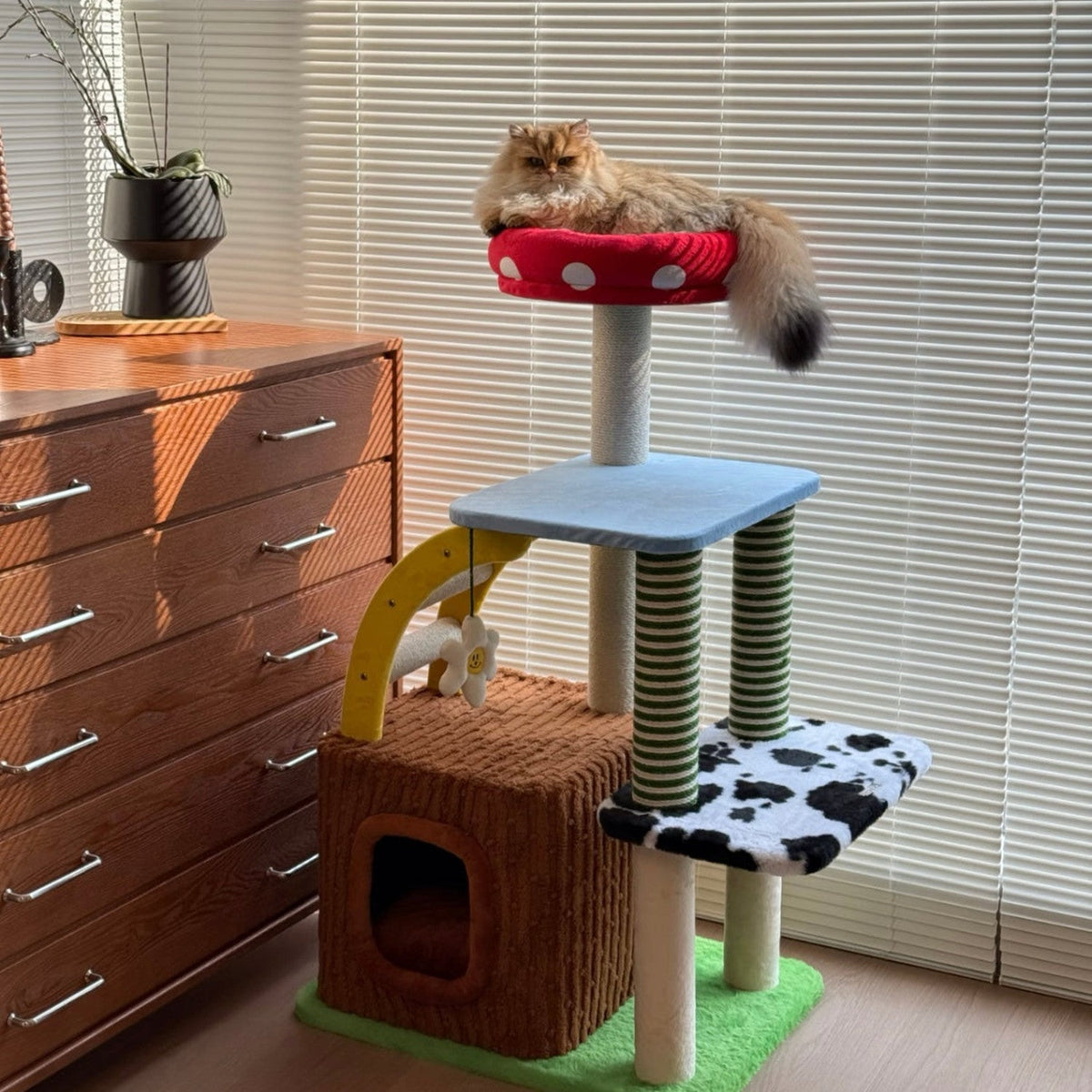
The zeze Cream Three-Layer Cake Cat Tree is 55 by 55cm and 110cm tall on a base 55cm across, about 12.55kg, with three tiers and a round doorway into each one: three hiding places at three heights. Its materials are plush, woven fabric, polyester fibre, MDF and catnip, with no rope anywhere in the list, so I would stand a scratching post beside it: the zeze Trophy post or the large Shy Tulip at 85cm. The zeze Happy Farm Cat Tree is 60 by 53cm and 105cm tall, three levels with jute-wound posts between them: scratching and climbing in one frame on a bigger footprint.
None of these is a small cat tree in the way the retail listings mean it. Those run about 42 to 50cm tall, below the survey's 90cm line. The point here is height per square of floor. For height with no floor at all, the zeze Striped Hanging Cat Hammock fixes to a window by suction cups and takes no sill. It is not a tree. If the flat is the main question, keeping a cat in a flat covers the tray, the smell and the bin.
Where should you put a cat tree in your house?

Near a window where the cat can look out. The 2013 guidelines ask that indoor resting areas include a location that gives the cat a view outdoors, and a tree by the window does that and gives height in one move. Put it in a room the cat already uses, on a hard, level floor so the base sits flat and the trunk does not sway. For a home with more than one cat, the guidelines ask for safe places with more than one way in and out, so a cat on the tree cannot be trapped by another below it.
No hercat tree is built corner-shaped; the fan-shaped towers that fill the "corner cat tree" listings are a different kind. The Two-Tier Arch and the Cake tree have square footprints, 45cm and 55cm, and a square tree sits in a corner as well as anything that size. For young cats under two, Cats Protection notes they are particularly susceptible to high-rise syndrome near open windows and balconies: if the tree goes by a window, the window stays shut or screened. If a Christmas tree is coming into the same room, give the cat its own tree before it arrives.
How many cat trees should I have for two cats?

At least as many safe places, sized for one cat, as there are cats, kept in separate parts of the home; the charities' rule is one resource per cat plus one, in different locations. One tree can serve two cats when it has two separate resting or hiding places and the cats get on; otherwise a second high place in another room does more good than a bigger tree in the same corner. The zeze Deluxe 3-in-1 Multi-Function Cat Tower has two tree-trunk dens, and its page describes the step platforms as giving each cat its own space. The zeze Farmhouse Cat Tree has a wooden house, two hammocks and a platform across four levels. The zeze Happy Farm Cat Tree page says it has room for two or three cats at once. Those are the maker's descriptions, not something I have tested.
What is the best cat tree for kittens?
A tree with a low first level, and a cardboard scratcher at floor level beside it. The 2013 guidelines ask for perches at a low height or reachable via ramps for kittens and older cats with limited mobility. A tree is not the kitten's first scratcher: in a controlled test of 40 kittens under eight weeks, an S-shaped cardboard scratcher was the preferred surface, and the scratcher piece covers why. The zeze Two-Tier Arch Cat Tree at 86cm is the shortest tree in my range. If the kitten has not arrived yet, the new kitten checklist covers every room in the house. Cats under two are particularly at risk from falls near open windows, so a tree by the window means the window stays shut.
A tree for a large cat

The zeze Farmhouse Cat Tree is the tallest and widest tree I stock: 70 by 60cm overall and 138cm tall, four levels with jute-wound uprights and a broad, thickened base, 13.45kg in the parcel. The zeze 3-in-1 Multi-Function Cat Tree has the widest overall footprint at 72 by 52cm. For a Maine Coon or a cat of that size, the Maine Coon guide covers the measurements in full.
How can I make my cat tree more stable?
No UK charity or vet body publishes a base-to-height rule for a cat tree. What is established is that cats reject a post or tree that moves when they lean on it: a heavy, stable base is what keeps the post used. A broader footprint relative to the height helps, a hard floor under the base helps, and tightening every bolt after assembly helps.
Across the six trees I stock, the pages describe the bases: the Two-Tier Arch has a weighted, solid base on a 45cm square footprint; the Cream Cake tree sits on a base 55cm across and weighs about 12.55kg; the Happy Farm describes a wide base; the 3-in-1 and Deluxe both describe a wide, reinforced base; the Farmhouse has a broad, thickened base on a 70 by 60cm footprint.
Wooden cat trees, and the kind I do not sell
I sell no solid-wood or Japandi cat tree, no floor-to-ceiling pole, and no starter tree under 50cm. The Farmhouse has a wooden house at the top on an MDF and rope frame, which is not the same thing. A reader who wants an oak or beech frame should look for a maker who works in wood.
The trees I stock, measured
| Tree | Height | Overall footprint | Levels | Hiding places | Scratching surface | Room it suits |
|---|---|---|---|---|---|---|
| Two-Tier Arch | 86cm | 45 x 45cm | 2 | 0 | Rope-wrapped posts | A flat; a kitten's first tree |
| Cream Cake | 110cm | 55 x 55cm | 3 | 3 (round doorways) | None: stand a post beside it | A cat that hides more than it climbs |
| Happy Farm | 105cm | 60 x 53cm | 3 | 0 | Jute-wound posts | Two cats on less floor |
| 3-in-1 | 102cm | 72 x 52cm | Multiple | 1 (tree-trunk den) | Rope-wrapped posts | One cat wanting a den and a lookout; widest footprint |
| Deluxe 3-in-1 | 118cm | 68 x 65cm | Multiple | 2 (tree-trunk dens) | Rope-wrapped posts | Two cats |
| Farmhouse | 138cm | 70 x 60cm | 4 | 1 (wooden house) | Jute-wound uprights | A large cat |

The Happy Farm is 105cm on a 60 by 53cm footprint, three levels with jute posts wound tight between them and a chick nest on top. Its page says it has room for two or three cats at once, and the jute posts make it a scratcher as well as a climbing frame.

The Cake tree is for the cat that hides more than it climbs. Three round doorways at three heights, 110cm tall on a 55cm base, and no rope in the build: a Trophy post or an ACE Tennis post beside it covers the scratching.

The 3-in-1 is 102cm with one den, a mushroom-top perch, rope-wrapped posts and a wide reinforced base: one cat's tree in a house with room for its 72 by 52cm footprint.

The Deluxe is the taller version at 118cm with two dens, and its page describes the step platforms as giving each cat its own space.

The Farmhouse is the tallest at 138cm with the widest base, four levels, a wooden house at the top and jute-wound uprights. The Maine Coon guide already recommends it for a grown cat of that size.
The Two-Tier Arch is the lightest and smallest: 86cm on a 45cm square footprint, two tiers with rope-wrapped posts and a weighted base. It is the kitten tree and the flat tree.
Where the honest answer is a kind of tree I do not sell, the stylish-furniture piece covers what to look for.
The trees and beds collection holds every tree above and the rest of the range. The scratcher piece covers the post that goes beside a tree without rope, which is what the Cake tree needs. If you want to know when the next zeze trees arrive, the newsletter at the bottom of the page is how I tell you.
Related posts
- The best cat scratching post for the way your cat scratches
- Stylish cat furniture that does not look like cat furniture
- Keeping a cat in a flat: the tray, the smell and the space
Sources
- AAFP and ISFM Feline Environmental Needs Guidelines, Journal of Feline Medicine and Surgery, 2013
- The effect of a hiding box on stress levels and body weight in Dutch shelter cats; a randomized controlled trial, PLoS ONE, 2019
- Owner observations regarding cat scratching behavior: an internet-based survey, Journal of Feline Medicine and Surgery, 2016
- Making your home cat friendly, International Cat Care
- Indoor cats, PDSA