
Cat backpacks, and when a shoulder bag or a plastic carrier is the better buy
A cat can travel on National Rail services for nothing, as long as it stays inside a fully enclosed carrier no bigger than 85 by 60 by 60cm, with room to stand and lie down. That is a better test of a carrier than a star rating, and a backpack with no room to lie down fails it.
Cat journeys come in four kinds: the vet, a move or a long train trip, a short outing, and the car. A backpack is the right carrier for some of them and the wrong one for others, and the split is set by the journey and the cat more than by the bag.
Are cat backpacks a good idea?
A cat backpack is a good idea for a calm cat on a journey made on foot or by train, such as a day's travel to a new home, provided it lets the cat lie down, hide and breathe. It is the wrong carrier for a frightened cat going to the vet, where a plastic carrier with a top that opens is easier on everyone. UK cat charities advise against backpacks because a typical one is too small to turn round in and the walking motion unsettles the cat. A backpack that unzips to double its floor answers the first point at a stop. Nothing fully answers the second, so the cat matters more than the bag.
The UK cat charities raise four things against backpacks: too little floor for the cat to stand, lie down or turn round, nowhere to hide, air that does not move, and the up-and-down motion of walking. Those are fair objections, and three of them are measurements you can check on a backpack before you buy it. Floor space is a number on the product page. Somewhere to hide is a panel that closes over the window. Air is mesh on more than one side. The motion is the one that stays, and it is the reason I would not put a nervous cat in a backpack at all.
Four journeys, and the carrier each one wants
The vet trip is ten or twenty minutes by car or taxi, with a cat that does not want to go and does not want a view. What helps is a plastic carrier whose top comes off, so the cat can be examined sitting in the bottom half. That carrier comes from any pet shop and I do not sell one. If your cat hides when the carrier appears, buy it there.
The move, or the train to a parent's house, is an hour or a day, with a walk at either end, with stops. Here the cat needs to lie down and you need both hands for the luggage. This is the journey a backpack that opens out into a small room was made for, and the tray stop is a real part of it: an adult cat pees two to four times a day and poos about once.
The walk or the café is a different trip again. For a cat that already wears a harness happily and likes to watch the world, a carrier is somewhere to retreat to between bouts of looking. The charities are wary of this one, since a cat taken somewhere unfamiliar for no reason of its own gains little. For the cat that asks to go out, a short trip is reasonable, ending the moment it flattens its ears.
In the car, any enclosed carrier works as long as it is fastened in place, and the rules for that are further down.
Do cats prefer hard or soft carriers?
Cats prefer the carrier they already know, whether it is hard or soft. What a carrier is made of matters less than whether the cat has slept in it before the day of the trip. The UK charities lean towards hard plastic because it wipes clean, has a firm floor and, on a good one, a top half that lifts off at the vet. A soft carrier wins on a long journey on foot or by train, where it sits closer to your body and has more space for the cat to lie down. A cover over the carrier helps with either kind, because a cat that cannot see the waiting room is calmer in it.
The firm floor is the part I would not skip: a cat braces against it, and a floor that sags is one more thing moving. With a soft carrier, press on the base before you buy.
What cat carriers do vets recommend?
No UK veterinary body recommends a brand of cat carrier. What the cat-friendly clinic guidance and the UK charities recommend is a set of features: a carrier that opens from the top, a top half that comes off so the vet can examine the cat where it sits, a solid floor, sides that wipe clean, ventilation on at least two sides, and a size that lets the cat lie down without sliding about. A plastic top-opener from a pet shop ticks every box. The guidance adds one more step for the owner: cover the carrier with a towel that smells of home and carry it level in both arms, never swinging from the handle.
A carrier held by its handle swings at every step; held underneath and steadied with the other arm, it stays level, and the cat arrives quieter.
What is the best bag to carry a cat in?
For a short errand with a calm cat that already wears a harness, the best bag is a crossbody sling that keeps the cat against your body with a clip inside for its harness. The zeze Cloud shoulder bag is that kind: a padded polyester sling, 57 by 60cm laid flat, worn across the body, with a safety clip inside that fastens to the cat's harness and a small inner pocket for treats. It is open at the top, so the cat's head can come out. That makes it the wrong bag for a train, where the rules ask for a fully enclosed carrier, and for a frightened cat on its way to the vet.

Inside that limit the cat rides against you, with your hand on it, and the clip keeps it there, so the bag only makes sense with a harness that fits well. The pidan harness set is the one I stock for that, and the harness range has two more from zeze.
What is the best cat backpack in the UK?
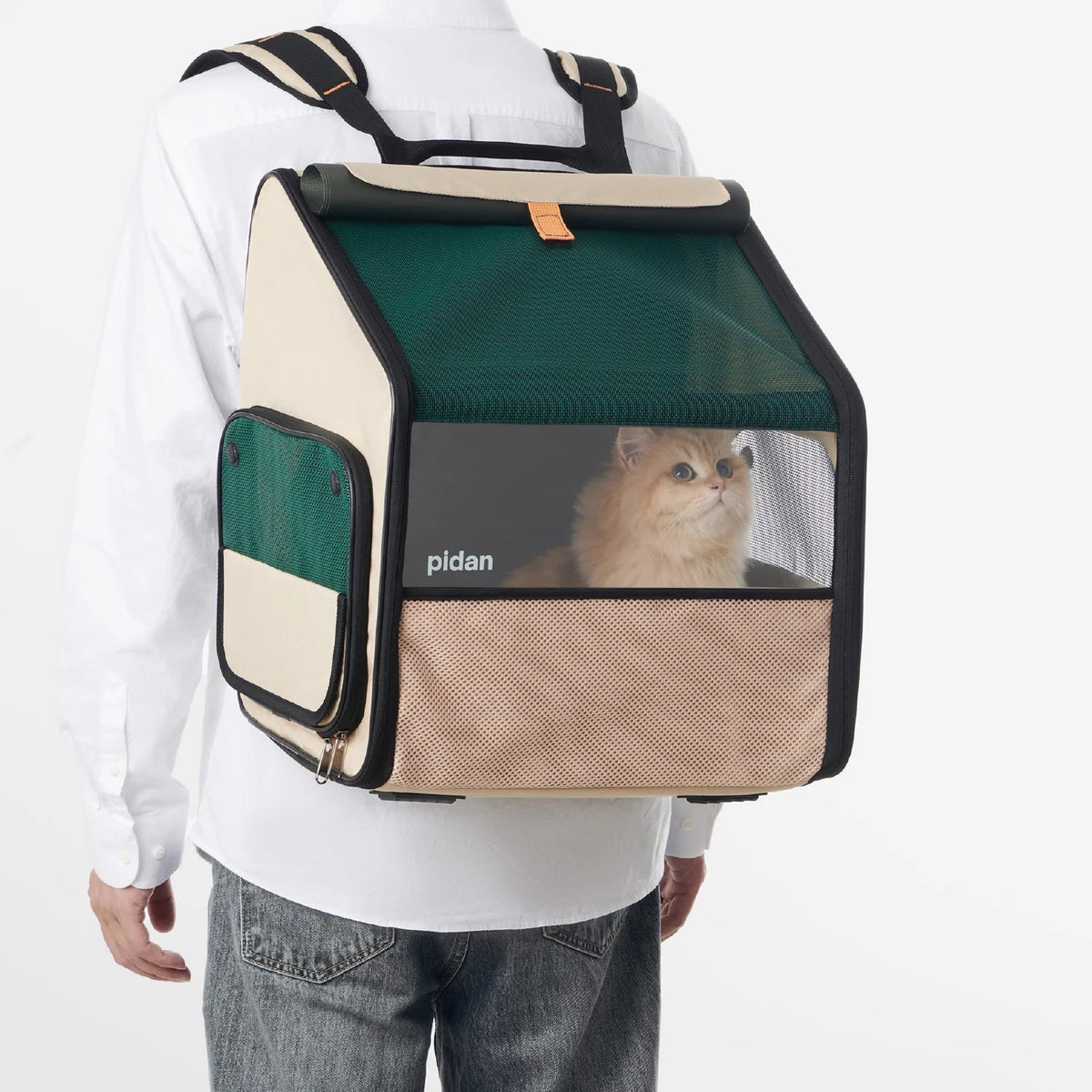
There is no single best cat backpack. The best one for your cat passes four tests: it opens out to give the cat room to lie down and turn, it has mesh on more than one side, its window can be covered so the cat can hide, and its floor stays firm under the cat's weight. The pidan Expandable Travel Habitat Carrier is the backpack I stock: one side unzips to double the space inside, the walls are mesh, and curtains on the top and both sides roll down over the window.
For a cat that tries to push its way out, keep its harness on and the lead in your hand whenever the zip is open. It also has a foldable litter tray that sits inside the expanded habitat, and a dust sheet in the base for setting it down outdoors.
Closed, the cat sits upright and looks out; opened at a stop, it has room to lie down. It does nothing about the walking motion, which is why I keep it for the cat that has already shown it travels well.
What size cat carrier do I need for a large cat?
A large cat needs a carrier it can stand up in, turn round in and lie down in at full length, and a weight rating above what the cat weighs. Weigh the cat first. The pidan Expandable carrier is rated for cats under 7.5kg and weighs 2.2kg empty, so a 7kg cat puts more than 9kg on your back. Then measure the cat lying stretched out, from nose to the base of its tail. The pidan Expandable measures 38 by 28.5 by 40.5cm closed and 38 by 38 by 58cm opened out, taken on the outside, so allow a few centimetres for the walls when you compare.

If your cat is over the rating, or close to it, a backpack is not the carrier; an extra-large plastic one is. Bigger is not always kinder, though: in a carrier much longer than it needs, a cat slides about at every corner.
Is it okay to put two cats in one carrier?
No. Two cats should travel in two carriers, however well they get on at home. The UK charities are agreed on this. Two cats in one carrier have less room and less air, and a journey can frighten even a close pair enough to turn on each other, which can sour the friendship once they are home. Put a blanket from their shared bed in each carrier so both smell the same, and keep the carriers side by side.
One adult can manage both on foot: a backpack on the back and the second carrier held level in both arms.
What kind of carrier is best for kittens?
For a kitten, the best carrier is one that will still fit the adult cat and has a top opening or a top that comes off, since that is the carrier it will learn to trust for life. Ask the breeder or rescue centre first, because the kitten may come home in one of theirs. If you buy one, line it with a towel that smells of the kitten's first home. Two kittens travel in two carriers, like adult cats.
You do not need to shut a kitten in a carrier at night; leave it open in the kitten's room with a towel inside, as a second bed. A kitten that sleeps in its carrier is the cat you can get to the vet in a year's time. The rest of that first room is in the new kitten checklist, and the first week with the tray is in how to litter train a kitten.
Can you put a cat in a car seat?
You can put a cat in a pet car seat, but the seat alone does not hold it. Rule 57 of the Highway Code says to make sure animals in a vehicle are suitably restrained so they cannot distract the driver or be hurt if you stop quickly, and it names a seat belt harness, a pet carrier, a dog cage or a dog guard as ways of doing it. For a cat the plain answer is a carrier, fastened with the seat belt on the back seat or wedged in the footwell behind a front seat, never in the boot. A cat loose on a lap or a seat is not restrained.

Where a car bed earns its place is with a cat that already travels calmly in a harness. The zeze Striped Pet Car Bed is a padded Oxford-fabric seat 60 by 60cm with a high back and raised sides, roomy enough for a cat to turn round in. The rest of the week it is a bed at home, so on travel days it already smells of the cat. A cat in it still needs a harness fastened to a car restraint: the bed is where the cat rides, and the harness is what holds it.
Trains, buses and the Tube
On the railways the rule is exact. Each passenger may take up to two cats or other small animals free. A cat must travel in a fully enclosed carrier no larger than 85 by 60 by 60cm, big enough for it to stand and lie down, and it must not come out on the train or at the station. Carriers do not go on seats. The pidan backpack is within that size in either shape. The conditions say "fully enclosed", and National Rail's own pets page adds "rigid and not open", so a soft-sided backpack is within the rules as written while a strict guard could read them the other way; travel with it closed and the curtains down. The open-topped shoulder bag is not an enclosed carrier, so leave it at home for this one.

On a long train journey the expanded habitat earns its size at the stops: at a quiet end of a platform, or in a station waiting room, you can open it out, put a few centimetres of the litter the cat uses at home in the foldable tray and give it a few quiet minutes. The cat stays inside the carrier throughout. A cat that cries steadily and paws at the door may be telling you it needs the tray.

London's buses, Tube, Overground, DLR, trams and Elizabeth line allow "any other dog or inoffensive animal", in a suitable container and off the seats. Use the wide gate, and carry the cat on an escalator. Buses elsewhere are at the driver's discretion. A cover over the carrier, with a gap for air, helps on all of them.
Getting the cat into it
The carrier that comes out of a cupboard on vet day is the one the cat runs from. Put the carrier out now, open, with bedding the cat has slept on, and feed the odd treat inside it. In a 2018 trial, 22 cats made a ten-minute car ride to a mock vet's surgery before and after six weeks in which half of them had 28 short reward-based sessions with their carrier, and the trained cats were less stressed on the ride.
For the pidan backpack, the right start is to open the habitat at home and let the cat explore it before the first trip. Close it only once the cat sleeps in there, then lift it, then walk round the flat. If a trip comes before the training does, wrap the cat in a towel that smells of home and lower it in through the top.
What this means for the carrier
If your cat panics at the vet, the carrier you want is a plastic one with a top that comes off, and you will find it at any pet shop. I do not stock one at the moment. Buy that first, leave it out in the room, and the vet trips get easier whatever else you own.
If your journeys are on foot and by train, with a cat that settles once it is moving, the pidan Expandable Travel Habitat Carrier is the one I would carry. It is the only carrier I stock that is enclosed for the train, gives the cat room to lie down at a stop and has a tray for the long day. In a flat without a car it covers the train, the move and the walk, and the rest of life with a cat in a flat is in keeping a cat in a flat.
For a short errand with a harness-trained cat, the zeze Cloud shoulder bag; for the calm car traveller, the zeze Striped car bed, with the cat still restrained. Two cats need two of whatever you choose.
Before the first trip
Both carriers are in the carriers and backpacks collection. Once the cat is home again, where cats sleep covers where it will want to recover.
Related posts
- The new kitten checklist, from someone who sells half of it
- Keeping a cat in a flat: the tray, the smell and the space
- Cats and the Christmas tree: what actually stops the climbing
Sources
- How to choose and use a cat carrier, Cats Protection
- Travelling with your cat, International Cat Care
- The Highway Code: rules about animals (47 to 58), GOV.UK
- National Rail Conditions of Travel, condition 24: taking an animal with you, National Rail
- Pratsch L. et al., Carrier training cats reduces stress on transport to a veterinary practice, Applied Animal Behaviour Science 206 (2018)