Article: Sisal, cardboard or carpet: choosing a scratcher your cat will use
Sisal, cardboard or carpet: choosing a scratcher your cat will use
Of 4,331 cat owners surveyed across 39 countries, carpet was the scratching surface they offered most often and rope was the one their cats used most when they had it. People buy carpet and cats want rope. That gap is why a frayed sofa arm so often sits within reach of a perfectly good post.
It is also why none of the scratchers I stock is carpet, so the numbers below and my own shelf point the same way, and you are welcome to keep that in mind as you read. A category page cannot tell you what cats pick when they are given a choice, which picks change with age, or how tall a post has to be before a cat bothers with it. The surveys can, so that is what follows.
What kind of scratcher is best for cats?
A rope-wound upright post, tall enough for the cat to stretch to full height, on a base heavy enough not to move, is the scratcher most cats use most. In the largest owner survey on the subject, 4,331 households in 2016, rope was the material scratched most often wherever it was offered, and cats used it more when the post was a simple upright or a cat tree of two or more levels standing at least three feet, about 90cm, tall. There are two exceptions. Kittens, in a controlled test of 40 under eight weeks old, chose corrugated cardboard over a hemp post every time. Cats between 10 and 14 years old preferred carpet, the only age group that did.
So the answer depends on the cat's age. For a cat between one and ten, a sisal or jute post is the safe first buy and a cardboard pad the cheap second. For a kitten, cardboard first. For an older cat that has always had carpet, carpet, which I do not sell.
The survey's other finding is the one I would act on first: households with more types of scratcher in them reported less scratching of furniture, and adding a second cat or a dog did not make it worse. Two or three different scratchers beat one perfect one.
Is a scratcher good for cats?
Yes. A scratcher is closer to a necessity than a treat. Cats scratch to shed the worn outer sheath of each claw, to stretch the muscles of the front legs and spine after sleep, and to mark: the paw pads carry scent glands, so the groove and the smell together are a message to other cats and a reminder to itself. A cat with nothing acceptable to scratch does not stop scratching; it scratches the sofa. In one veterinary practice's survey of 140 cat-owning households, 83.9 per cent of cats scratched something they should not have, 81.5 per cent of them furniture, and the fabric-covered chair was the most common target.
The same survey tested what owners had tried to stop it. Of every method, reward and punishment alike, only one made a measurable difference: physically placing the cat next to the designated scratcher. Punishment of any kind changed nothing in how often the cats scratched, which is worth knowing before the next time the sofa arm goes.
Sisal, cardboard or carpet, under the claw
The three materials feel different under a claw, and a cat treats them as three different things to do.

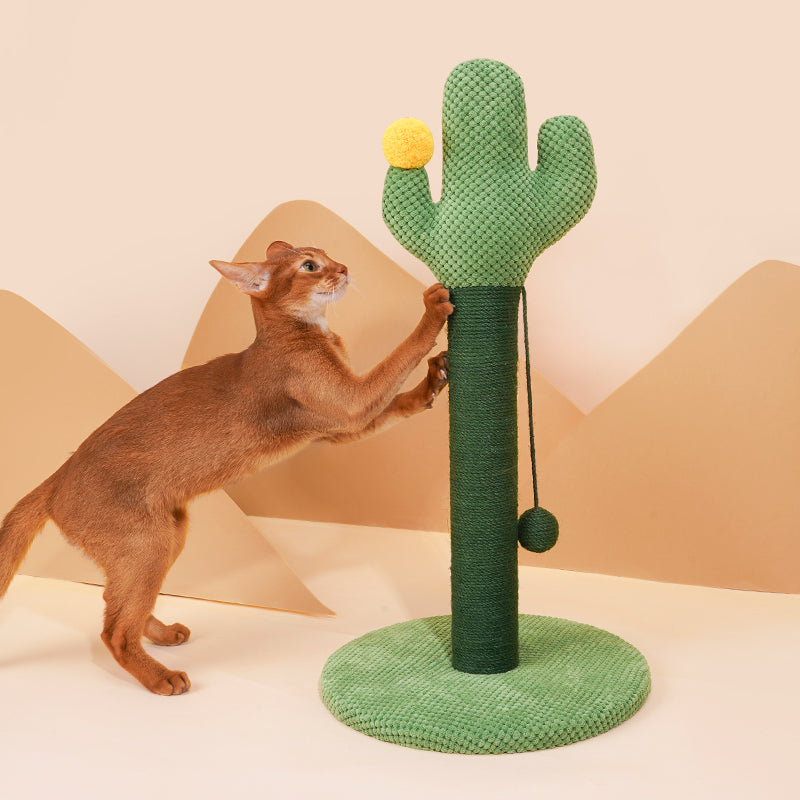
Sisal is the fibre of an agave leaf, spun into rope or woven into a mat, and it is what the "rope" on a scratching post nearly always is. A claw hooks into the twist and drags down it with resistance, which is the sensation a cat is after, and the fibres fray slowly rather than tearing away, so the surface wears down over months rather than sessions. Jute, the other rope you will find on a post, is a softer bast fibre with a similar twist; the zeze Tulip and Shy Tulip posts are wound in jute, the Cactus post in a linen and sisal mix, and the difference under a claw is slight. Both leave a fine dust of fibre at the base and nothing else on the floor.
Cardboard is corrugated board turned on its edge, so the claw goes into the open flutes and pulls them apart. That is why cats who like it like it very much, and why it is a consumable: the pidan and zeze pads are designed to be scratched through and replaced, not to last. It sheds. Each session leaves a small confetti of paper, and a household that cannot live with that should start with sisal. In its favour, it is the cheapest way to put a second and third scratcher in the flat, it is what the kittens chose, and it is the one material sold flat, curved and boxed, so it covers the cats who scratch along the floor as well as the ones who reach up.
Carpet is the one I do not stock, because of what the survey found rather than any dislike of it. It was the most commonly offered surface and it was not the most used at any age below ten. A carpet post also teaches a cat that carpet is for scratching, and the hall carpet pays for that lesson. Where a cat is already ten or older and has scratched carpet all its life, the survey says give it carpet, and any pet shop will.
Does your cat scratch up or along?
Look at the sofa arm before you look at any product. A cat that reaches up the arm and pulls down is a vertical scratcher and wants a post or a wall-mounted pad at that height. A cat that scratches the doormat, the rug by the bed or the seat of the chair is a horizontal scratcher and wants a mat or a flat pad. Plenty of cats do both, and the charities' advice is to match the replacement to the surface being damaged: vertical for vertical, at the same height, and with a similar texture.
Two findings back that up. In the practice survey, cats used upright posts more often than flat pads. In the kitten test, the same scratcher was preferred standing up over lying flat. Neither settles it for your cat. If you are buying one thing and have not watched where the damage is, the upright post is the better bet.

In my range the split is simple. Vertical: the zeze Tulip post, the zeze Cactus post and the tall Shy Tulip post, and for a cat that climbs as well as scratches, the jute-wound uprights on the zeze Happy Farm tree and the Farmhouse tree. Horizontal: the pidan round and box scratchers, the zeze Retro scratcher bed and the zeze Neon Sweetheart pad. The pidan L-shape does both at once, which is the point of the shape: a flat run for the cat that scratches along and a raised back for the one that reaches up. If you want sisal on the floor rather than cardboard, the FUKUMARU sisal mat is the one horizontal sisal surface in the range, and it fixes to the side of a sofa with its own velcro tapes.
How tall should a scratching post be?
As tall as the cat standing on its hind legs at full stretch, and the owner survey's line was at least three feet, about 90cm, with a base narrower than three feet used more than a wider one. Height is where most posts on sale fall short, and the reason is simple: a 90cm post with a base heavy enough to hold it is a large object to ship and to fit in a flat, so the shelves fill with short posts that an adult cat scratches once and ignores.
Stability matters even more than height, and every charity says the same: a post that rocks when the cat throws its weight into a stretch gets rejected. A tall post needs a heavy base or a wall bracket, so on a product page look for the base width and the weight, and if neither is given, assume the post is light.
On my own shelves the three zeze posts are 57 to 60cm, 65cm and 85cm tall. The two shorter ones sit under the survey's line, and I would rather say so than describe them as full-height. What they are is a proper vertical stretch for a kitten, a small or medium cat, or a cat that scratches the lower arm of a sofa, on a 35cm weighted base that stays flat on carpet and hard floors, light enough to move between rooms while you find the spot. The large Shy Tulip is the one for the cat that reaches up, plants both front paws and still has shoulder left: 85cm of jute, a 39cm weighted base, 3.1kg. If your cat reaches higher than that, the zeze trees at 105cm and 138cm are the answer, and the large-cat section below has their sizes.
What do cats not like to scratch?
Cats avoid anything that moves when they lean on it, anything smooth, and anything in a room they do not use. A post that wobbles is abandoned after one or two attempts, which is why a lightweight post is the commonest reason a scratcher goes unused. Slick surfaces, hard plastic, glass and polished wood, give the claw nothing to hook and are left alone, which is what the anti-scratch films for sofa corners rely on. And in a survey of 1,211 cats, where the post was put made a measurable difference: a post in the room where the scratching happened was the one that got used.
They also take no notice of being told off. The practice survey found that punishment, the method owners used most, made no difference to how often cats scratched the wrong thing. The cat is not being awkward. It is looking after its claws, and it will do that wherever it happens to be when it wakes up.
What is the best cat scratcher in the UK?
There is no single best scratcher, because the evidence points to a set of three rather than one thing: an upright rope post the cat can stretch on, a cardboard pad on the floor, and both of them in the room where the cat sleeps and scratches. The 2016 survey found furniture scratching fell as the variety of scratchers in a home rose, and the practice survey found posts used more than pads, so the post is the first buy and the pad is the second, not the other way round. "Best" then comes down to the cat's age, which decides cardboard or rope, and to its size, which decides the height of the post.
One part of this is cheap. A cardboard pad costs from £6.99 in my range, so the second and third scratcher that the survey rewards are the cheapest part of the shopping. The part worth spending on is the post, because the base and the height are what the cheap ones save on.
A scratcher for a kitten
Kittens choose cardboard. In the 2019 test, 40 kittens under eight weeks were offered two scratchers at a time in a mocked-up living room, and the corrugated cardboard with a curved, S-shaped profile won against a hemp post with a toy on top, against raised pads covered in window screen or short carpet, against bubble wrap, and against flat and rectangular cardboard. Sprinkling dried catnip on it, spraying catnip oil or adding the hair of other cats changed nothing, which is worth knowing because the standard advice for a new scratcher is to bait it with catnip. The one finding that was not about material was about angle: the same scratcher stood upright was preferred over the same one laid flat.
The kittens in that test were under eight weeks old and already scratching, so there is no age to wait for: the scratcher goes down the day the kitten arrives, and the sooner there is something good to scratch, the less the sofa gets used. The shape that did best in the test is closest, in what I sell, to the pidan round scratcher, a 48cm disc of tightly wound corrugated paper with a recessed centre a kitten will sit in as often as scratch, and the zeze Retro scratcher bed, 41cm square with a reinforced edge. Both are pressed from corrugated board glued with water-based and starch-based adhesives, which is what I would check on any cardboard scratcher for an animal that chews things. For the upright finding, the pidan L-shape gives a kitten a raised cardboard back to reach up as well as a flat run, and the zeze Tulip post at 57 to 60cm is the rope post a kitten grows into rather than out of. If the kitten has not arrived yet, the first week with the tray is written up separately and the scratcher goes on the same list.

A scratcher for a large cat, and how tall the post has to be
A large cat needs the same things as any cat, only bigger: a post it can stretch to the top of, which for a Maine Coon means the 90cm survey line or above, and a base wide and heavy enough that nothing moves when five or six kilograms lands on it. None of the zeze posts or trees carries a maximum cat weight, and none needs one. They are engineered wood, paper tube and rope on weighted bases, and a cat is not going to be too heavy for them. What decides it is the height and the base, and both are on the product pages.
For most large cats the Shy Tulip post is the one. It is 85cm of jute on a 39cm weighted base at 3.1kg, tall enough for a big cat to plant both paws and pull down at full stretch, and it sits 5cm under the survey's line, which I would rather say than round up. A cat of Maine Coon size, one that reaches past the top of an 85cm post, needs more than a post. The zeze Happy Farm tree is 105cm on a 60 by 53cm fleece-wrapped base and weighs just under 10kg. The Farmhouse tree is 138cm on a 70 by 60cm base at 13.45kg, with a solid wood house on top, and its page sizes it for a multi-cat household. On both, the uprights between the levels are wound in jute, so the thing the cat climbs is the thing it scratches, and the base is wider than anything a landing cat can tip. The Farmhouse is the one I would put in front of a Maine Coon: it is the tallest thing I sell, the base is the widest, and at 13kg it stays where it is put. If your cat is a Maine Coon, the tray and the carrier change size with it too, and the breed guide covers both.

Where to put it, and how to get it used
Next to the thing being scratched, and near where the cat sleeps. Cats scratch on waking, so a post by the bed or the sunny end of the sofa is used; a post in the spare room is furniture. Where the sofa arm is the target, the post goes beside that arm, touching it if the room allows, and it stays there until the habit has moved, at which point it can drift a foot a week to where you would rather it lived. In a home with more than one cat, International Cat Care's rule is one scratcher per cat plus one, in different places, because a scratcher carries a cat's scent and two cats may not want to share one.
To introduce a new one, the one method with evidence behind it is the simplest: carry the cat to it, set it down with its front paws on the surface, and let it go. A wand toy dragged around the base, so the cat's claws catch the rope in play, does the same job with less handling. Catnip is worth a try on an adult cat and did nothing for the kittens in the test. Punishment has no evidence at all. In the practice survey it was the method used most and the one that changed nothing.
What this means for the scratcher
For one cat in a flat with a frayed sofa arm, I would buy the zeze Cactus post or the Tulip post, £29.99 and £24.80 today, put it hard against the arm, and lay the pidan L-shape, £16.90, along the floor at the sofa's foot with its raised back against the base. Between them that is the vertical and the horizontal covered, in the room the cat uses. A Neon Sweetheart pad, £6.99 and 4cm deep, slides under the sofa edge as the third scratcher the survey says makes the difference.

For a kitten, the pidan round or the Retro scratcher bed on the floor of whichever room it sleeps in, and the Tulip post from the first time it reaches up the furniture. For a cat that reaches higher than the Tulip, the large Shy Tulip at £39.90. For the big cat, the Farmhouse tree at £128, or the Happy Farm tree at £59.90 where the ceiling or the floor says 105cm rather than 138. Two cats: one post each plus a pad, and the pidan box scratcher at £19 is the cheapest way to add a second cardboard surface; the Farmhouse's four levels are the alternative if the two are going to share one structure.
The whole range is in the scratcher collection and the trees and beds collection, by zeze and pidan.
If the sofa arm is already frayed
The post goes beside it this week, and the scratcher collection has everything above in one place. If the scratching is the least of it and the cat is in a one-bedroom flat with you, the flat piece covers the tray, the smell and the bin. If a kitten is on its way, the first week with the tray is the companion to this one, and a wand toy from the toy collection is how the new post gets its first scratch. The piece on stopping the sofa scratching outright, deterrents included, is next; the newsletter box at the foot of this page is where it will arrive.
Related posts
- Keeping a cat in a flat: the tray, the smell and the space
- How to litter train a kitten: the tray, the litter and the first week
- Tofu, cassava, wood, corn or paper: which plant litter suits which household
Sources
- Journal of Feline Medicine and Surgery, 2016: Owner observations regarding cat scratching behavior: an internet-based survey
- Journal of Feline Medicine and Surgery, 2018: Survey of cat owners on features of, and preventative measures for, feline scratching of inappropriate objects: a pilot study
- Journal of Feline Medicine and Surgery, 2019: Preference of kittens for scratchers
- Cats Protection: Why do cats scratch?
- International Cat Care: Scratching on furniture and carpets