
Keeping a cat in a flat: the tray, the smell and the space
In 2021, 54 per cent of London households lived in a flat, against 17 per cent in the rest of England, and one London home in five has a single bedroom. A cat in one of those homes shares the hallway and the bathroom with the people it lives with, and the bin with the whole building, and its tray is never more than a few steps from the kitchen. Whether a cat can be happy in a flat at all, the charities settled some time ago, and I take it first only because it is the question people ask. The questions that follow are the practical ones: where the tray goes, why it smells, what happens to the waste when there is no garden, and what the law now says if you rent.
I make cat litter for a living, so the interest is declared. The first three questions have nothing to sell in them, and the litter comes in only where the honest answer is the litter.
Is it fair to keep a cat in a flat?
Yes, provided the flat gives the cat what the outdoors would have given it: somewhere high to climb, something to scratch, a place to hide, play every day, and a litter tray it can reach at every hour. Cats raised indoors, older cats and cats with FIV suit it best; a cat that grew up choosing whether to go out can find a closed door stressful as an adult. Almost a third of UK cats, 31 per cent, now live entirely indoors, up from 15 per cent in 2011, and 57 per cent of their owners keep them in because they judge the outside unsafe.
The condition is the whole answer. An indoor cat's day is as long as an outdoor cat's and has less in it, and the charities' word for the risk is boredom, which shows up as weight, as scratched furniture, and sometimes as a tray that stops being used. A one-bedroom flat cannot give a cat a garden, but it can give it height, which is what a cat is after: a shelf it is allowed on, a windowsill cleared for the purpose, and a post tall enough to stretch up fully that does not tip when it does. A tree or a perch by the window turns the street into television. A balcony needs mesh or netting before the cat is allowed on it; cats under two are the most likely to fall.
One in five indoor cats, on the same survey, has the option to go out and chooses not to. What decides it is not the floor area but what is on the shelves.
Can I keep a cat in a rented flat?
In England, since 1 May 2026, a private tenant has the right to ask to keep a pet, and the landlord cannot unreasonably refuse. The request goes in writing with a description of the animal. The landlord has 28 days to answer, in writing, and must give reasons if the answer is no; a blanket "no pets" clause in the tenancy no longer settles it, because the Renters' Rights Act writes the right into existing agreements as well as new ones. The main lawful ground for refusal in a flat is a head lease that forbids pets, which the landlord cannot override.
So the first document to read is not the tenancy but the lease above it, if there is one; a landlord who owns a leasehold flat is bound by the freeholder's rules. Where there is no such clause, put the request in early and in writing, describe the cat plainly, and offer what a careful tenant would offer anyway: a tray that is scooped daily and a scratching post, which between them cover the two things a landlord is worried about, the smell and the sofa.
Can a cat be left alone for 8 hours?
A healthy adult cat can be left for a working day. Cats Protection puts the ceiling at around 12 hours, and says even that should not be routine. The figure assumes food, water, somewhere to climb and a clean tray are in place before the door shuts. Kittens and cats with a medical condition need someone in sooner than that, and anything over a day needs a visit, morning and evening.
In a flat the working day shows up in the tray. A cat that has been in for nine hours has used it at least once, and if there is one tray and it is already soiled, the cat will look for somewhere else. That is the practical reason for the charities' arithmetic below, one tray per cat plus one, and it applies to a single cat in a one-bedroom flat as much as to three cats in a house. It is also the reason the morning scoop matters more than the evening one.
Where should you put a litter tray in a flat?
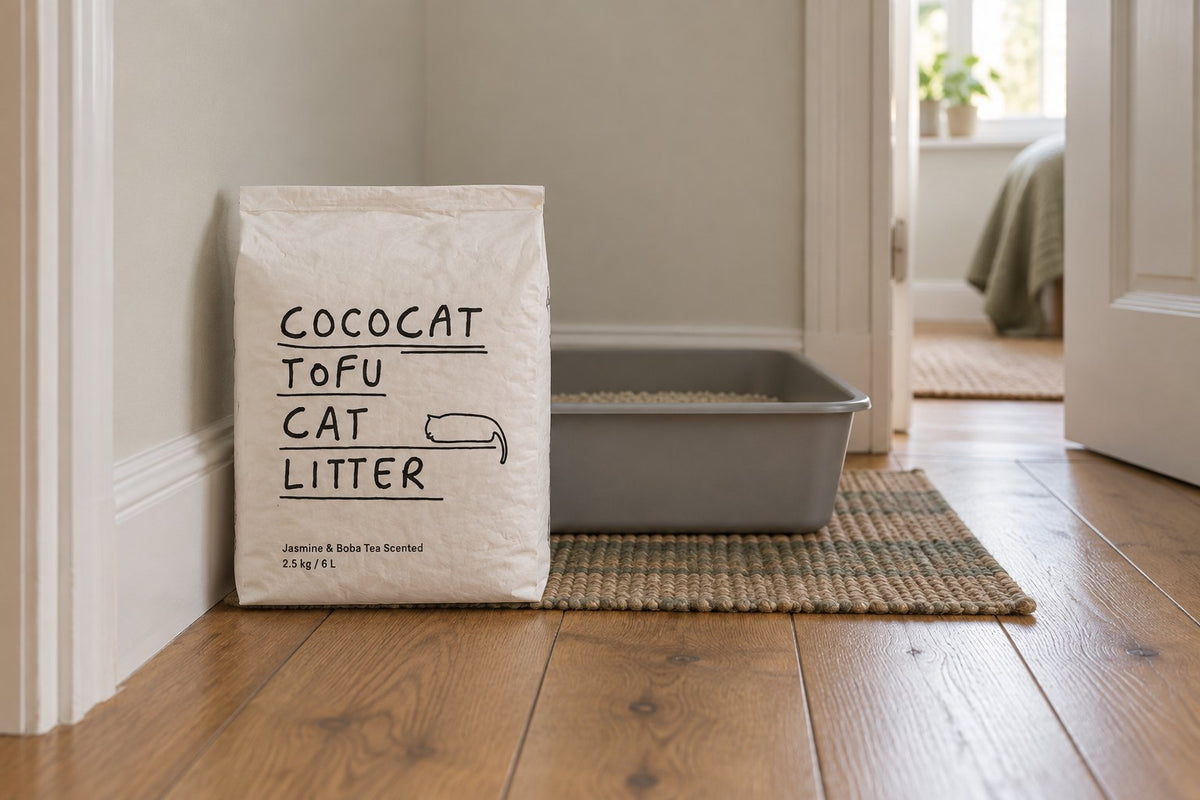
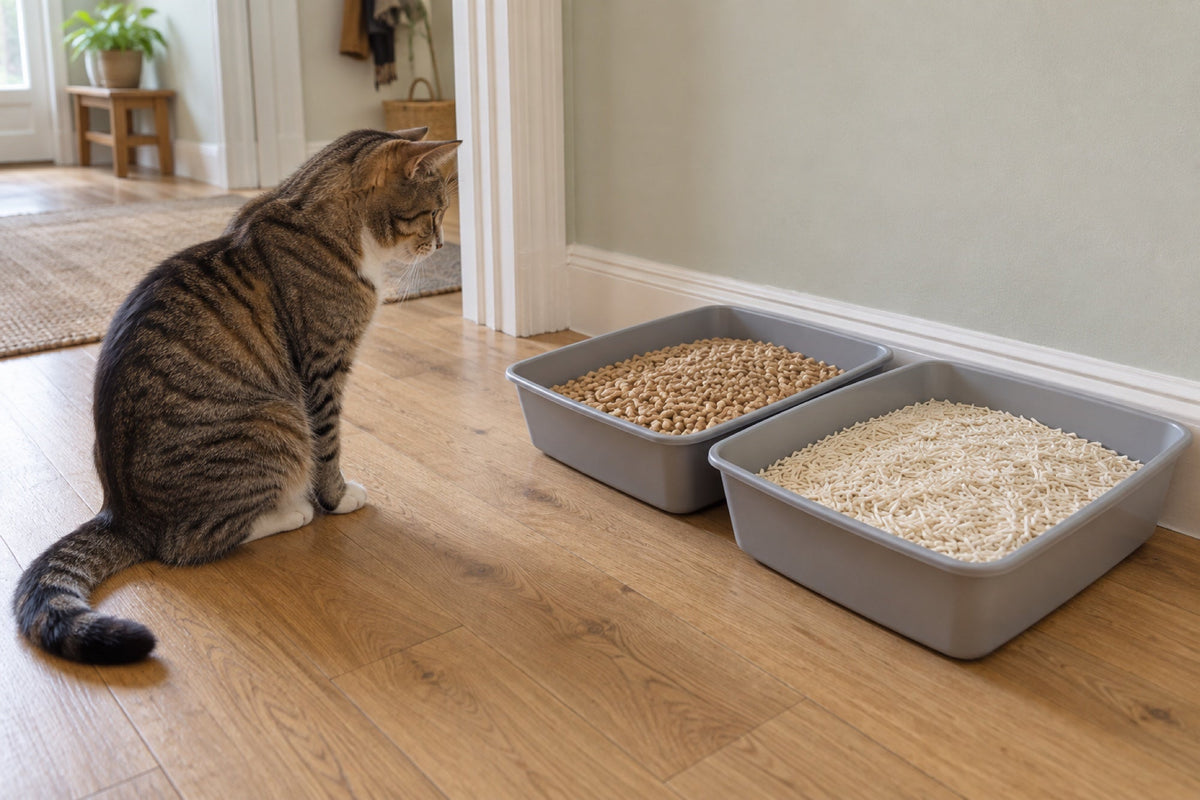
Put the tray somewhere quiet that the cat can reach at every hour, away from its food and water, away from the washing machine, and out of the corridor everyone walks through. The tray should be at least one and a half times the cat's length from nose to the base of the tail, and the count is one tray per cat plus one, in different places. In a flat that usually means the bathroom with the door left ajar, the far end of the hallway, or a cupboard with its door taken off, and the spare tray in a different room from the first.
The bathroom is the most common answer and the one with the catch. In a Mumsnet thread on where people keep the tray, the bathroom is named more than any other room, and the same thread has the owner who finds herself waiting until the cat has finished and, at other times, the cat waiting patiently outside for its turn. A bathroom door that gets shut is a tray the cat cannot reach, and a tray the cat cannot reach at 7am is a wet patch somewhere else. If the bathroom is the only room, the fix is a door wedge and the habit of leaving it open, or a tray in a second place for the hours the door is closed.

The hallway works better than it sounds. A tray at the far end, away from the front door, is quiet between the morning and evening comings and goings, reachable from every room, and away from the kitchen. Its cost is that it is the first thing a visitor sees, and that the pellets that leave on paws land on the floor everyone walks on, which is what the mat at the tray's edge is for. The cupboard with the door removed, or a cat-sized hole cut in it, is the flat-dweller's version of the utility room, and it is a good one provided the cupboard does not also hold the washing machine.
Where not to place a litter box?
Not beside the food and water bowls, which a cat will not toilet next to. Not next to the washing machine, the boiler or the dishwasher, because a cat mid-use that hears a spin cycle start may not go back to that tray. Not in the doorway or the through-corridor of the flat, and not in front of a full-length window where another cat can look in. Not in a cupboard with the door shut. And not two trays side by side, which the cat counts as one tray; the second one goes in another room.

How do you stop a flat smelling of the litter tray?
A litter tray smells when urine sits in it: bacteria break the urea down into ammonia, and the smell builds with the hours, not with the brand. So the fixes are about time. Scoop clumps and solids at least once a day and twice if you are home; keep the litter deep enough that urine clumps on the way down rather than reaching the base and drying there; empty and wash the tray weekly in hot water with a mild unscented washing-up liquid, never bleach, which reacts with urine; and run the extractor or open the window in the room the tray is in. Fragrance covers a smell for the person and can put the cat off using the tray, which is why the charities' advice is unscented litter.
The depth figure is where my number and the charities' differ, and the difference is worth explaining rather than hiding. The charities give 3 to 4cm, which is what a cat likes to dig in. For our tofu litter I fill to 5 to 7cm, because a pellet litter clumps around the urine as it falls, and if the layer is too shallow the urine reaches the plastic and dries there, which is the "sets like cement" complaint that runs through every brand in this category. The extra centimetre or two is what stops clumps setting on the base. In a low kitten tray that will not take 5cm, start at 3cm and scoop twice a day, which is the same principle from the other direction.
On fragrance I am on the wrong side of the charities' advice, and I am not going to pretend otherwise. Our tofu litter carries a light jasmine milk-tea scent and there is no unscented version of it. In our survey of 369 UK customer accounts across five plant-litter brands, scent drew the warmest feedback of any attribute and the firmest objections, and seven of the 369 describe a cat refusing the tray, four of them over the smell: under two per cent, in a sample where the dissatisfied write more readily than the content. Where the room is small and either of you dislikes fragrance, the answer is a different raw material rather than a different label, and ours is the cassava litter, unscented because cassava starch has no base note to cover.
Do cats prefer open or closed litter trays?
UK charity guidance favours an open tray, or a hood with its flap removed. A hood keeps the smell inside the box where the cat has to stand in it, and a cat with one way out can feel cornered, which is why the guidance on a hooded tray is to take the flap off. In a flat the covered box is bought for the person: it hides the tray in a hallway and keeps more of the litter in. That is a fair reason, provided the cat agrees, and the way to find out is to run the covered box beside the open tray for two weeks and see which one is used.

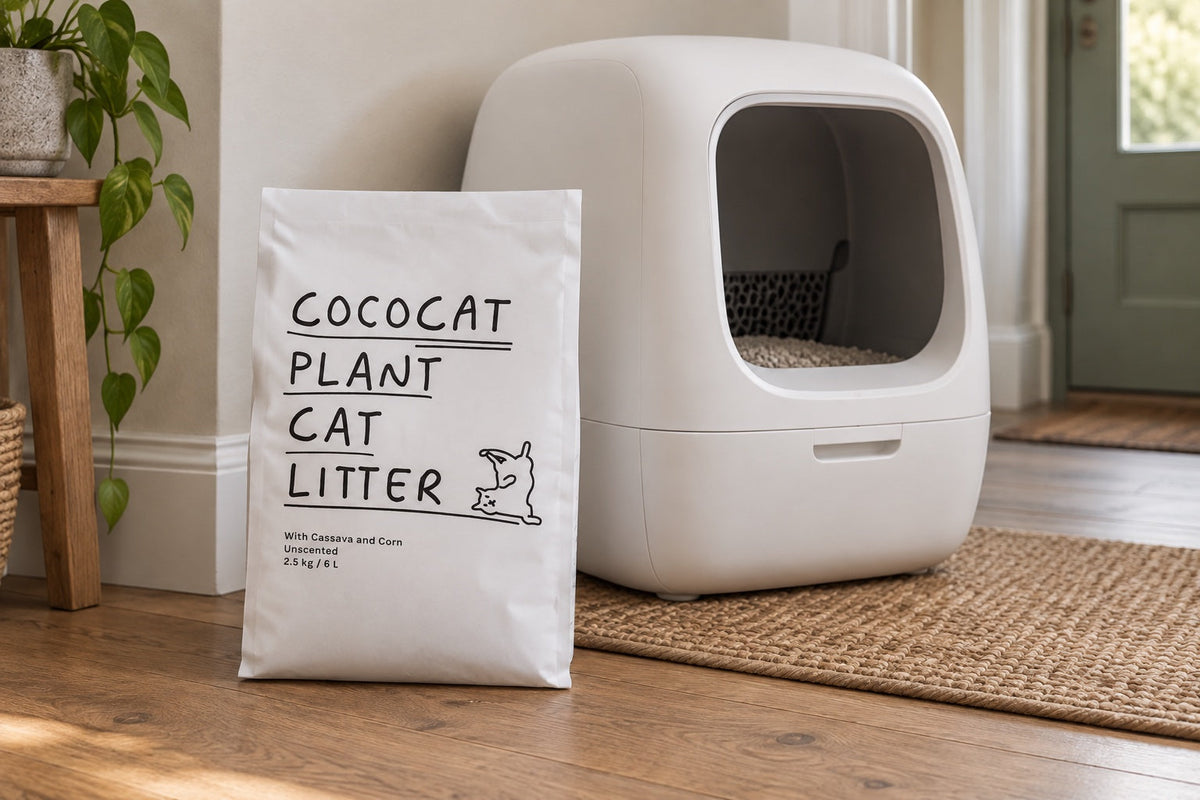
If the cat does agree, the version the guidance can live with is a cover with a proper doorway rather than a flap. The Snow Dome we sell is that kind: a covered box 54.8cm wide with a grated doorway that knocks tracked litter off paws on the way out, which in a hallway is the point of it. It is not the right first tray for a kitten, which needs low sides and an open top, and it is not the answer for a cat that has just told you it prefers the open one. The rest of the litter box collection is mostly open trays and mats.
The bin, the toilet and the stairs
A house has a garden bin and a back door. A flat has a shared bin store, a communal corridor and, unless there is a lift, stairs, and every bag of used litter travels all three. That decides which litter is sensible more than any question of smell does. A non-clumping litter is replaced whole, every week on the manufacturers' own instructions, so the whole tray goes down the stairs every week. A clumping litter is scooped and topped up, so what goes down the stairs is a small bag of clumps, and the full change comes every few weeks. Over a month the difference in what you carry, and in what goes into the black bin, is the whole tray several times over.
The toilet is not the shortcut it looks. UK water companies' guidance is against flushing cat litter, and one of them, Anglian Water, clears more than 40,000 blockages a year; the guidance is written for clay and silica, which do not break down in water, and it is sound. Our own position is narrower than the category's marketing. For the tofu litter, solids go to the bin, small amounts of clumped litter may go down the toilet where your local rules permit it, and nothing goes down older or restricted plumbing. More than a quarter of London's homes were built before 1919, so it is worth knowing which kind yours is before you try. The cassava litter does not go down the toilet at all: a clump dense enough to survive a machine's rake is too dense for a drain. Treat flushing as an occasional convenience. The bin is the plan, and a clumping litter is what keeps the bin small.
What this means for the tray
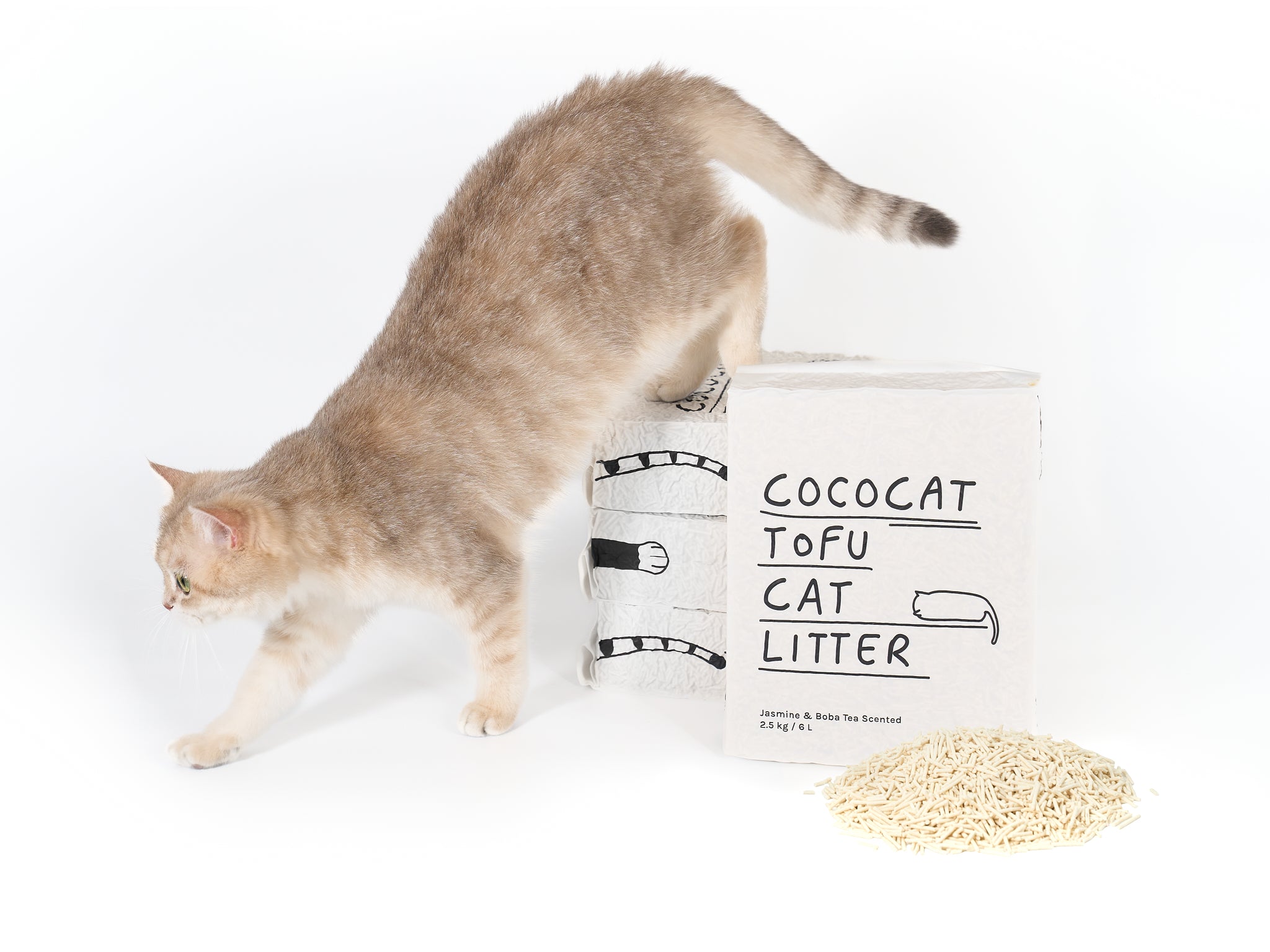
In a flat the tray is nearer to where you live than it is in a house, so the three things that matter are dust, scent and what goes in the bin, in that order. For an open tray and one cat, I would fill it with CocoCat's tofu litter. It is a pea-fibre pellet that clumps, so the tray is scooped and topped up rather than emptied, which in a flat is the difference between carrying a small bag down the stairs and carrying the tray. It comes off the line through a 99.9 per cent dust-filtration process, a figure that rates the equipment rather than your air; what customers describe is the absence of the grey film clay leaves on the skirting board, which in a one-bedroom flat is the skirting board beside the sofa. One cat gets through roughly one 6-litre bag a month on our own sales data, scooped daily, with a full change every two to three weeks, and four if you keep up with the scoop.

Two honest notes. The scent is real and it divides people, as above; if the room is small and fragrance is not wanted, the cassava is the right choice and not a second-best. And a pellet leaves the tray on paws. Low tracking is one of the three things praised across every brand in our customer survey, against clay, wood and sand, and it is still not zero, so the mat goes at the exit, and in a hallway the mat is the difference between sweeping once a day and once a week.
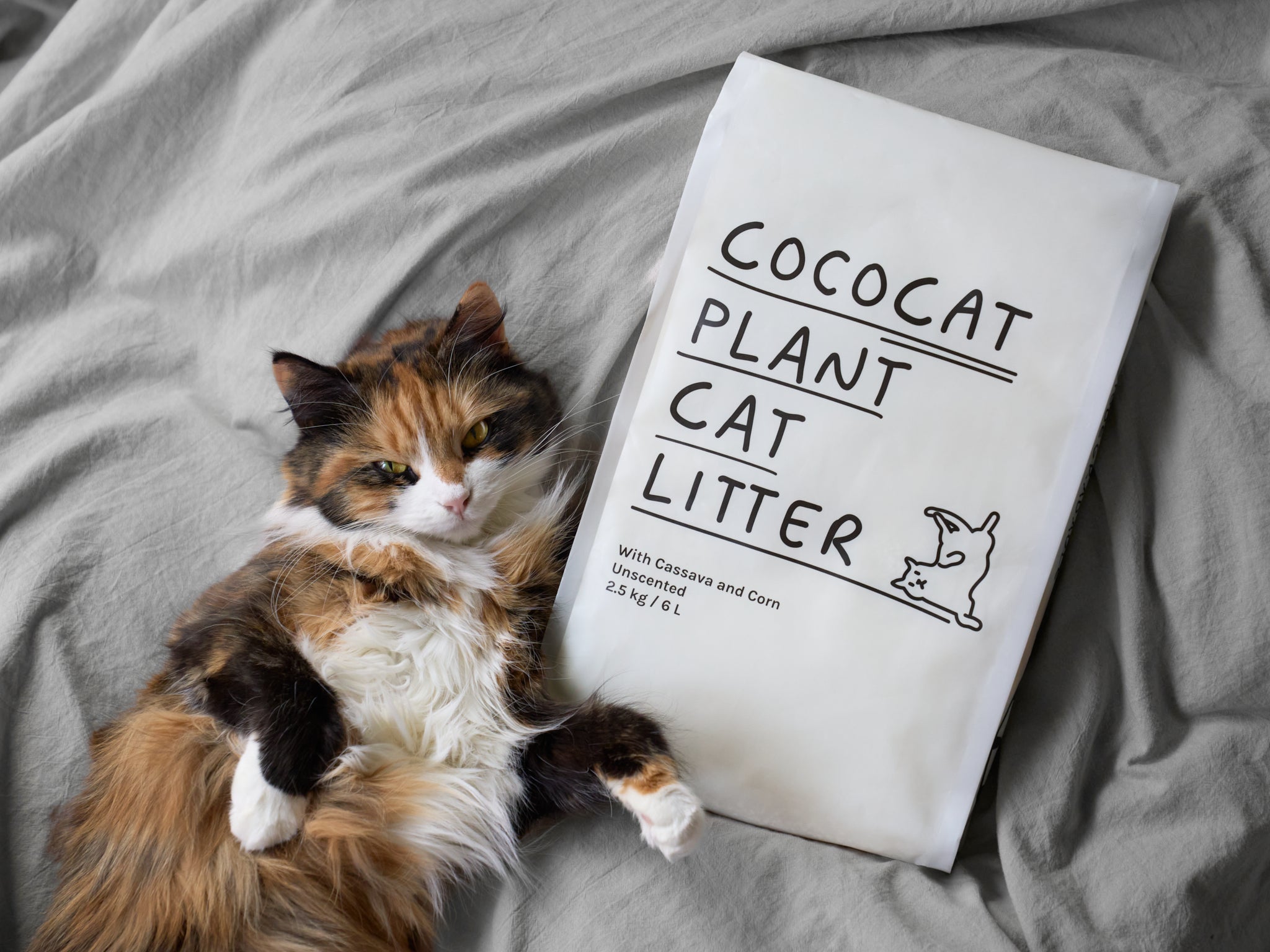
For the flat with a machine, or the household that wants no fragrance at all, the cassava litter is the bag. It is cassava flour with corn starch, corn flour and guar gum, a fine rounded granule that clumps on the cassava's own starch with no mineral filler, unscented because there is nothing to cover, and built for the sifting an automatic box does. It goes in the bin only, and a fine granule travels further on a paw than a pellet does, so it wants the mat more, not less. Both are in the cat litter collection, and the tofu guide has the fill and change notes in one place.
If the tray is at the end of the hallway
The tofu litter is the bag for the open tray, and the cassava for the machine or the fragrance-free flat. If you are weighing the category's real drawbacks first, they are written up honestly, and if you have not settled on a material, tofu, cassava, wood, corn and paper are compared in one place. A kitten arriving in the flat is a separate first week. If you would like the next piece when it is written, the newsletter box is at the foot of this page.
Related posts
- The disadvantages of tofu cat litter, and what to do about each
- Tofu, cassava, wood, corn or paper: which plant litter suits which household
- How to litter train a kitten: the tray, the litter and the first week
Sources
- London Assembly Research Unit, November 2024 (Census 2021 and English Housing Survey figures): London's housing stock
- PDSA: PAW Report 2024: Cats
- Cats Protection: Indoor cats
- Ministry of Housing, Communities and Local Government: The Renters' Rights Act Information Sheet 2026
- Battersea Dogs & Cats Home: How to create the best litter tray set up for your cat

Leave a comment
This site is protected by hCaptcha and the hCaptcha Privacy Policy and Terms of Service apply.