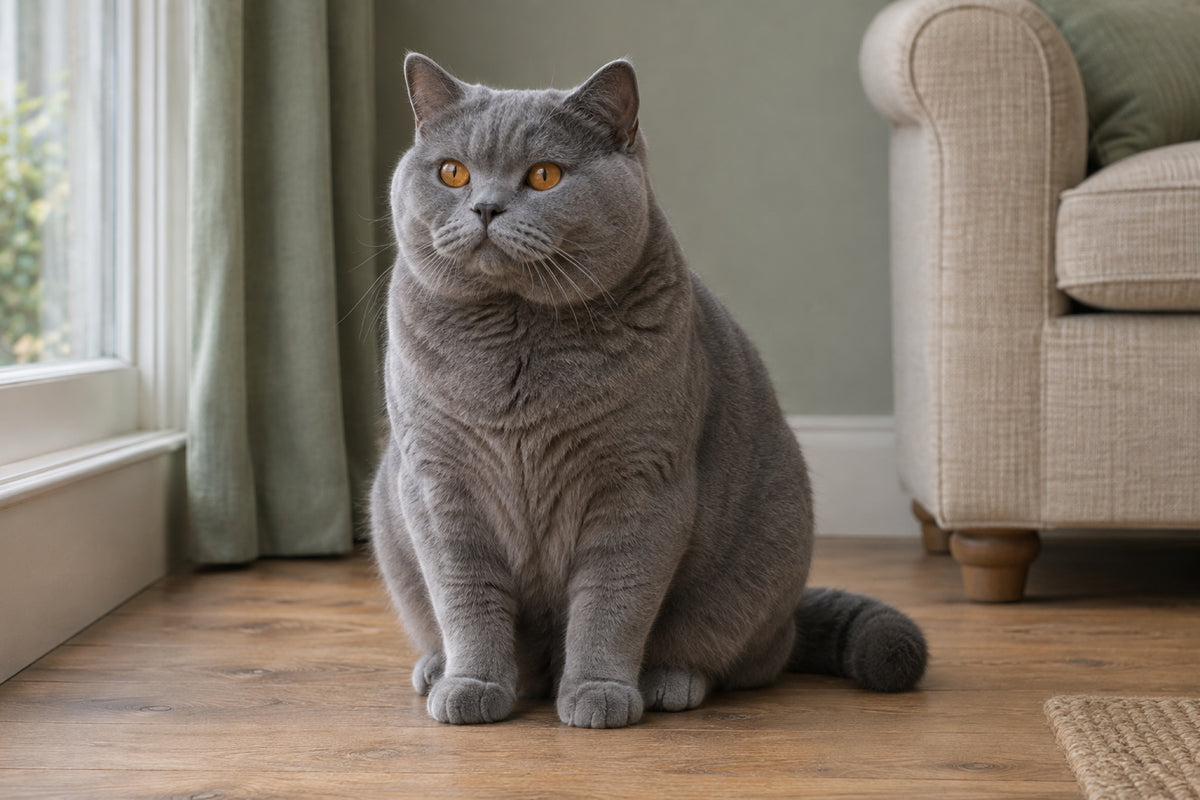
British Shorthair: size, temperament, cost in the UK, and what a solid indoor cat needs at home
The GCCF registered 5,873 British Shorthairs in 2025, a third of the 17,464 pedigree cats on its books that year and nearly twice the Ragdoll's 3,111 in second place. It is a compact, slow-maturing breed: cobby rather than long, with males that outweigh the females by a clear margin, and up to five years to fill out. Its needs at home are about weight and routine more than length.
I stock one litter box, rated for cats under 7kg, and a male of this breed can reach 7.7. Where the fit is close, the sections below say so.
Key facts
- Lifespan: 14 to 20 years by the registry; in UK vet records, cats of the British breeds that died in 2019 averaged 9.6 years across all causes
- Weight: males 4.1 to 7.7kg, females 3.2 to 5.4kg; up to five years to full maturity
- Coat: short, dense, crisp; weekly groom, more through the moults
- Indoor suitability: yes, as an indoor-only cat, with stimulus and weight watched
- Typical UK price: £800 to £2,000 for a pedigree kitten (checked November 2026)
- Recognised by: GCCF (shown since the first show, 1871), FIFe
Which one is better, Ragdoll or British Shorthair?
Neither; they suit different households. The British Shorthair was the most registered breed with the UK's largest registry in 2025, 5,873 to the Ragdoll's 3,111. A British Shorthair male weighs 4.1 to 7.7kg on a compact, cobby frame; a grown Ragdoll male starts at about 6kg. The British Shorthair's coat is short and dense, needing extra grooming only through the moults; the Ragdoll's is medium-length and silky, needing weekly care year round. The British Shorthair prefers four paws on the ground and may not want to be carried; the Ragdoll is named for going limp and relaxed when picked up. The Ragdoll guide covers that breed in the same detail.
A British Shorthair is the calmer companion for a household that wants a quiet, patient cat nearby rather than on top of them. It is tolerant, not talkative, and will wait for an invitation to sit beside you rather than jump into your lap. It does well with other cats and a calm dog. A Ragdoll is the better choice for someone who wants a cat that flops into their arms, is playful and needs more grooming. Both breeds live happily indoors; the British Shorthair's tendency to weight gain makes daily play the bigger consideration for this one.
Is a British Shorthair an indoor cat?
Yes, a British Shorthair can live as an indoor-only cat, on two conditions: give it enough to do, and manage its tendency to gain weight. It is a calm, trusting cat, and that trust is why it needs supervising outside. My reading is that the same calm makes a flat an easier fit than it is for a highly active breed, provided the flat has posts to scratch, things to climb, and a daily play session.
An indoor cat needs shelves and climbing points, scratching posts, and interactive toys that let it hunt. Each indoor cat needs its own litter tray and resting place, plus a spare tray. The indoor environment predisposes to obesity, and the British Shorthair's slow metabolism makes that a breed-level concern rather than just a general one. A British Shorthair that has always gone outside can find indoor life stressful, so the decision is easier made with a kitten than changed later; a catio sits between the two. Tray placement, space and the smell in a small home are covered in keeping a cat in a flat.
Do British Shorthair cats shed?
Yes. The British Shorthair's coat is short, dense and crisp, and its registry describes it as having more fur per square inch than any other breed, a description rather than a measurement. Expect moult-season handfuls. A weekly comb is enough outside the moults, and the zeze Sunflower brush with its stainless-steel pins earns its keep when the undercoat comes away in spring. Older cats may need help to stop mats forming. The coat does not need regular bathing.
If anyone in the household is allergic to cats, a British Shorthair is not the answer, and neither is any other breed. A 2024 review of the evidence found no scientific basis for a hypoallergenic cat breed: every cat produces Fel d 1, the main cat allergen, even the hairless Sphynx. The amount varies from cat to cat, and on average unneutered males produce more than females. A short coat does not add allergen, but it does shed into furniture and clothing. Before committing, spend time with the actual cat and see how you react.
How long do British Shorthair cats sleep?
Nobody has measured a breed-specific figure. Domestic cats sleep for approximately 12 to 18 hours a day, and the British Shorthair is described as prone to laziness once mature, a cat that prefers routine to adventure. That is a reason to build play into the day rather than a sign of illness. A change in an individual cat's usual sleep or activity, though, is worth a vet visit, not more play. Where cats sleep covers what cats look for in a sleeping spot and why.
How much do British Shorthair cats cost in the UK?
A pedigree British Shorthair kitten from a registered UK breeder typically costs £800 to £2,000, the range Cats Protection gives for pedigree breeds and names this one among them (checked November 2026). Running costs sit at over £1,000 a year, with insurance at around £25 to £50 a month. What a kitten needs on day one is in the new kitten checklist.
What that money should buy is paperwork worth reading. Ask the breeder for the parents' PKD DNA results, because polycystic kidney disease was a problem in this breed and is now controlled by testing. Ask for heart scans, because there is no DNA test for hypertrophic cardiomyopathy in British Shorthairs, and the check is echocardiographic screening by a vet. Ask the blood group of both parents, because more than half the British Shorthairs in a UK study were type B, and a type B queen mated with a type A tom risks neonatal isoerythrolysis in the kittens. For any cat imported from another registry for breeding, a negative ALPS test has been required since 1 March 2025. Those checks are explained in the section below.
What are the disadvantages of British Shorthair cats?
The heart, the blood group and the weight. In a study of 329 Danish British Shorthairs screened for hypertrophic cardiomyopathy, 8.5 per cent were positive, with males at 20.4 per cent against females at 2.1. In a 1999 UK study, 58.7 per cent of 121 British Shorthairs were blood type B, a type that puts kittens at risk when a type B queen is mated with a type A tom. And a 2024 veterinary review names the British Shorthair among breeds more susceptible to being overweight, consistent with the breed's slow metabolism. All three are manageable with screening and routine: a heart scan, a blood test, play and portions.
HCM has no DNA test in this breed, so the check is a heart scan done by a vet, of the parents before mating and later of the cat itself. The study was Danish, and the cats in it were presented for routine screening rather than drawn at random, so the 8.5 per cent is a screening-population figure, not a UK household prevalence.
The blood-group study is from 1999 and the proportion may have shifted since. The mechanism has not: a type B queen carries anti-A antibodies in her colostrum, and type A kittens can develop neonatal isoerythrolysis, which is rare but carries a high mortality when it occurs. Breeders blood-type for exactly this reason.
Polycystic kidney disease came into the breed through the Persian outcrosses used to restore type after both world wars, a link that is inference from two sources rather than one study tracing the route directly. PKD is now under control in the breed through DNA testing.
ALPS, a lethal disease in kittens first described in British Shorthair kittens in New Zealand, is the reason for the import test rule above. In the New Zealand study, 7 of 32 British Shorthairs were carriers.
The breed's four-paws-on-the-ground temperament can count as a disadvantage for a household expecting a cat that enjoys being picked up and carried. The registry puts it plainly: the British Shorthair "may not wish to be carried about as an adult."
On lifespan, the registry gives 14 to 20 years. In a UK study of 7,936 cats that died in 2019, cats of the British breeds, a group that includes a few British Longhairs, averaged 9.6 years at death. That is an average over every death recorded in one year, including the young: the same study found that purebred cats had 1.83 times the odds of dying before the age of three. The registry's range describes cats that reach adulthood; the veterinary figure averages all of them.
History and origin
The British Shorthair was among the earliest breeds shown, at the Crystal Palace show of 13 July 1871, where 170 exhibits included classes for English Shorthair cats and the best in show was a 14-year-old blue tabby owned by Harrison Weir, who drew up the first standards. The breed descends, probably, from cats the Romans brought to Britain, and that is the registry's own hedge.
Both world wars depleted the breed, and breeders outcrossed to Russian Blues, Burmese, Chartreux and Persians to restore type. The Persians brought in the longhair gene, and the British Longhair became a named breed in 2017, gaining championship status in 2021. The British Blue remains the flagship colour, with almost half the registrations in the self colours alone. The breed is registered in five colour groups: self, colourpointed, tipped, tortoiseshell and bicolour, and tabby.
How big do British Shorthairs get?
British Shorthair males weigh 4.1 to 7.7kg, females 3.2 to 5.4kg, making this a noticeably sexually dimorphic breed. The body is cobby, broad-chested and low on the legs, described by the breed standard as equally massive across the shoulders and the rump. Mature males develop full jowls. A British Shorthair takes up to five years to reach full physical maturity.
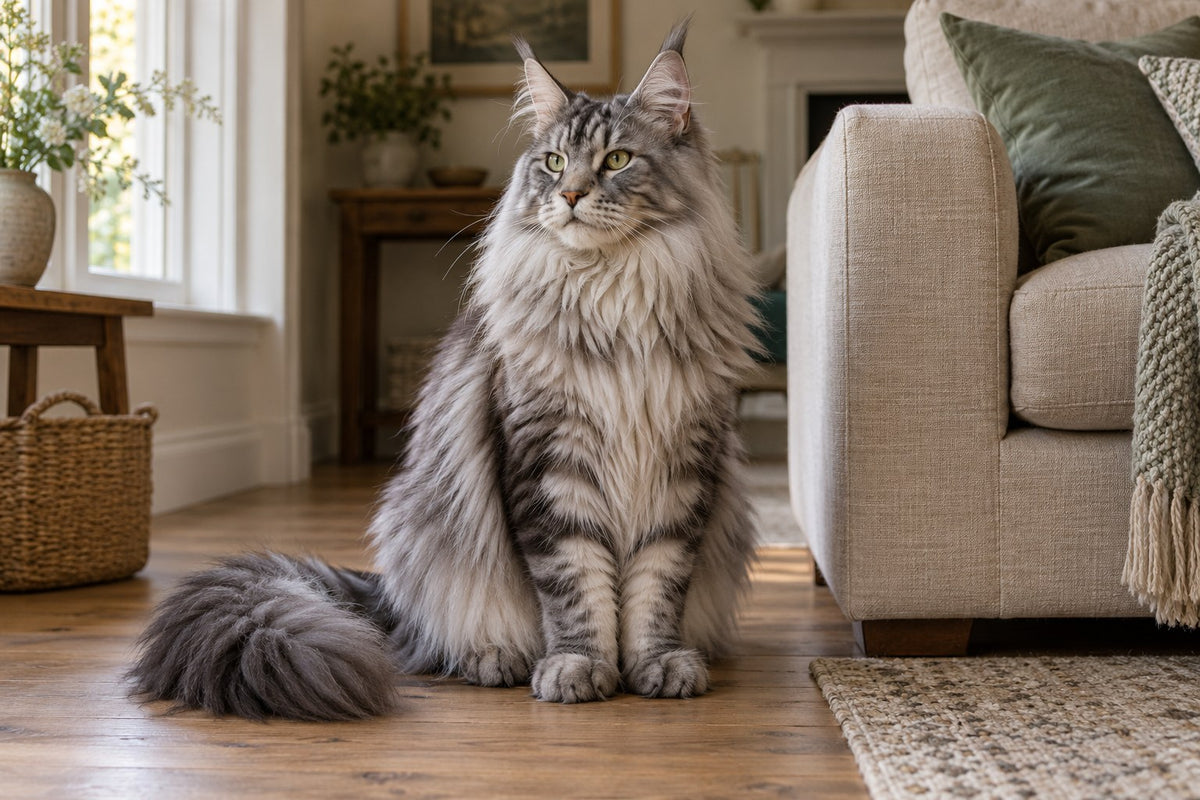
For all its weight the British Shorthair is a compact cat, not a long one. No registry publishes a body length, and the unsourced figures online vary enough to be useless. The standard says "medium to large, but not rangy". Compared with a Maine Coon, which is longer, leggier and heavier, the British Shorthair fills a smaller footprint for its weight, and that changes what it needs in the tray and the carrier.
What a British Shorthair needs at home
A British Shorthair needs what any indoor cat needs, fitted to its weight and its quiet temperament: a tray it can turn round in, a litter that does the job, a post or tree it stretches against at its own pace, a carrier rated for the vet trip, and something to chase.
The tray
The rule of thumb is a tray one and a half times the cat's length from nose to the base of the tail. No registry publishes a British Shorthair body length, so the honest answer is: measure the cat. By that rule, a tray 54.8cm across suits a cat of at most about 36.5cm from nose to tail base, and less where the inside is narrower than the outside.
The tray I sell is the pidan Snow Dome, a covered dome 54.8cm across on the outside, with a round basin that holds about 4 to 5cm of litter and a grated entrance corridor through which litter falls back as the cat steps out. Its page rates it for cats under 7kg. Every female in the breed's weight range fits within that, with room to spare. Most males fit too. The top of the male range, 7 to 7.7kg, is over the rating, and the inside of the basin is narrower than 54.8cm, though its measurement is not published.

A vet nurse writing in a cat charity's magazine suggested two trays for one cat, separate toilet places, and the common formula is one tray per cat plus one extra in different locations, advice she was careful to note is not based on hard evidence. For two cats, three trays. The litter box collection holds one product, the Snow Dome, so a second or third tray is another dome or an open tray bought elsewhere.
The litter

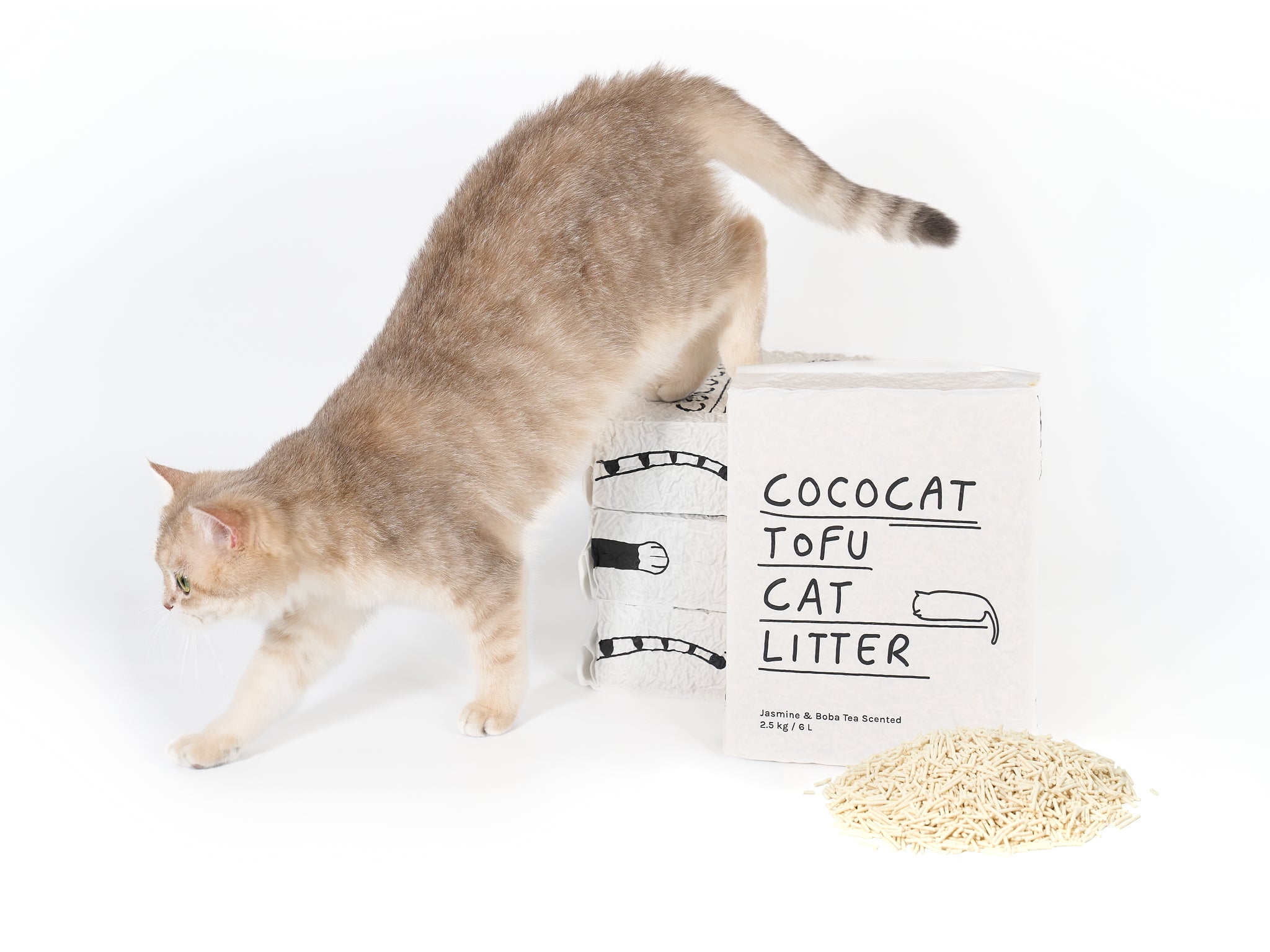
CocoCat tofu litter is pea fibre, corn starch, guar gum and plant-based enzymes, pressed into pellets about 1.5mm across. It clumps, so you scoop and top up. It has a Jasmine bubble tea scent, and there is no unscented version. It tracks: a light pellet rides out of the tray on paw fur. In the Snow Dome the grated corridor catches some of what the paws carry, and what escapes sweeps up dry. The disadvantages piece covers tracking in more detail.
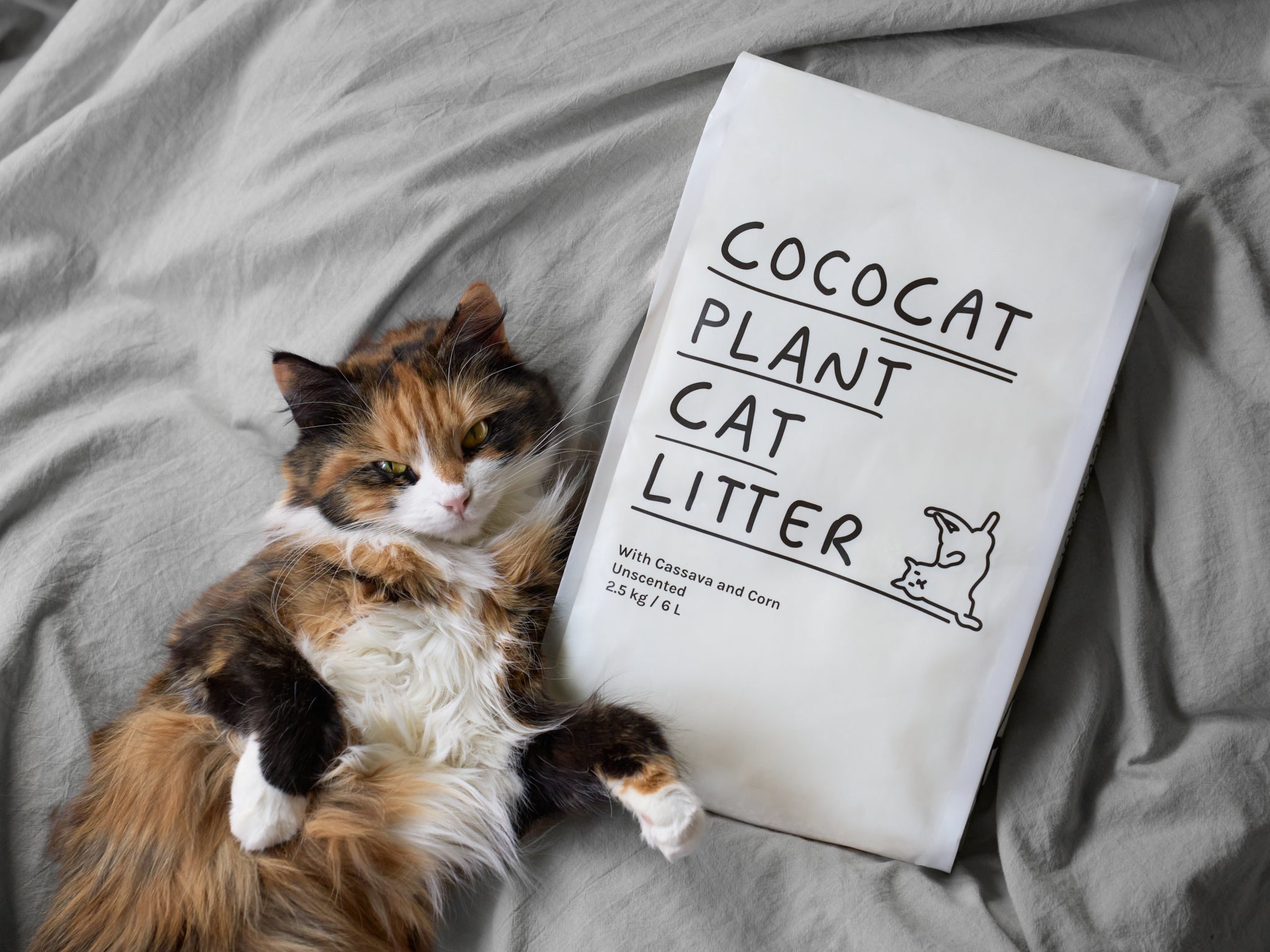
CocoCat cassava litter is cassava flour with corn starch, corn flour and guar gum, unscented, with a fine rounded grain. It suits a cat that dislikes any scent and a household running an automatic litter box.
A short, dense coat with no breeches or toe tufts gives granules less to cling to than a long coat, which is my inference from the breed standard rather than a measured fact; paws still carry pellets regardless of the coat above them. How often to change it has the routine, and both bags are in the cat litter collection.
The scratching post

A British Shorthair prefers to have all four paws on the ground. That suggests, though nobody has measured it, that lower, broader frames suit this breed better than the tallest tower. In the largest owner survey on scratching, cats used posts most when they stood at least 90cm tall, and the three tallest single posts I sell sit just under that, at 85 to 86cm: the zeze Shy Tulip, large on a 39cm weighted base, the zeze Trophy on a 43cm base, and the zeze ACE Tennis on a 40cm base. For a cat that does climb, the zeze Happy Farm tree is 105cm on a 60 by 53cm base, and the zeze Two-Tier Arch is 86cm on 45 by 45cm with rope posts and dangling balls. For a household with two cats, the zeze 3-in-1 at 102cm on 72 by 52cm is built for multi-cat homes. For a climber, the zeze Farmhouse tree is the tallest in the range at 138cm on a 70 by 60cm base with jute-wound uprights. Choosing a cat scratcher has the survey behind the height line, and the full range is in scratchers and trees and beds.
The carrier

The pidan Expandable Travel Habitat is a backpack, 38 by 28.5 by 40.5cm, that unzips to 38 by 38 by 58cm. It is rated for pets under 7.5kg: every female and most males, but the heaviest males at 7.5 to 7.7kg are past it. Getting a British Shorthair used to a carrier early is worth the effort, because this is a breed that does not enjoy being carried. Cat backpacks and carriers covers carrier training. The full range is in the carrier collection.
Play

A British Shorthair left to its own routine will choose the sofa over the hunt, so daily play matters more for this breed than for a naturally busy one. An indoor cat needs interactive toys and play that lets it hunt. The zeze Tulip teaser wand is 123cm and gets a cat on its feet, the pidan bouncy ball and feather set is for batting about between sessions, and the zeze Forest Snake tunnel gives a hiding and ambush spot. What matters is the routine: a short session morning and evening, every day. The rest is in toys.
Which household suits a British Shorthair
A British Shorthair suits a calm household, flats included, with someone home enough for daily play and portions kept in line with activity rather than appetite. It does well with older children, with another cat, and with a calm dog. It is a cat that follows you from room to room, waits for an invitation to sit beside you, and takes an interest in whatever you are doing without climbing onto your shoulders to do it.
It is not the cat for an allergic household. It is not the cat for a family that wants to carry one around. And it is a breed whose slow metabolism means the play and the portions need to stay up for the cat's whole life, not just the kitten year.
The tray, the posts and the carriers above are in litter boxes, scratchers and carriers. The newsletter box is at the foot of the page.
Related posts
- Maine Coon: size, temperament, cost in the UK, and what a cat this big needs at home
- Keeping a cat in a flat: the tray, the smell and the space
- The best cat scratching post for the way your cat scratches
Sources
- Governing Council of the Cat Fancy: British
- Journal of Feline Medicine and Surgery, 2024: Life tables of annual life expectancy and risk factors for mortality in cats in the UK
- Journal of Veterinary Internal Medicine, 2011: Prevalence of hypertrophic cardiomyopathy in a cohort of British Shorthair cats in Denmark
- Allergologie Select, 2024: Hypoallergenic animals: A promise of hope for allergic patients?
- Vicky Halls RVN, The Cat (Cats Protection), Autumn 2013: To pee, or not to pee