
Tofu, cassava, wood, corn or paper: which plant litter suits which household
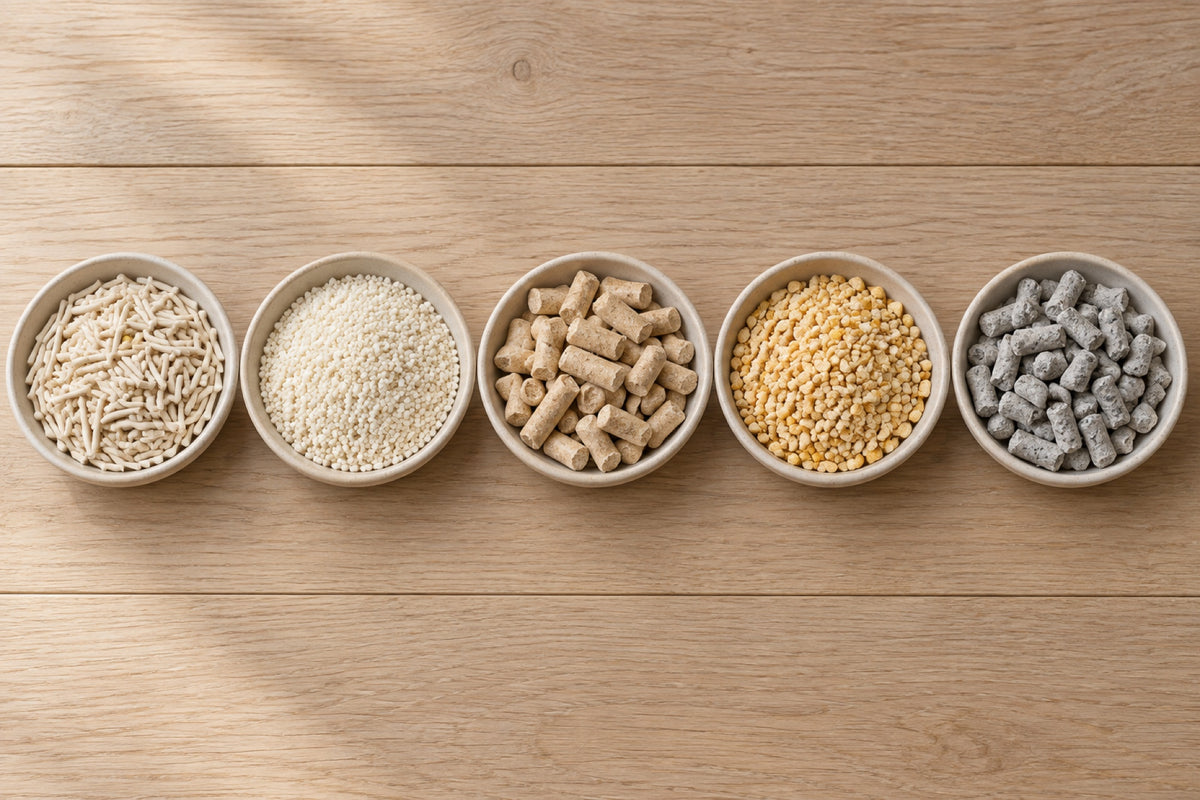
Line up the five plant litters sold in Britain and you are looking at a pea harvest, a cassava field, a sawmill's offcuts, a maize crop and a stack of yesterday's newspapers. None of them started out as cat litter. Each was milled, pressed or pelleted into something that would hold a cat's business, and the differences between them are larger than the shelf suggests: two of the five will not clump at all, which changes your week more than any claim on the front of a bag.
I make two of the five for a living, so take the recommendations with that in view. What I can offer in exchange is the part the roundups skip. Most guides give each material a paragraph of adjectives. This one explains what each thing actually is, what it does in a tray, where it fails, and what I would ask a manufacturer before buying it.
One number for scale before we start: the UK keeps 10.5 million pet cats, and 39 per cent of the people who own one own more than one. Multi-cat homes are the ones where the maintenance differences below stop being academic.
What is the best natural litter for cats?
There is no single best natural cat litter, because the five plant materials sold in the UK split on one property that decides the whole routine: tofu, cassava and corn clump, and wood pellets and paper pellets do not. A clumping litter is scooped and topped up and suits anyone arriving from clay. A pellet litter is sifted or partly replaced on a shorter cycle and tracks far less. The cat has the casting vote on texture: in an 18-cat field study, cats preferred fine clay and silica granules over wood pellets, while the RSPCA found wood pellets performed best in its own trials. The best natural litter is the one whose routine you will keep up and whose texture your cat accepts.
That is the honest shape of the answer, and it is why the rest of this page is organised by material first and then by the things that decide daily life. All five are grown or recycled rather than mined, and all five break down after use, so the environmental question is the easy one. The two harder questions are whether a given material does the job well in your home and whether your particular cat will use it, and those depend on which of the five you pick.
Tofu litter: pressed plant fibre that clumps like clay
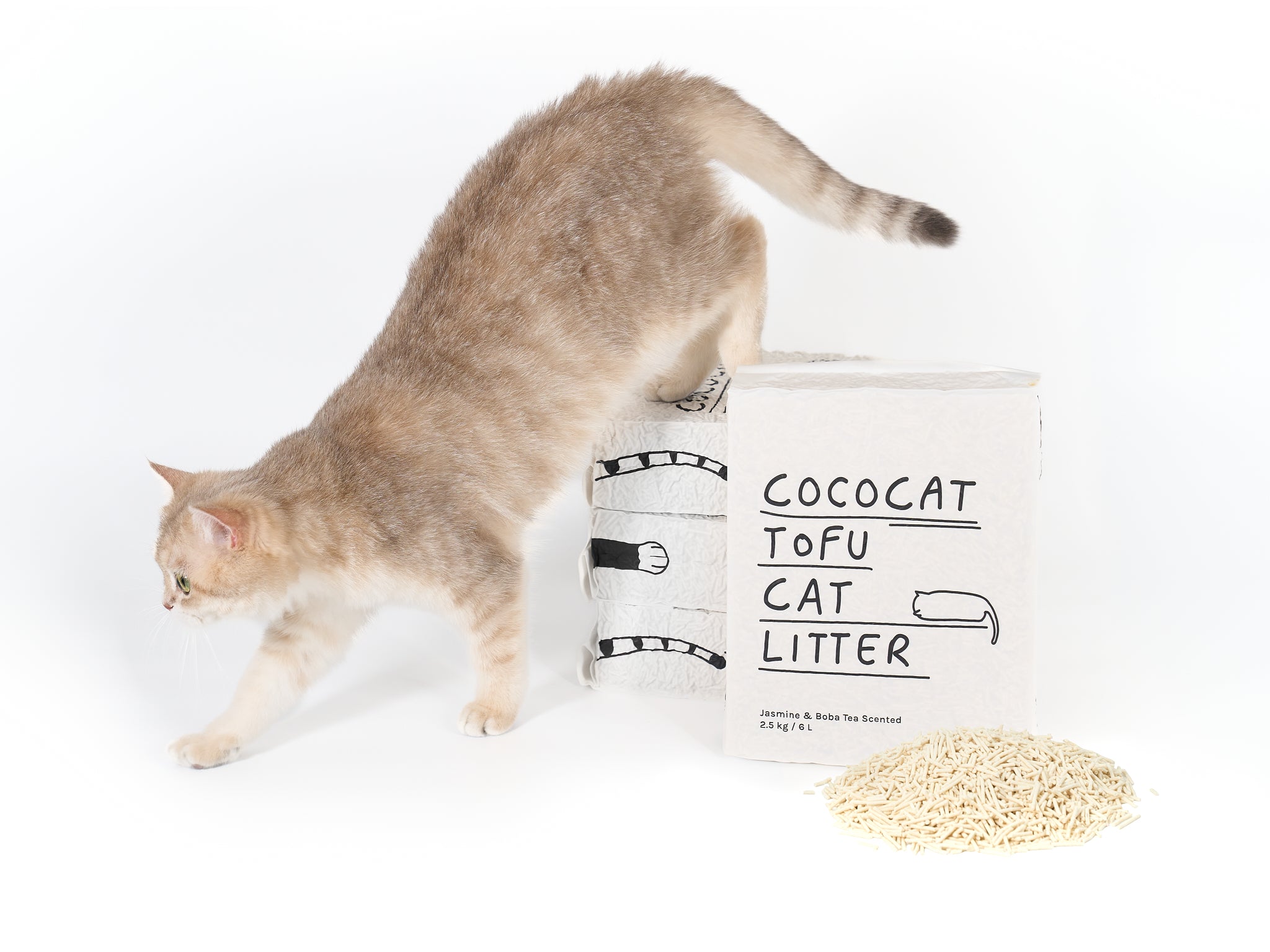
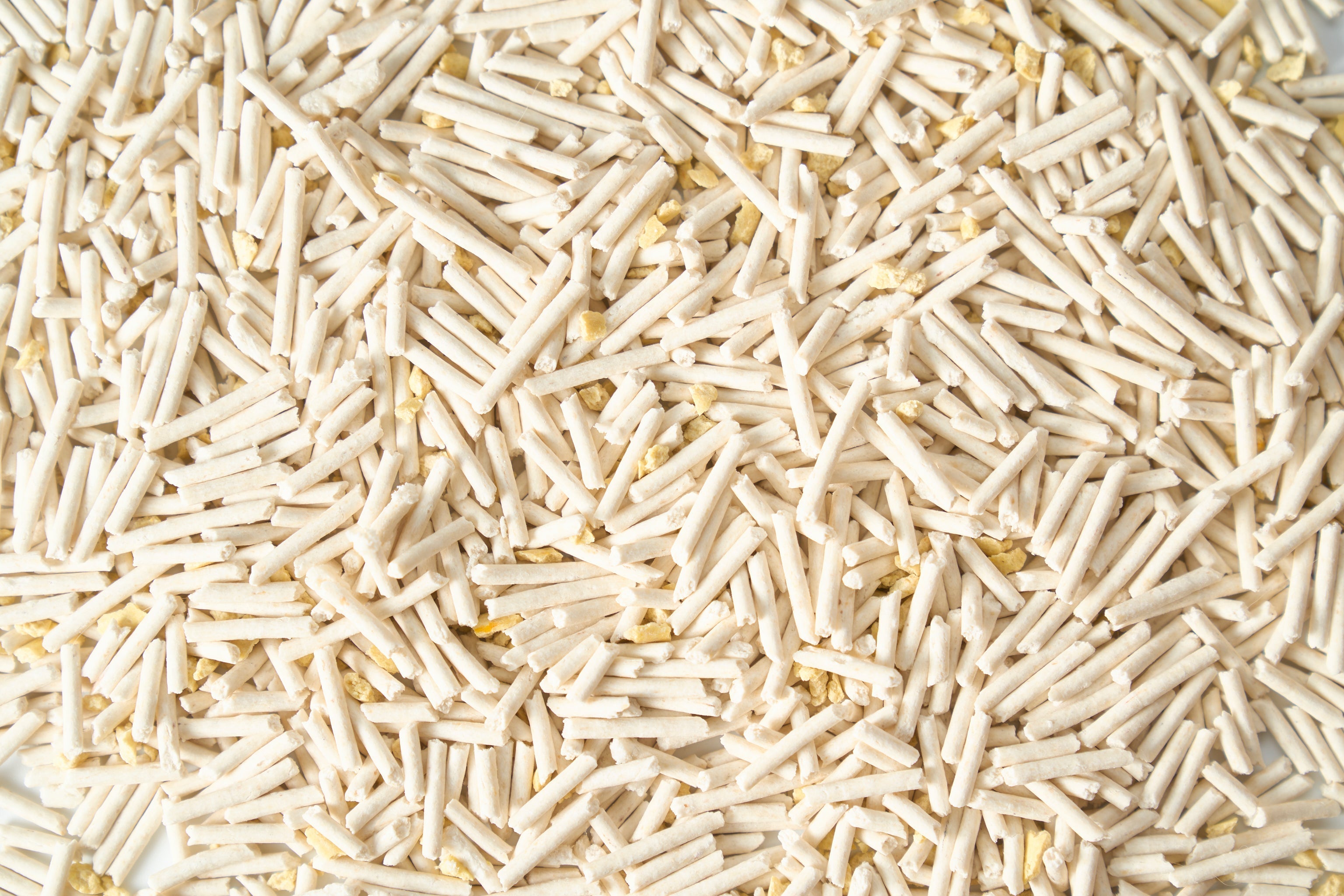
Tofu litter is a pressed pellet made from the fibre left over from plant-food production, typically soy okara or pea fibre, extruded into short cylinders a millimetre or two across. Despite the name there is no tofu in it. It clumps on plant starches and gums rather than on any mineral, it is light in the hand, and of the five it asks the least of anyone arriving from clay: scoop the clump, top up, no change of habit.
Our own tofu litter is built on pea fibre, pressed into pellets of roughly 1.5mm. Pea fibre rather than soy is a deliberate choice: it carries the absorption without the base note that soy okara brings, which is the note a good deal of the category answers with added fragrance.
The weakness is tracking, and it is ours to own. A light dry pellet rides out of the tray in paw fur and lands in the hallway. A textured mat under the tray catches most of it and what escapes sweeps up dry, but if you live in one room and cannot bear grit underfoot, read the wood section below before you buy ours. The second weakness is humidity: tofu clumps come out softer in a steamy bathroom than in a dry hallway, and a soft clump is a clump that can break on the scoop. What you are buying is the clay routine without the clay, and you pay for it with a mat by the tray and a deeper fill.
Cassava litter: fine grain, starch clumping, no mineral filler
Cassava litter is milled from the flour of the cassava root, the same starchy tropical crop that gives us tapioca. Ours blends cassava flour with corn starch, corn flour and guar gum, and clumps on the cassava's own starch rather than on any added mineral. The grain is finer and rounder than a tofu pellet, which matters more than it sounds: fine, even granules pour without bridging and sieve cleanly, which is what the rakes and sensors inside an automatic litter box are built to handle. It is unscented, because cassava starch has no base note to cover.
Cassava carries one question that deserves a straight answer rather than reassurance, which is that the raw root naturally holds a compound that can release cyanide. It is a fair thing to ask and the answer is a matter of processing chemistry, so we take it apart properly in its own piece rather than waving at it here. Of the five it is the best fit for a machine and for a fragrance-free home, and being a fine granule it travels further on a paw than a pellet does.
Wood litter: compressed sawdust, the pellet that stays in the tray
Wood litter is sawdust compressed into pellets under heat and pressure, usually softwood, usually with nothing else added at all: the best-known UK brand lists compressed sawdust and no additives. A wet pellet swells and crumbles back into sawdust, which is why the traditional wood tray is a sieve tray: soiled sawdust falls through to a lower chamber and the intact pellets stay above. Finer-milled clumping wood-fibre litters also exist in the UK, so "wood" on a bag does not tell you which routine you are buying. Check for the word clumping.
Wood is the material I would recommend to anyone whose deal-breaker is tracking. A pellet the size of a thumbnail does not leave the tray, and the RSPCA reports that wood pellets performed best in its own litter trials. Here is the qualification that the roundups leave out: in a field study of 18 cats, the animals showed a significant preference for clay or silica granules over wood pellets. So the material that suits the human best is one that a fair share of cats would not choose, which is the whole trade in one sentence. If your cat has always dug in something sand-like, offer wood in a second tray rather than switching the only one. The switch between wood pellets and tofu is written up on its own, routine by routine.
Softwood raises a phenol question worth handling honestly. Pine and cedar contain aromatic compounds that are a genuine concern in small-animal bedding, and commercial pellets are kiln-dried at high temperature, which drives most of them off. I have found no feline case literature establishing harm from kiln-dried pine litter, so the fair statement is that this is a reason to buy pellets sold as cat litter rather than raw stove or bedding pellets, not a reason to avoid wood.
Corn litter: whole-kernel grain that clumps on its own starch
Corn litter is whole-kernel maize, or ground cobs, pressed into an absorbent granule that clumps on contact with its own starch; the best-known corn brand is built on exactly that. It scoops like clay, it is soft underfoot, and it carries a faint sweetness of its own that you will either not notice or not like.
Two things are worth knowing before you buy it, and neither is a reason for alarm. The first is aflatoxin. Corn is among the crops most prone to Aspergillus moulds, whose aflatoxins cause liver damage in cats at sufficient dose, and a cat grooms its paws after using the tray. The response from the established manufacturers is heat treatment and batch testing, and I could find no documented case of a cat harmed by aflatoxin in litter, so this belongs in the category of a question to ask a brand rather than a hazard to flee. What follows from it is practical: do not leave a corn tray wet and unscooped in a warm room, which is the condition moulds want.
The second is simpler. Corn litter is a grain, and grain in a warm cupboard is food for pantry moths and weevils. Owners report infestations, sometimes in bags opened for the first time; those are forum accounts rather than a measured rate, but the mechanism is ordinary enough to act on. Store the bag sealed and cool, and buy a size you will get through rather than the biggest on offer. Kept dry in the tray and sealed in the cupboard, it is a clumping grain that scoops like clay.
Paper litter: recycled pellets, the most absorbent and the least discussed
Paper litter is recycled paper pressed into soft, highly absorbent pellets, and it is the one material on this list that generally does not clump. It is also the standard veterinary recommendation after abdominal or paw surgery, because a dust-free non-clumping pellet will not stick to a wound. For a kitten's first tray, or a cat with respiratory trouble, its softness and low dust make it a serious choice rather than a budget one.
Now the depth item, and I want to mark clearly where evidence ends and inference begins. Recycled paper is not a clean input stream. A 2011 survey of 202 paper samples across 15 product types found bisphenol A at microgram-per-gram levels in recycled-content products including napkins and toilet paper, and identified paper recycling itself as the contamination route, because thermal till receipts carry BPA that is not chemically bound and transfers to whatever it is pulped with. That is the established part. Here is the inference: no study I can find has measured bisphenols in paper cat litter specifically, so nobody, me included, can tell you what is in a given bag. What that justifies is a question to the manufacturer about the input stream and whether the pulp is de-inked, not a warning. I would rather hand you the question than a scare. It is the softest and most absorbent pellet of the five, with no clump to lift and one question to ask.
Which of them clump, and what that changes in your week
Tofu, cassava and corn clump. Paper does not, and the traditional wood pellet does not, though clumping wood-fibre versions exist. This is the single largest practical difference between these five materials, and it is the one the shelf hides.
With a clumping litter, each wee becomes a firm lump you lift out whole, so the tray runs on scooping and topping up. Published guidance on how often the whole tray then needs replacing genuinely disagrees, from weekly for one cat at one end to every two to four weeks at the other. Scoop daily and where you land between those two is mostly a question of tray size and how many cats share it; for our tofu litter the figure we publish is a full change every two to three weeks, and four if you keep up with the scoop.
With a non-clumping pellet, urine is absorbed rather than isolated. Nothing lifts out except solids, the soiled layer accumulates underneath, and the routine becomes sieving or a full change of the affected portion on a shorter cycle. It is not necessarily more work: sieving twice a week can take less time than scooping daily. But it is a different job, and buying a sack of wood pellets expecting to lift out clumps is the disappointment I hear about most in this category.

There is a quieter argument for clumping that nobody sells on. A clump is a record. One firm lump per visit makes it obvious when a cat starts urinating more often, or barely at all, and both are changes worth taking to a vet early. A pellet tray absorbs that signal along with the urine.
Dust, tracking and the small flat
Two properties decide whether a litter is liveable in a small home, and they pull against each other. Dust is about particle size: fine milling makes a granule that feels sand-like to a cat and hangs in the air when you pour. Tracking is about granule size and weight: the bigger and heavier the piece, the less of it leaves the tray on a paw.
Ranked for tracking, wood pellets are the best of the five and paper pellets are close behind, because both are large. Tofu, cassava and corn all track, tofu most of all in my experience of shipping it. Ranked for dust, paper and tofu are the low end, and the mineral question below matters more than the plant material for anything in the middle. Our tofu litter comes off the line through a 99.9 per cent dust-filtration process, a figure that rates the equipment rather than your air; what customers describe is the absence of the grey film clay leaves on the skirting board.
Odour I will not rank, ours included. Across all five materials, how a tray smells tracks how it is run, how often it is scooped and how deep the litter sits, more than whose name is on the bag. The charities' floor is at least 3 to 4 centimetres of depth, daily scooping, and one tray per cat plus a spare; for a clumping litter we go deeper, 5 to 7cm, so urine clumps on the way down rather than reaching the base. Get those right and any of these five is liveable in a flat. Get them wrong and no bag will save you. The flat-dweller's version of this, where the tray goes and what stops the smell, has its own page.
Kittens, and the cats who taste things
For a kitten the material question is mostly an ingestion question, because very young kittens sample litter while grooming and playing. With clumping sodium-bentonite clay, Cornell's Feline Health Center reports anecdotal accounts of gastrointestinal obstruction and calls ingestion a particular concern with kittens, while stressing that the evidence is sparse rather than settled. A plant granule does not absorb and set the way bentonite does, which is the honest basis for preferring plant materials for a young cat: not that plants are magic, but that the specific swelling mechanism is absent.
For a first tray I would shortlist paper for its softness and low dust, or a fine plant granule such as our tofu litter, and I would insist on unscented whatever the material. Whatever is in the tray, a kitten that keeps eating litter needs a vet's opinion before it needs a different bag. The first week with a kitten and a tray is written up separately.
The litter an automatic box needs
An automatic litter box needs a litter that clumps firmly and pours freely, because the machine's entire method is to sieve a solid clump out of loose clean granules. Non-clumping wood and paper give the mechanism nothing to separate, so those two are out. Of the three that clump, cassava is the strongest fit: fine, even, round grain that flows through rakes and sensors, clumping on starch with no mineral filler to grind. Corn works on the same principle. Tofu clumps too, but the softer clump it forms in humid rooms can crumble under a rake, so if the machine is the centre of your setup rather than an experiment, pair it with cassava. Which litters work in an automatic box, machine by machine, is its own page.
How do you dispose of biodegradable cat litter?
In the UK, used cat litter of any material goes bagged into the general waste bin. Biodegradable litters cannot go into council food or garden waste collections, because used litter carries urine and faeces and fails composting facilities' acceptance criteria. Flushing is more restricted than the word "flushable" on a bag implies: the water companies' rule is that only pee, poo and toilet paper belong down a toilet, and one of them has cleared 35 kilograms of flushed cat litter from a single sewer blockage. Our own line is deliberately conservative: scoop solids to the toilet only where your water company and local rules permit it, and everything else to the bin.
The word biodegradable on a bag describes what the litter is made of, not which bin it belongs in. If you compost at home, the published local-authority guidance is to remove faeces first and add only small quantities; I would add, as caution rather than quoted guidance, to keep the result away from anything you plan to eat.
What cat litter should you stay away from?
Four things are worth avoiding, and none of them is a brand. A pellet not sold as cat litter: stove and horse-bedding pellets are cheaper than the same material in a litter bag, and they are not made to the kiln-drying and additive standards a litter is, so the saving buys an unknown. A scented litter for a cat that has already turned a tray down, because in our survey of 369 UK reviews the smell was named in four of the seven refusals. A litter with undeclared mineral filler if biodegradability is why you bought it, since ground limestone is what is left in landfill when the plant matter has gone. And a swelling clumping clay for a kitten that eats litter, for the ingestion reason above. Everything else on this page is a trade rather than a hazard.
The list is short on purpose. The category's real risks are ordinary: a tray run too shallow, scooped too rarely or shared by too many cats, and none of those is fixed by a different bag.
What the label will not tell you
Here is the fact that reframes every claim on every bag in this category. Cat litter is not pet food, so no law requires it to list its ingredients, quantify a filler or stand behind the words on the front. A litter can be part ground limestone and say nothing at all, and the cheapest way to make a plant litter clump firmly is to add mineral. Some brands do disclose, to their credit: pidan's tofu litter lists a silica and calcium carbonate blend, and Tuft & Paw's lists calcium carbonate beside soybean and pea fibre. Plenty of others say nothing, and are entitled not to.
Two kitchen tests settle it in a minute. Pour white vinegar on a spoonful: calcium carbonate answers with a sustained fizz, plant material does not, though a faint reaction can also be a baking-soda deodoriser. Stir a spoonful into warm water and leave it: plant matter swells and softens toward pulp, while inert mineral settles as grit on the bottom. What is still sitting there tomorrow is what would still be sitting in landfill years from now. Our cassava litter contains no added calcium carbonate or mineral filler of any kind, which is a claim we put in writing precisely because so few in this category do.

The five compared
| Tofu | Cassava | Wood | Corn | Paper | |
|---|---|---|---|---|---|
| What it is | Pressed pea or soy fibre pellets, 1 to 2mm | Milled cassava flour granules, fine and round | Compressed softwood sawdust pellets | Whole-kernel maize or ground cobs | Recycled paper pressed into soft pellets |
| Clumps | Yes, on plant starch | Yes, on cassava starch | Usually no; clumping wood-fibre versions exist | Yes, on corn starch | No |
| Tray routine | Scoop clumps daily, top up | Scoop clumps daily, top up | Sieve tray, sawdust falls through, replace lower layer | Scoop clumps daily, top up | Replace soiled portion, no scooping of clumps |
| Tracking | High | Moderate to high | Lowest of the five | Moderate to high | Low |
| Dust | Low | Low | Low, some fines as pellets break | Moderate | Low |
| Texture a cat meets | Small pellet, sand-adjacent | Fine grain, closest to sand | Large hard pellet | Coarse granule | Large soft pellet |
| Automatic boxes | Workable; softer clumps in humidity | Best fit of the five | No | Yes | No |
| Kitten first tray | Yes, unscented | Yes, unscented | Not the first choice; hard underfoot | Yes, with the storage caveat | Yes, softest option |
| Worth asking about | Undeclared mineral filler | Undeclared mineral filler | Kiln-dried and sold as cat litter, not stove pellets | Aflatoxin testing; storage pests | Input stream and whether pulp is de-inked |
| Disposal | Bagged, general waste | Bagged, general waste | Bagged, general waste | Bagged, general waste | Bagged, general waste |
Two rows in that table decide most purchases. If you want the clay routine without the clay, you want tofu, cassava or corn. If tracking is what you cannot live with, you want wood, and you accept sieving in exchange.
What this means for the tray
For an open tray and a cat arriving from clay, I would fill it with CocoCat's tofu litter. It is a pea-fibre pellet that clumps, so the tray is scooped and topped up rather than emptied, and the clump is the record a pellet tray cannot keep. Fill it to 5 to 7cm so urine clumps on the way down; one cat gets through roughly one 6-litre bag a month on our own sales data, scooped daily, with a full change every two to three weeks. Two notes travel with it. It is lightly scented, with jasmine milk tea, and there is no unscented version; if fragrance is not wanted, the cassava is the right choice and not a second-best. And a pellet leaves the tray on paws: low tracking is one of the three things praised across every brand in our survey, against clay, wood and sand, and it is still not zero, so the mat goes at the exit.

For the household with a machine, or the one that wants no fragrance at all, the cassava litter is the bag. It is cassava flour with corn starch, corn flour and guar gum, a fine rounded granule that clumps on the cassava's own starch with no mineral filler, unscented because there is nothing to cover, and built for the sifting an automatic box does. It goes in the bin only, and a fine granule travels further on a paw than a pellet does, so it wants the mat more, not less. Both are in the cat litter collection; the tofu guide and the cassava guide hold the fill and change notes, and the litter box collection has the mats and trays.

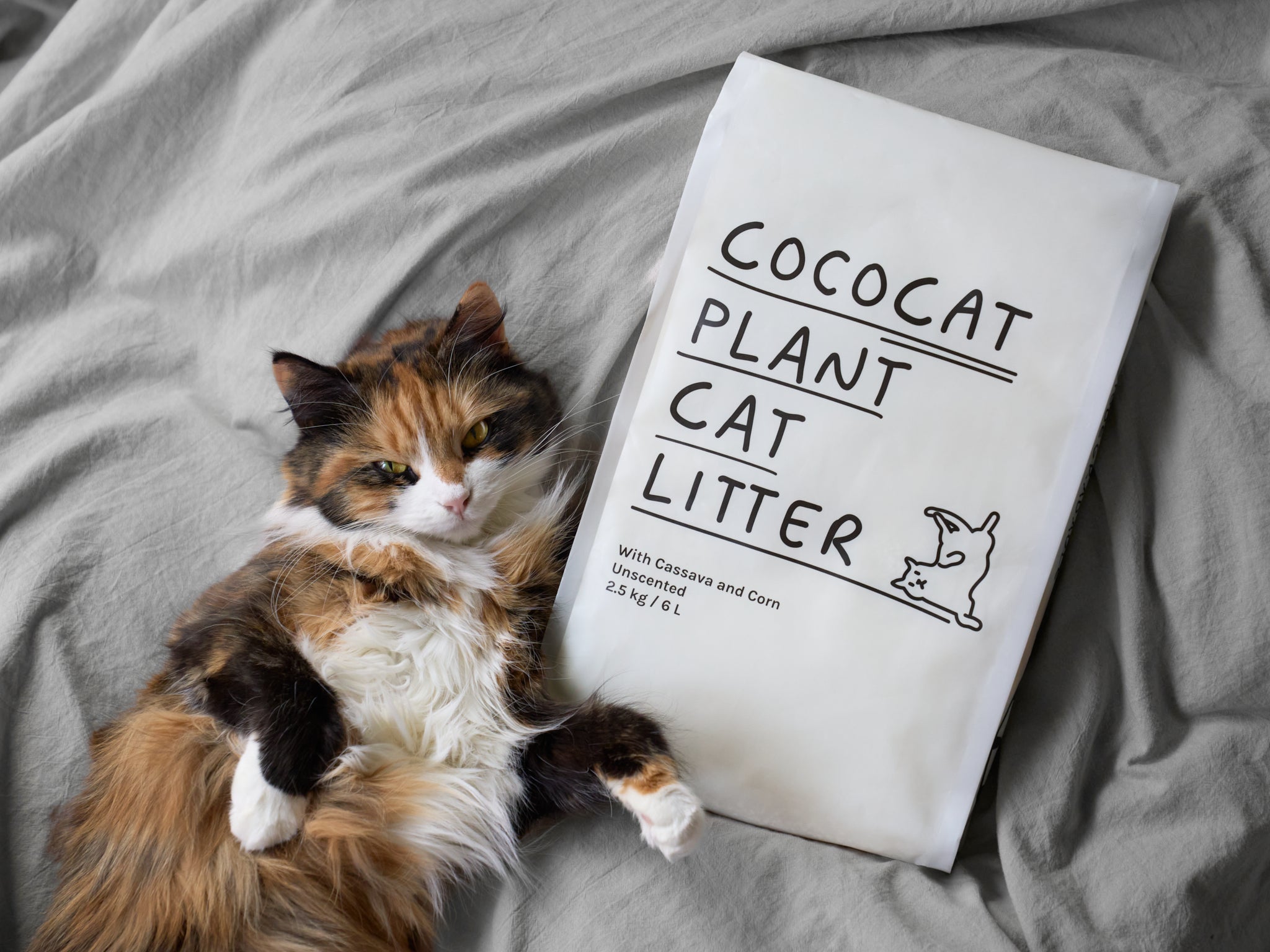
Whichever column is yours, the cat holds the casting vote. Switch gradually over about a week, or run the old and the new side by side and watch which tray gets used; that is the charities' method and it is ours. And if the answer turns out to be wood pellets, buy the wood pellets. We sell two of these five materials, and a comparison is only worth writing if it stays true when the answer is not us.
If you are choosing between the five
The tofu litter is the bag for the open tray and the switch from clay, and the cassava for the machine or the fragrance-free home. If you want the category's drawbacks before its strengths, they are written up honestly; if the question is what cassava actually is, that is answered on its own. If you would like the next piece when it is written, the newsletter box is at the foot of this page.
Related posts
- Tofu litter vs wood pellet litter: what changes and what doesn't
- The disadvantages of tofu cat litter, and what to do about each
- Which litters work in an automatic litter box
Sources
- Cat litter and litter trays, RSPCA
- Villeneuve-Beugnet, V. and Beugnet, F., Field assessment of cats' litter box substrate preferences, Journal of Veterinary Behavior 25 (2018)
- Does Clumping Kitty Litter Pose a Risk to Cats?, Cornell Feline Health Center, CatWatch, September 2024
- Cat litter, North London Waste Authority
- Liao, C. and Kannan, K., Widespread Occurrence of Bisphenol A in Paper and Paper Products, Environmental Science & Technology 45(21) (2011)

Leave a comment
This site is protected by hCaptcha and the hCaptcha Privacy Policy and Terms of Service apply.