
Tofu litter vs wood pellet litter: what changes and what doesn't
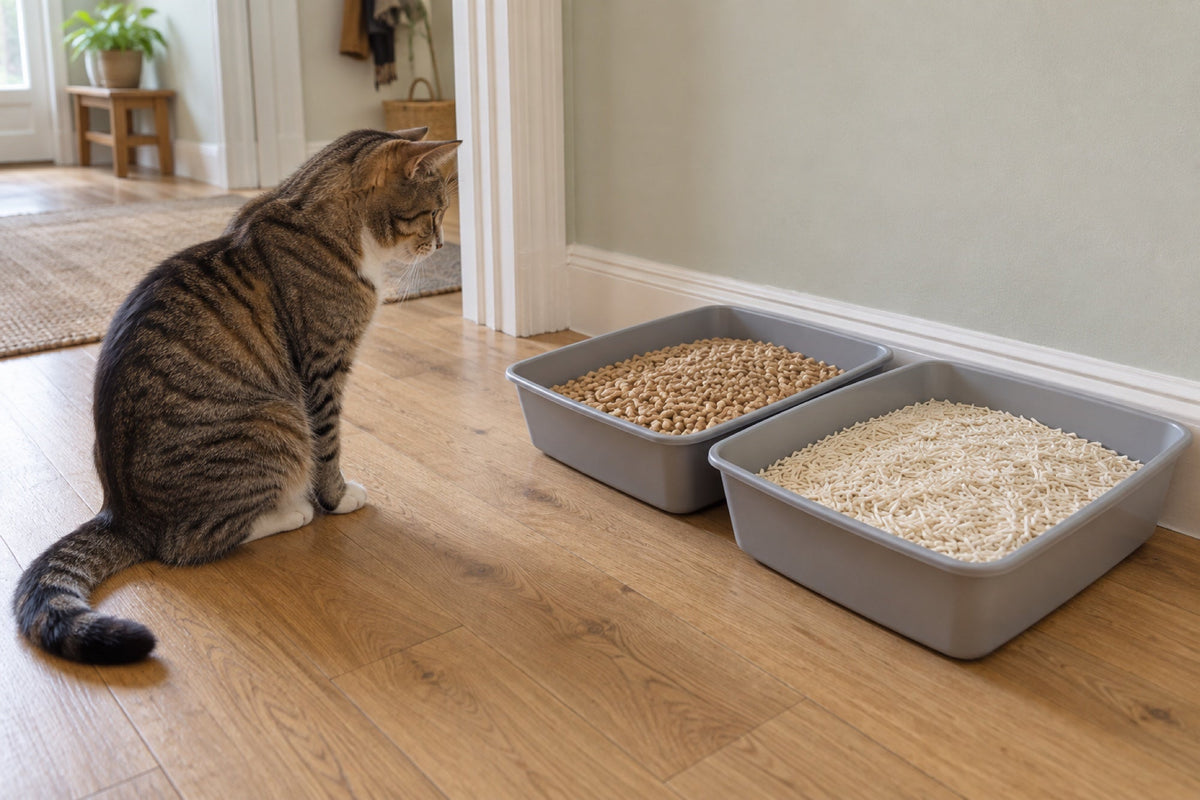
A wood pellet is about six millimetres across and made of nothing but sawdust pressed hot until it holds. A tofu pellet is about a millimetre and a half across and made of pea fibre pressed the same way. Wet them and they do opposite things: the wood pellet swells and falls apart into damp sawdust, the tofu pellet grabs its neighbours and sets into a clump you can lift out whole. Almost everything wood pellet owners say they love about wood, and almost everything they say they hate, comes back to that one difference.
I make the tofu one, so read what follows knowing that. To write it I read 448 reviews of the best-selling own-brand wood pellet in Britain, 171 forum posts about wood pellets, and the 28 reviews in our own corpus where someone had come to plant litter from wood. Wood pellets are the cheapest litter in the country that is not clay, and I will say plainly where they win. But the complaints wood users make are specific, they repeat, and a clumping plant litter answers most of them by mechanism rather than by marketing.
Is wood litter better for cats?
Wood pellet litter is better on price and on dry-pellet tracking, and worse on four things its own users report most: not being able to see where the cat has been, ammonia from the wet layer under the pellets, a sifting routine that has to be improvised, and pellets some cats find too hard or sharp to stand on. The RSPCA found wood pellets performed best in its own trials and adds that some cats prefer a fine sandy litter; in a field study of 18 cats, the cats showed a significant preference for fine clay and silica granules over wood pellets. A soft 1.5mm tofu pellet sits at the fine end of that scale. Neither material has been shown to harm a cat when sold and used as litter.
The two studies are not in conflict. The RSPCA's trial rated how the litter performed for the person running the tray. The 18-cat study measured which tray the cats chose. Wood scores well on the first and poorly on the second, and that is the material in a sentence: it suits the person best and the cat least, on the evidence we have. The rest of this page takes the person's side of that seriously, because it is the person who reads reviews.
What wood pellet users complain about, in their own order
Of 150 one-to-three-star reviews of the best-selling own-brand pellet, written in the six months after one reformulation, 104 say the litter is no longer the litter they had used for years. 85 describe the tray smelling, 13 of them using the word ammonia. 47 describe pellets that either refuse to break down or collapse after one wee, and 22 say they now change the whole tray every two or three days where they used to go a week. 14 describe a cat refusing the tray and 10 say the pellets are too hard or sharp. On the forums, 23 posts describe a sifting method in detail, and the methods include a colander, a garden sieve and a dustpan; one poster sieves "like a mad thing". A whole thread exists to ask how to tell where the cat has weed.
The same 448 reviews praise the price 103 times, the wood's naturalness 70 times, its odour control 56 times, the satisfaction of sifting 56 times and its lack of dust in the bag 29 times. So this is not a bad product with unhappy customers. It is a product whose whole performance depends on a system working, pellets crumbling at the right rate, sawdust separated out, tray deep enough, and when any part of that system slips, which the reviews say it does from bag to bag, the failure arrives within a day or two and no amount of scooping recovers it. A clumping litter does not have that system. That is the argument of this page, and each section below takes one of the complaints and shows what changes.
Why is tofu cat litter better?
Tofu cat litter is better than non-clumping wood pellets on five specific points, and not in general. You can see what to remove, because each wee sets into one firm clump and each clump lifts out whole. Nothing is sifted: the daily job is a scoop, with no sieve tray, colander or method to learn. The wet material leaves the tray the same day rather than sitting as a saturated layer under dry pellets, which is where the ammonia wood users describe comes from. The pellet is soft and about 1.5mm, near the fine texture cats chose over wood pellets in the 18-cat study. And the whole tray is changed every two to three weeks with daily scooping, not every two or three days. It is not better on price or on dry-pellet tracking, where wood wins clearly.
The next four sections take those points one at a time, because a list is easy to write and a mechanism is what makes it true.
The tray you can read
"How do I know where he has urinated in the tray to scoop it out?" is a real question from a wood pellet owner, and it has no good answer, because a non-clumping pellet absorbs urine and darkens a little and that is all. One reviewer of the darker reformulated pellets says wet ones "look like lumps of cat poo"; another says you "end up having to empty half the litter tray whenever your cat does a pee". A clumping litter answers this by mechanism. Urine hits tofu pellets and they bind into one firm lump around it, so the tray shows you where the cat went and you remove that and nothing else.
There is a second reason to want that, which nobody sells on. A clump is a record. One firm lump per visit makes it obvious when a cat starts urinating more often, or barely at all, and both are early signs a vet would want to hear about. A pellet bed absorbs that signal along with the urine. In a house with one tray and one cat, the clumps are the only daily health check anyone is doing.
No colander, no garden sieve
A wood tray runs on sifting. The pellets that got wet crumble into sawdust, the sawdust sinks or falls through a slotted tray, and someone has to separate it from the dry pellets on top, daily or twice daily, or the tray becomes what one reviewer called a "sludgy stinky mess" after "just a day or two even when spot cleaned". The purpose-built sieve trays are not a reliable answer: of 14 reviews of the best-known one, five are one to three stars, and two say the sift function clogs and is "useless". So people improvise, and the improvisations are the tell: a dustpan held over the tray and shaken, a garden sieve into a bin bag, a colander. Wood pellet owners also do not agree on whether sifting is even necessary; one forum exchange runs three days on whether leaving the sawdust in is hygienic.

A tofu tray has no sawdust stage. The clump is lifted out on an ordinary slotted scoop, the loose pellets fall back through the slots, and the tray is topped up from the bag. The fill is deep, 5 to 7 centimetres for our tofu litter, because a clump needs pellets beneath it to form on; urine that reaches the base dries there instead. That is the whole method. A plain deep tray replaces the sieve tray, because a sieve's slots pass a 1.5mm pellet and have nothing left to do.

Where the ammonia comes from
The wood pellet owners who love the material for odour and the ones who hate it for odour are describing the same physics from either side. When a pellet crumbles fast and the sawdust drops beneath dry pellets, "the pellets on top trap the smell", as one forum poster puts it, and "the only smell is the wood smell". When the pellet swells instead of crumbling, or the sawdust is not sifted out, urine sits wet under the surface, and that is the condition ammonia needs: one reviewer describes "a horrendous ammonia smell despite of cleaning 3x a day". 85 of the 150 critical reviews describe that second state, and the reviewers say it arrives within the first day or two of a bag that behaves differently.
A clumping litter removes the wet material from the tray the same day it arrives, so there is no saturated layer to turn. That is a mechanism, not a promise of a smell-free tray, and I want to be exact about it. Odour in our own reviews is contested too: the same tofu litter is praised for odour control by some customers and described as smelling after days of use by others, and the complaints share a pattern, which is a tray run too shallow or scooped too rarely. Run the tray as above, one tray per cat plus a spare, and what a clumping litter gives you is that the smell is handled by removal rather than by your diligence at the sieve.
What are the downsides of using tofu litter?
Tofu cat litter has three real drawbacks against wood pellets and each has a known answer. It costs more per litre, £1.33 to £1.67 for ours against 37p for the best-selling own-brand pellet, though it is used up by clumps lifted out rather than by sawdust thrown away, which narrows the gap over a month without closing it. It tracks more than a dry wood pellet: a light 1.5mm pellet rides out on paws where a thumbnail-sized pellet does not, so a mat goes at the exit. And most tofu litters are scented, ours lightly with jasmine milk tea, with no unscented version; the cassava litter is the fragrance-free bag in our range. A fourth is smaller: the clump softens in a humid room, so a bathroom tray wants the deeper fill.
The scent point deserves more than a line, because it is the one that sends people back to wood. Thirteen per cent of the praise for wood pellets is for smelling of nothing but wood, and one reviewer in our own corpus went back to wood for that reason alone. If no added fragrance is the thing you value most, the tofu litter is the wrong bag and the cassava litter is the right one: unscented because cassava starch has no base note to cover, a fine rounded granule that clumps on its own starch, and the same scoop-and-top-up routine.
How often do you change wood pellet cat litter?
Wood pellet litter is changed by the layer rather than on a fixed date: solids lifted daily, sawdust sifted down once or twice a day, the wet layer replaced when it fills, and the whole tray emptied on a cycle the supplier guidance leaves to the household. When the system works, users report going a week to ten days, some longer. When a bag behaves differently, 22 of the 150 critical reviews describe changing the whole tray every two to three days. A clumping tofu litter runs the other way: scooped daily, topped up, and fully changed every two to three weeks for our tofu litter, four if the scooping is kept up, with the routine unchanged from one bag to the next.
That last clause is the one the reviews taught me to write. What wood users describe losing is not a feature but predictability: the bag that used to last a fortnight now lasts three days, and nobody told them why. I will not promise that any litter is identical from bag to bag, and a page that did would not deserve your trust. What I can say is what happens to ours before it is sealed: every batch goes through a dust-removal stage, then to a professional laboratory for testing to EU standards, including particle size and dust level, and is vacuum-sealed only after it has passed. The routine the customer runs does not change from one bag to the next, because there is no sifting system to drift.
What does each cost a month?
Per litre, wood pellets cost about a quarter of what our tofu litter does, and nothing on this page changes that. The best-selling own-brand pellet, Pets at Home's 30-litre bag, is £10.99 at the time of writing, which is 37p a litre. Our tofu litter is £9.99 for a 6-litre bag, £1.67 a litre, and £79.99 for the 60-litre pack, £1.33 a litre. Per month the gap narrows because the two are used up differently, but it does not close: on the figures below, wood pellets run at £3 to £5 a month for one cat and tofu at £8 to £20.
| Litter | Price per litre | How it is replaced | Litres a month, one cat | Cost a month |
|---|---|---|---|---|
| Wood pellets | £0.37 to £0.65 | sifted, topped up | about 7 | £3 to £5 |
| CocoCat tofu | £1.33 to £1.67 | scooped and topped up | 6 to 12 | £8 to £20 |
What the extra buys is the four things above: a tray you can read, no sifting, the wet material out the same day, and a routine that does not depend on the bag. One of our own customers, arriving from wood, put it as "roughly the same cost as the wood pellets I was buying", because the cat uses less; I would not go that far on our own figures, and the honest range is the one in the table. There is also a cheaper wood pellet than the litter one, the stove or horse-bedding sack, and owners swap to it once they notice. I would not, for a standards reason rather than a marketing one: pellets sold as cat litter are kiln-dried and additive-free to a specification written for a cat's tray, and a fuel or bedding pellet is written to a different one.
What is the healthiest type of litter for cats?
The healthiest cat litter is low in dust across its whole life, unscented, made of a material the cat will not swallow in quantity, and soft enough that the cat will use it; no single material owns all four. Wood pellets are low in dust in the bag, which their users rightly praise, and become dust after use, which is the stage where people who left wood report coughing and hoovering. Our tofu litter comes off the line through a 99.9 per cent dust-filtration process, a figure that rates the equipment rather than your air, and it stays a pellet after use rather than becoming powder. On fragrance, unscented is the safer default for a cat that has ever refused a tray, and in our range that means the cassava. On ingestion, the concern in the veterinary literature is swelling clumping clay in kittens, not plant fibre. And a cat that stops using the tray, strains, or eats litter needs a vet before it needs a different litter.
Two things wood does better here belong in this section. A pellet that does not clump cannot form a mass in a kitten that eats it, and some owners choose non-clumping wood for kittens on exactly that reasoning; plant fibre does not swell and set the way bentonite does, but a kitten that keeps eating any litter is a vet's question first. And softwood carries a phenol question of its own, the aromatic compounds in pine and cedar that are a recognised concern in small-animal bedding; kiln drying drives most of them off, I have found no feline case literature showing harm from kiln-dried litter, and the fair reading is a reason to buy pellets sold as cat litter, not a reason to avoid wood.
Which suits your cat
Texture decides more switches than price does. A cat that has always used wood pellets has learned a hard, coarse surface and may find a fine pellet strange for a week. Cats that arrive from a rescue often arrive already trained on wood, which is a habit rather than a preference, and the reviews say so with some pride. In either case the method is the charities' method: mix the new litter into the old gradually over about a week, or set the new one in a second tray and let the cat vote. If the vote goes to wood, buy the wood. If the reviews are any guide, the vote more often goes the other way: 14 of the 150 critical wood reviews describe a cat refusing hard or sharp pellets, and in our own corpus seven of 369 reviews, under two per cent, describe a cat refusing a plant litter, four of those seven naming the smell rather than the texture.
So the first thing to check when a switch to tofu fails is the fragrance, and the fragrance-free answer in our range is the cassava litter. The second is depth: a tray filled to the 2 to 3 centimetres a wood pellet wants will make a tofu clump stick to the base, and 5 to 7 centimetres fixes it.
What this means for the tray
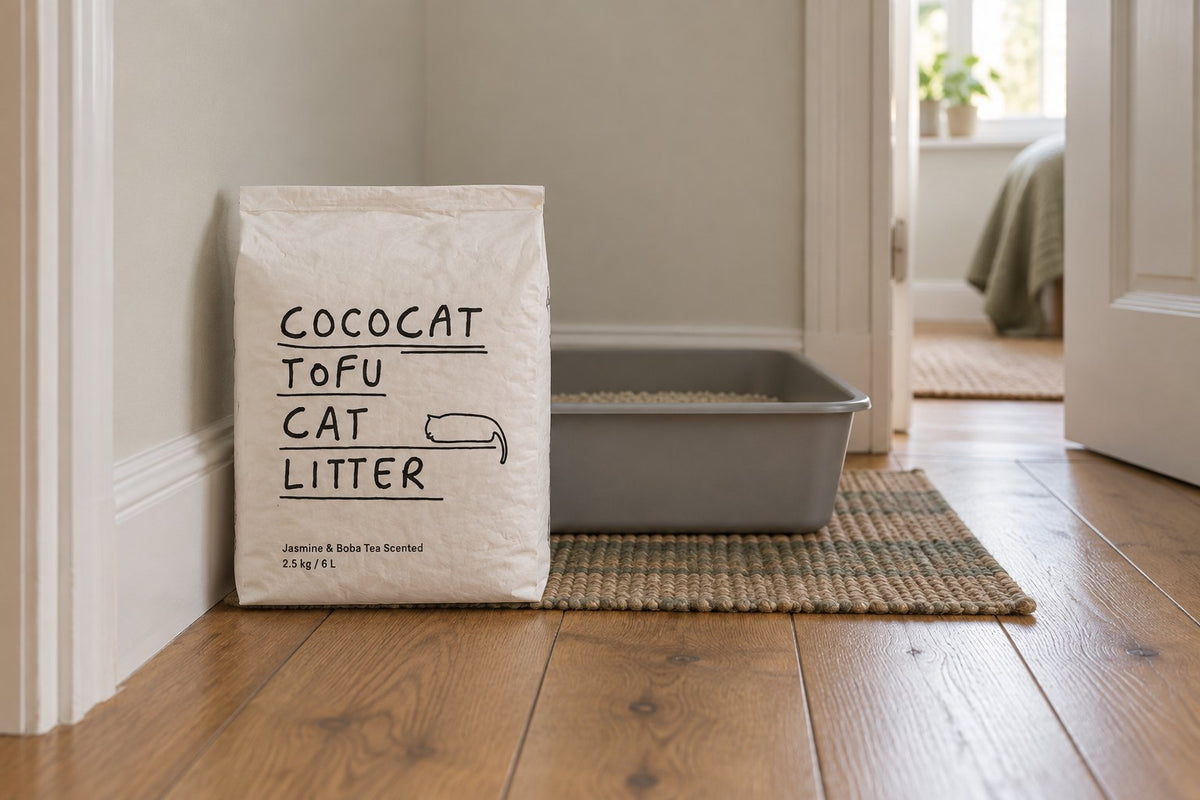
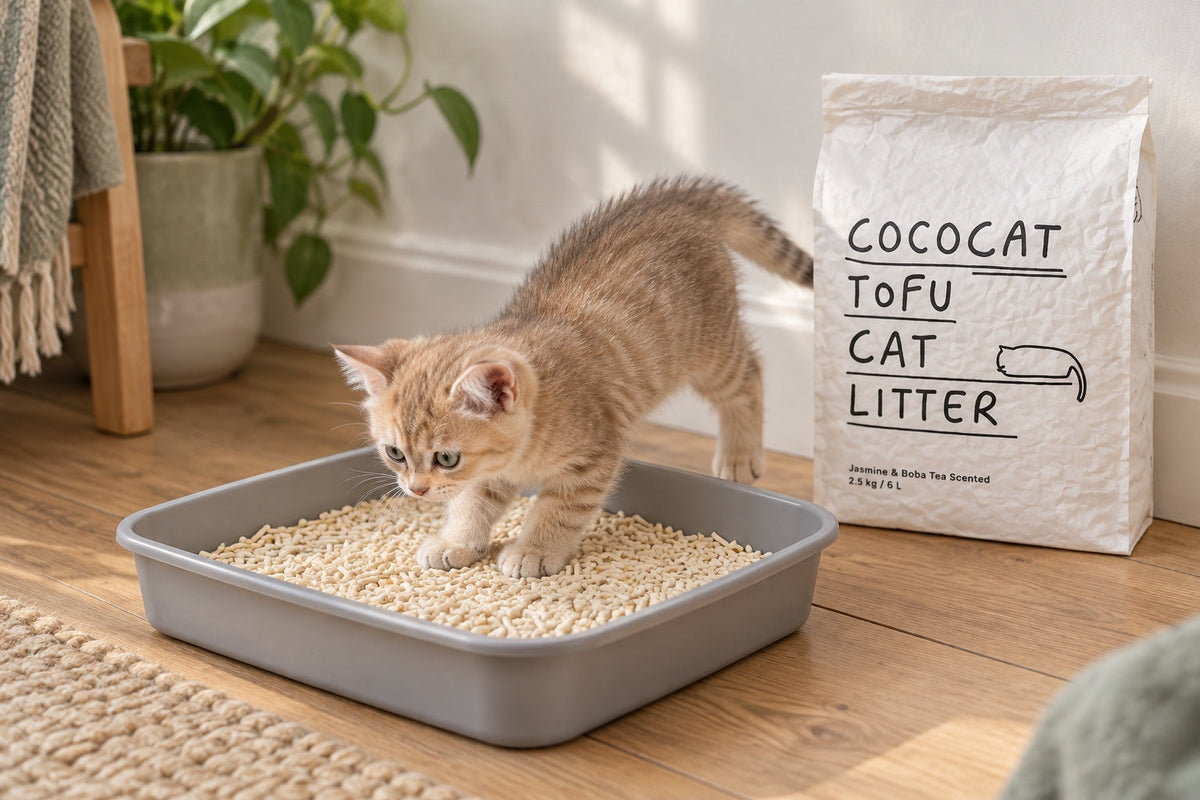
If you are leaving wood pellets for any of the reasons above, CocoCat's tofu litter is the bag I would put in the tray. It is a pea-fibre pellet of roughly 1.5mm that clumps on plant starch: one firm lump per visit, lifted out on a scoop, nothing sifted, the wet material out of the tray the same day. Fill a plain deep tray to 5 to 7cm, scoop daily, and expect a full change every two to three weeks; one cat gets through roughly one 6-litre bag a month on our own sales data, and the routine is the same from the first bag to the tenth. The scent is light and it is there, jasmine milk tea, and there is no unscented version of the tofu litter. And it will track more than the dry pellets you are leaving, so a mat at the exit goes in the basket with the first bag.

If what you value in wood is that it smells of nothing, the cassava litter is the bag instead: unscented, a fine rounded granule that clumps on the cassava's own starch, bin only, and the one I put in an automatic box, where a wood pellet gives the machine nothing to sieve. Both are in the cat litter collection, and the tofu guide has the fill and change notes in one place.
And if the floor matters more to you than the tray, if a heavy-weeing cat needs the volume a pellet bed gives, or if your cat has voted for wood in the second tray, buy the wood pellets. This page is only worth writing if it stays true when the answer is not us.
If you are leaving wood pellets
The tofu litter is the bag for the switch from a sieve to a scoop, and the cassava for the fragrance-free tray. If you want the tofu category's drawbacks laid out before you buy, they are written up honestly. If wood and tofu are two of several you are weighing, all five plant litters are compared in one place, and if the tray is in a flat, the flat has its own page. A kitten's first tray is a separate first week. If you would like the next piece when it is written, the newsletter box is at the foot of this page.
Related posts
- Tofu, cassava, wood, corn or paper: which plant litter suits which household
- The disadvantages of tofu cat litter, and what to do about each
- Which litters work in an automatic litter box
Sources
- Cat litter and litter trays, RSPCA
- Villeneuve-Beugnet, V. and Beugnet, F., Field assessment of cats' litter box substrate preferences, Journal of Veterinary Behavior 25 (2018)
- How to create the best litter tray set up for your cat, Battersea Dogs & Cats Home
- Pine & Spruce Aroma Wood Pellet Non-Clumping Cat Litter, Pets at Home (product page and customer reviews)
- Does Clumping Kitty Litter Pose a Risk to Cats?, Cornell Feline Health Center, CatWatch, September 2024

Leave a comment
This site is protected by hCaptcha and the hCaptcha Privacy Policy and Terms of Service apply.