Article: Where cats actually sleep, and whether a bed changes it
Where cats actually sleep, and whether a bed changes it
A resting cat is comfortable, spending nothing to stay warm, in air of about 30 degrees. In Britain that is a heatwave, and it sounds wrong until you remember what the cat does on the hottest day of the year: it lies full length in the sun on the patio while you look for shade. A cat's body runs at about 38.5 degrees, a degree and a half above ours, in a small frame that loses heat quickly, under a coat built for sleeping rough. The room we keep at 20 or 22 is one we find comfortable in a jumper. For a cat that is doing nothing, it is a cool room, and everything it does about that looks like character: the radiator, the laptop lid, the square of sun that moves across the carpet, your side of the bed after you have got out of it. None of this means the house should be at 30. It means the cat wants one spot warmer than the room, and it will find one.
The second thing a cat wants from a sleeping place is not to be watched, or at least to see anything coming before it arrives. Put those two together and you have the answer to where cats sleep, and the reason the bed you bought is empty while the cat is asleep in the box it came in. What follows is the evidence for both, what each of the popular sleeping spots is giving the cat, and where a bed you choose fits in.
Where do indoor cats sleep at night?
Indoor cats sleep where it is warmest, highest and hardest to be approached from behind, and at night that is usually the owner's bed, the back of the sofa, a chair by the radiator or a windowsill. A cat sleeps about 16 hours in every 24, though the figure varies a good deal between studies and between cats, and the larger part of it is by day. Night is broken into shorter bouts with waking between, which is why a cat may start on your feet and finish on the landing. Cats also keep several sleeping spots and move between them; Cats Protection reads that as parasite management inherited from the wildcat, an interpretation rather than a measured finding, but the rotation itself is easy to see in any home.
Thirty-eight per cent of the UK's 10.2 million owned cats never go outside, and in rented flats and city centres it is nearer half. For those cats the choice of sleeping spot is the whole of their territory, and it is worth looking at the spots they choose before buying anything, because the cat has already told you what it wants: how warm, how high, and how covered.
Should cats have beds?
A cat needs resting places it has chosen; it does not need a product. The environmental guidelines that feline vets in Britain and America published together in 2013 ask for at least two resting areas per cat, kept apart from food, water and tray, and for a "safe place" that is private, usually raised, and enclosed enough that the cat feels hidden, at least one per cat. A cardboard box on its side qualifies. So does a shelf. A bought bed is the easiest way to put warmth, height and cover where you would like the cat to sleep instead of on your pillow, and the beds that get used supply those three things in the place the cat already goes.
Whether a bed is worth buying, then, depends on whether the cat's current spots are ones you can live with. A cat that sleeps on the sofa back and the end of your bed has already met the guideline. A cat that sleeps on the kitchen worktop, in the airing cupboard or on the only chair a guest could sit on has met it too, and a bed is how you negotiate.
Warm, high and covered: what the cat is choosing
Start with warmth, because the number is so far from what we assume. A resting cat's comfortable range runs from roughly 30 to 38 degrees, and a British room in winter sits ten degrees below the bottom of it, which is why the cat seeks out anything warmer than the air: a radiator, a laptop, a folded jumper, your lap. It does not want the whole room at 30. It wants a spot that holds heat, ideally its own, and warm bedding and a raised bed off the cold floor are the standard advice from the people who study cat housing. That is not a luxury. It is the difference between a cat that settles and one that keeps moving.
Height comes next. Cats watch their surroundings from a vantage point when they can, and will take a shelf, a window seat or the top of a wardrobe over the same cushion on the floor. A raised place lets a cat see what is coming and be out of reach of the dog, the toddler and the vacuum cleaner. It is also, in a room with a radiator or a sunny window, where the warm air is.
Cover is the one with the strongest experimental evidence, and the evidence comes from shelters, where a new environment makes cats do the things they do at home only more so. Twenty-six shelter cats were each given a choice of four linked compartments for ten days: one empty, one with a prey toy, one with a perch, one with a hiding box. They spent a median 55 per cent of their time in the hiding compartment, 2 per cent with the toy and 4 per cent in the empty one. In a randomised trial at a Dutch shelter, cats given a box settled, on a standard stress score, a week sooner than cats without one. Those are shelter cats under real stress, and I would not claim the same size of effect in a quiet flat. What I would take from it is the direction: when a cat is unsure, cover is what it reaches for, and a bed with sides or a roof is a bed a nervous cat will use.
Do cats prefer open or closed beds?
Cats that are settled and like to watch the room tend to use open beds; cats that are new, nervous, elderly or living in a busy household tend to use enclosed ones, and the enclosed bed is the safer first buy because it works for both. The shelter studies above show cats choosing a hiding box over every other option when they are unsure, and the veterinary guidelines describe the ideal open perch as one with a dip or raised sides, so even a cat that wants a view is partly hidden. The bed that satisfies both is open on top with a rim high enough to lean into, or enclosed with a doorway wide enough to see out of.
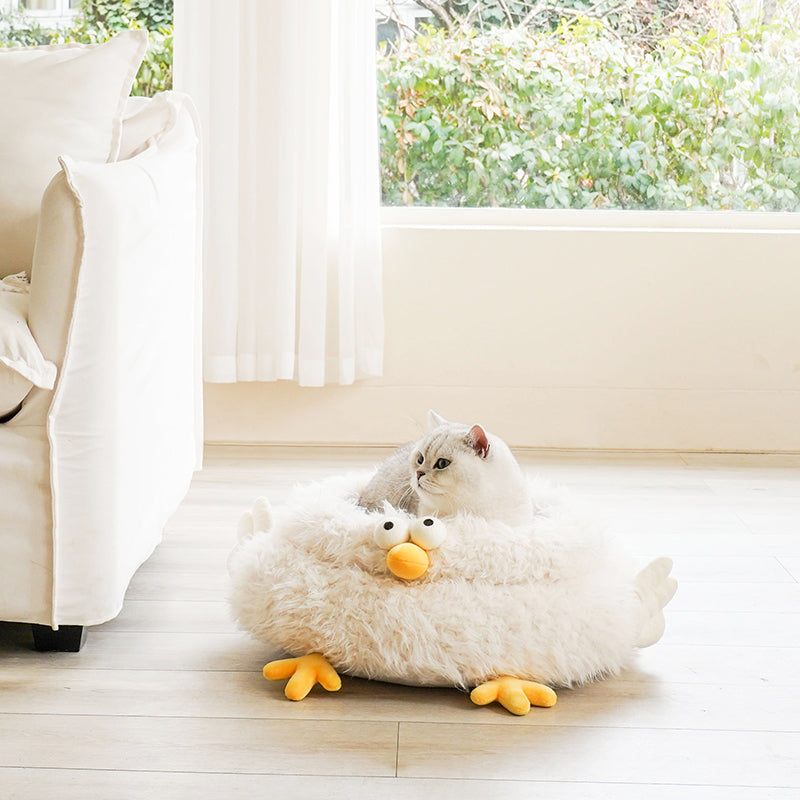
In practice the two are not as far apart as the shelves suggest. The zeze Gugu Chicken bed is an open nest, 49cm across and 21cm high, but the rim is deep and padded so a curled cat has something at its back and only its head above the edge, which is the curled posture a cat sleeps in when it is keeping warm. The Blue Monster house is the enclosed one, a 45cm dome with a doorway cut wide so the cat inside can see the whole room, which matters more than the size of the house: a hiding place with a good view out is a den, and a hiding place the cat cannot see out of is a trap it will not use twice. The striped armchair sits between them, open at the front and held on three sides by a high back and two rolled arms. If you are buying one bed and do not know which your cat is, buy the one with sides, or buy the thing that has both.

The zeze trees put an open bed and a closed one on the same frame, which is how I would settle the question for a cat I had not watched. The Farmhouse tree has a solid wood house with a cushioned floor and an arched doorway at the top, 138cm up, and below it an open platform, a chick hammock and a cow-print hammock, so the cat has an enclosed high den and three open perches and picks by mood. The 3-in-1 tree has a soft-lined tree-trunk cave low down and a cushioned mushroom-top perch above it, and the Deluxe 3-in-1 has two tree-trunk dens and the mushroom bed on top, with inner pads that lift out for washing. The Happy Farm tree is the open version, a deep chick-shaped nest with a curled rim at 105cm over two lower perches. A cat that hides for the first week and watches from the top for the rest of its life has not changed its mind; it has used both halves of the same piece of furniture.
The radiator bed, and what the cat wants from it
The most searched bed in Britain in January is the radiator bed, and the idea behind it is right: a surface warmer than the room, a position off the floor, and a wall at the cat's back, all in the spot the cat has already chosen. The heated bed, which peaks in November, is the same want with a plug.
The trouble is contact. A cat that falls asleep on a hot surface does not wake up because it is too hot; it wakes up when it has had enough sleep, and by then a radiator running at full heat has been against the same patch of skin for an hour or more. Veterinary hospitals list radiators and electric heating pads among the common causes of thermal burns in cats, and the cats most at risk are the older and stiffer ones that are slowest to move off. That is the same cat the radiator bed is usually bought for. Cats Protection's advice is to keep beds out of draughts and not too close to heat sources, and a cat should always be able to walk away from a warm spot without effort.

So the version I would build is the bed near the radiator rather than on it: an arm's length away, never touching the panel, in the corner the cat already uses. The cat gets the warm air rising off the radiator and none of the metal. For that job I stock beds that hold warmth by their shape rather than by a heating element. The Gugu Chicken bed is a deep dished nest in long-pile plush, padded all the way through, and the dished centre holds the warmth a curled cat makes for itself rather than letting it escape sideways. The Blue Monster house is a plush dome, so the cat's own heat stays inside with it. The zeze armchair and the striped sofa bed have a raised, padded base that lifts the sleeping cat clear of the floor and the draught that runs along it, and a high back that holds warmth on three sides. Put any of them beside the radiator with a folded blanket in the seat and you have what the cat was after, without the part that burns.
If you do buy a heated bed elsewhere, the two things to check are that it has a thermostat and that the cat can leave it. If you buy a radiator hammock, check the radiator's rated load and the hammock's, and check the surface temperature with your hand before the cat does.
Sleep and scratch in the same place
Cats scratch when they wake, which is why the charities tell you to put the post next to the bed, and why a bed that is also a scratcher is not a gimmick. The cat stretches, drags its claws down the nearest thing with resistance, and goes back to sleep, and if the nearest thing is the sofa arm, the sofa arm pays. A cardboard scratcher shaped as a bed puts the two habits on one object.

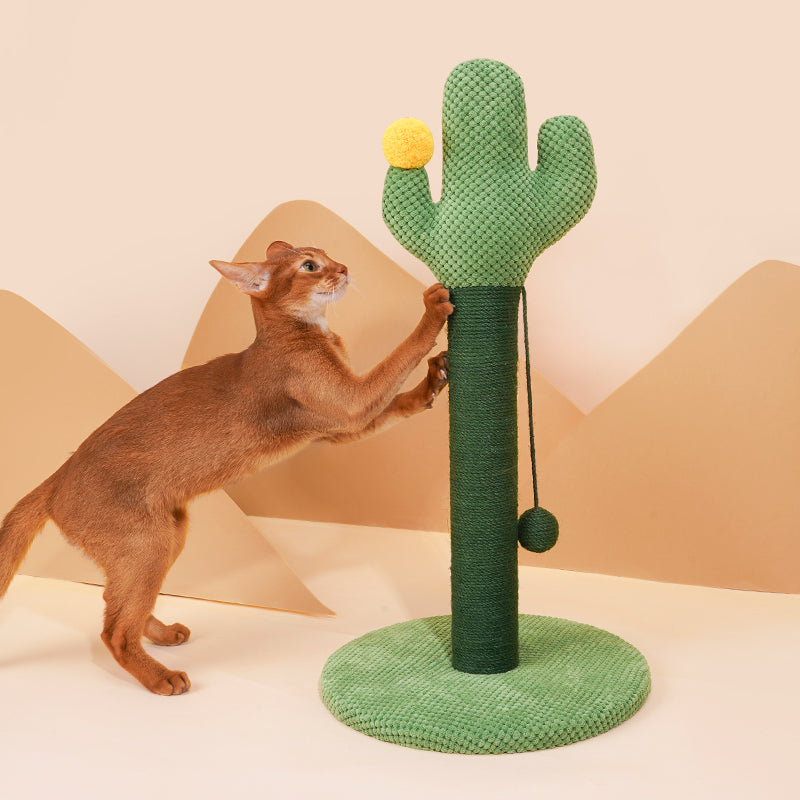
The zeze Retro scratcher bed is 41cm square of corrugated cardboard pressed into a shallow bowl, so a cat curls into the dip to sleep and rakes the same surface when it wakes; at £18.99 it is the cheapest bed in the range and the one most bought. The pidan round scratcher does the same at 48cm across with a recessed centre. The Milk Carton house is the covered version, 55.5cm tall on a 33.5 by 30.5cm footprint, with a front door, a side porthole to look out of, and corrugated walls the cat scratches on its way in and out. And every zeze tree above is a scratcher first: the uprights the cat climbs to reach the house, the cave or the nest are wound in jute or sisal, so the post is already where the bed is. Cardboard sheds a little confetti with each session and wears through over months, which is what it is for, and the scratcher piece covers what to do when the cat scratches up rather than along.
Why do cats prefer cardboard boxes instead of cat beds?
A cardboard box gives a cat cover on five sides, an opening it can watch, insulation from the floor, and no smell it did not put there itself, and a new bed offers none of those things on the first day. The box is the hiding place the shelter studies tested, and cats in those studies chose it over toys, perches and open space. A new bed, by contrast, smells of the factory and the warehouse, sits where you put it rather than where the cat sleeps, and gives no cover unless it has sides. The box wins on the cat's terms, not because the cat is being contrary.
The fix follows from the diagnosis. Put the new bed where the cat already sleeps, not where the bed looks best, and move it a foot a week afterwards if you must. Put something inside that smells of the cat: the blanket it has been sleeping on, or a worn T-shirt of yours. Do not wash every bed and blanket in the house on the same day; leave one with the cat's own scent on it. And if the cat has settled on a box, let it keep the box for a fortnight beside the new bed, then take the box away. If you would rather the box were furniture, the zeze Milk Carton house above is a cardboard box built as one, with an exit and a lookout.
What is the best bed for an elderly cat?
The best bed for an elderly cat is low enough to step into rather than jump into, soft, warm, out of draughts and the busy parts of the house, and placed where the cat already chooses to sleep. Joint disease is close to universal in old cats: of 100 cats over 12 X-rayed in one series, 90 per cent showed degenerative joint changes, and a later study of 100 cats across every age found changes in at least one limb joint in 91 per cent, rising with each year. A cat that has stopped jumping to its usual spot, or has started sleeping in new, lower places, is showing you where it hurts, and that change is worth a vet visit before a new bed.

The bed the search results recommend for this cat is an orthopaedic memory-foam one with a low front, and I do not sell one, so I will not pretend the plush beds are it. What I do sell that suits an older cat is the lowest and softest thing in the range: the Gugu Chicken bed is 21cm high in total and padded all the way through, so a stiff cat steps over the rim rather than climbing it and sleeps on a dished, insulated base. The Sandwich sofa bed has a loose backrest and cushion that lift out, which turns a three-sided sofa into a 28cm-high open mattress with a canvas surface that is cooler in summer. For a cat that still wants its old high place, the guidelines' answer is steps or a ramp to it rather than a bed on the floor, and a chair pushed against the sofa or the bed does that job for nothing.
A bed for two cats
Two cats need two beds, in two places, unless they already sleep touching. The veterinary guidelines ask for at least as many safe places as there are cats, each sized for one, and separated from each other, because cats that get on well in the day still compete for the warm spot at night, and the one that loses sleeps somewhere worse. Cats that groom each other and sleep in contact are a bonded pair and can be given a bed big enough for both, and even then a second bed elsewhere costs little and settles the arguments.
For the pair that sleeps together, the Sandwich sofa bed in the large size is 85 by 69cm, which its page sizes for two cats that share, and the striped sofa bed at 68 by 53cm will take a pair of friendly ones. For two cats that are merely civil, two Gugu Chicken beds in two rooms is a better buy than one sofa, and cheaper.
A tree is the other way to give two cats separate places on one footprint, because the separation cats care about is as much vertical as it is across the room. The Happy Farm tree is sized on its page for two or three cats climbing and resting at once, with a nest at the top and two perches below, so the cat that wins the nest and the cat that takes the platform are each on their own level. The Farmhouse tree does the same over four levels with the house on top, and the 3-in-1 and Deluxe 3-in-1 towers are built on a wide base for two cats on them at the same time, with a den each on the Deluxe. In a flat with one warm corner, a tree in that corner ends the argument over it.
Getting the bed used, and keeping it clean
Placement decides most of it. The bed goes where the cat sleeps now, raised if that is possible, out of the hallway and away from the washing machine, and well apart from the food, the water and the tray, which cats want kept separate from where they sleep. A bed in the spare room is a bed for the spare room. The scent rules above apply: something of the cat's inside it, and not every bed washed at once.
Cleaning is where the bed you can take apart earns its price. Loose hair comes off any plush with a brush or the upholstery head of the vacuum. Beyond that, the armchair and striped sofa covers unzip, the Blue Monster's inner cushion lifts out, and the Mondrian sofa bed has a removable washable cover; the Gugu Chicken and the Sandwich are sponge-and-brush beds, and their pages say so. The reason to care is fleas: flea eggs drop off the cat where it sleeps, so if there is ever an infestation, the bed is where it seeds, and the cover or blanket that comes off and goes through the wash is the thing that breaks it. A folded blanket in any bed, washed weekly, does the same job for a bed that cannot be washed itself.
What this means for the bed
For the cat that sleeps on the radiator, I would buy the zeze armchair, £45 today, put it an arm's length from the radiator in the corner the cat already uses, and lay its own blanket in the seat. For the cat that has just arrived, or lives in a flat with a dog, a toddler or a doorbell that goes all day, the Blue Monster house, £35.99, in the quietest room, with its cushion rubbed over the cat's old blanket first. For the cat that curls, the Gugu Chicken bed at £22.50, which is also the one I would put down for a kitten and for a cat over twelve, for the same reason: it is the lowest rim in the range. For the sofa cat you would like off the sofa, the striped sofa bed, £59, or the Sandwich, £59 in medium and £69 in large, on the sofa cushion the cat already uses, then on the floor beside it once the habit has moved. Two cats that sleep touching: the large Sandwich. Two cats that do not: two Gugu Chickens in two rooms, or one Happy Farm tree at £59.90 with a level each. For the cat you have not watched yet, or the one that hides for a week and then wants the high ground, the Farmhouse tree at £118 gives it the closed house and the open perches on one frame. For the cat that scratches the sofa arm on waking, the Retro scratcher bed at £18.99 beside that arm.

The whole range is in the trees and beds collection, by zeze, with the pidan scratchers alongside.
If the bed you bought is still empty
Move it to where the cat sleeps this week and put the cat's blanket in it; the trees and beds collection has everything above if the problem is the bed rather than the place. Cats scratch on waking, so the post goes next to wherever the bed ends up, and the scratcher piece says which post. If the cat is one of the 38 per cent that never goes out and the flat is small, keeping a cat in a flat covers the tray, the smell and the bin, which are the other three things the bed has to be kept away from. If a kitten is on its way, the bed goes on the same list as the tray, and the first week with the tray is written up.
Related posts
- Sisal, cardboard or carpet: choosing a scratcher your cat will use
- Keeping a cat in a flat: the tray, the smell and the space
- How to litter train a kitten: the tray, the litter and the first week
Sources
- The Scientific World Journal, 2016: Environmental Aspects of Domestic Cat Care and Management: Implications for Cat Welfare
- Journal of Feline Medicine and Surgery, 2013: AAFP and ISFM Feline Environmental Needs Guidelines
- Behavioural Processes, 2017: Environmental enrichment choices of shelter cats
- Journal of the American Veterinary Medical Association, 2002: Radiographic evidence of degenerative joint disease in geriatric cats: 100 cases
- Cats Protection: Cats and sleep
---