Article: Maine Coon: size, temperament, cost in the UK, and what a cat this big needs at home
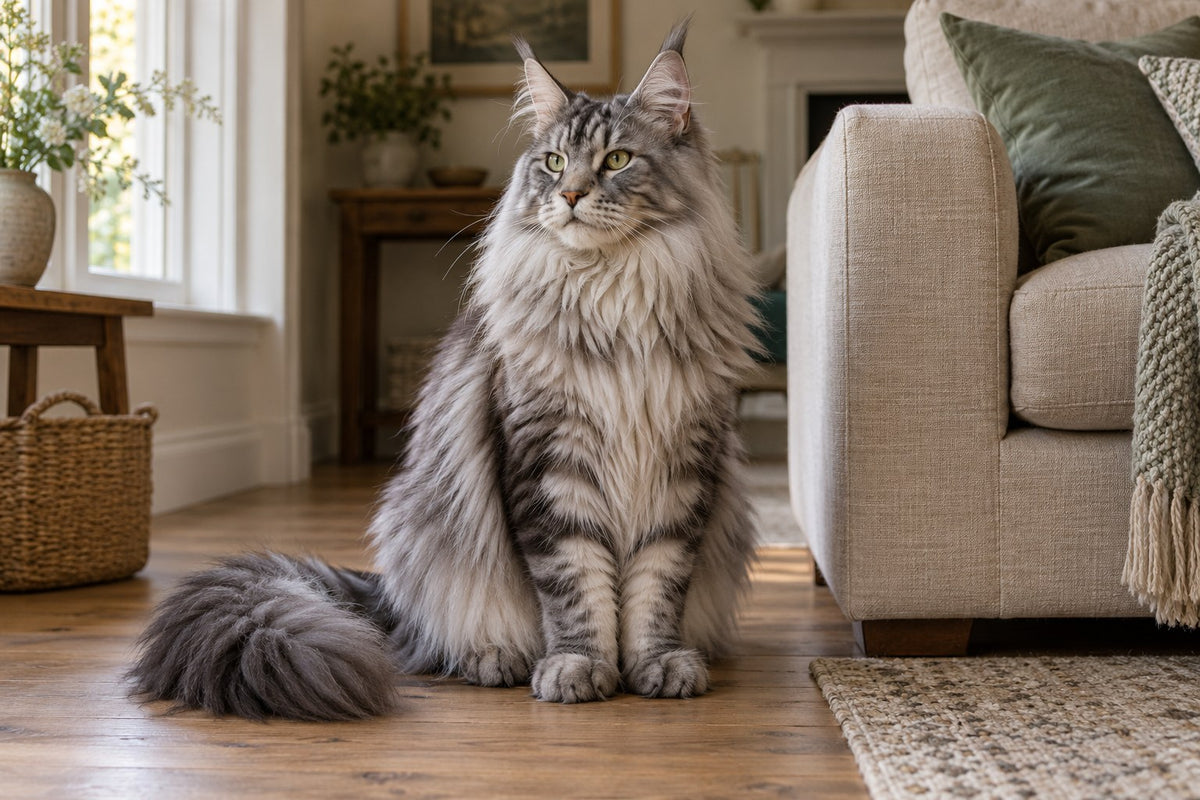
Maine Coon: size, temperament, cost in the UK, and what a cat this big needs at home
A Maine Coon kitten born this autumn may still be filling out in 2030. The breed is slow to mature, taking up to four years, and the GCCF calls it the largest domestic breed it recognises, with grown males reaching 8 to 9kg. That size is most of what is different about living with one: the tray, the scratching post and the carrier all have to be chosen for the cat it will be at four, not the kitten that arrives.
I sell some of that furniture and not all of it, and for a grown Maine Coon some of my range is too small. Where that is the case, the sections below say so.
Key facts
- Lifespan: 9 to 15 years by the registry's figure; 9.7 years on average for the 69 Maine Coons in a UK study of 2019 deaths
- Weight: 4.5 to 9kg; males are the larger, up to 8 to 9kg
- Coat: long and shaggy over a soft undercoat; a comb through at least weekly, more in the spring moult
- Indoor suitability: yes, with room to climb; an active cat that needs a strong climbing frame
- Typical UK price: £800 to £2,000 for a pedigree kitten (checked November 2026)
- Recognised by: GCCF (championship status 1993), FIFe (1982), CFA (1976)
How big will a Maine Coon get?
A grown Maine Coon weighs 4.5 to 9kg, and males are the larger of the two, reaching 8 to 9kg. The breed grows slowly: it can take three to four years to reach full size, so a two-year-old Maine Coon may still be getting broader. The body is long and rectangular, the bone heavy, and the tail at least as long as the body from shoulder blade to base of tail. Size varies between individual cats and between lines, so the parents are the best guide to how big a particular kitten will get.
What the weight range hides is length. A Maine Coon is built long as well as heavy, with a broad chest, big round paws tufted between the toes, and ears that, by the breed standard, should end in lynx tufts. No registry publishes a standard body length for the breed, and the figures that circulate online run from under 50cm to over a metre, depending on whether the tail is counted. For anything you are buying to fit the cat, a tape measure from the nose to the base of the tail is worth more than any average.
Do Maine Coons like to sleep with you?
Some Maine Coons sleep on the bed and some never do, and nobody has measured how many. The breed's reputation is for being sociable without being clingy: the British registry describes it as gentle, friendly and playful, and the American one as fairly independent, wanting a moderate amount of company rather than constant attention. A Maine Coon that settles at the foot of the bed is choosing warmth and company; one that sleeps on a high shelf is choosing height. Both are normal for the breed.
Where a cat sleeps depends more on the room than the breed. Cats look for warmth, height and somewhere with their back covered, and a cat this size needs a bed or a shelf large enough to stretch out on. Where cats sleep covers what they look for and why.
What is the closest relative to a Maine Coon?
The Maine Coon's closest relatives are the ordinary farm and street cats of Western Europe that settlers took to North America. In a 2008 genetic study of cat breeds and random-bred cats from around the world, the Maine Coon grouped with the Western European breeds, and American random-bred cats grouped with Western European ones, which fits cats arriving with European settlers. The breed was shaped in New England as a working farm cat, was being shown at agricultural fairs there by the 1860s, and became Maine's state cat.
It looks most like the Norwegian Forest Cat and the Siberian, two other big long-coated breeds from cold places, and the popular story puts Viking cats or a raccoon in its past. The raccoon is impossible, and the genetics do not single out a Norse ancestor. What the three share for certain is a dense all-weather coat, longer on the back and flanks, with full breeches.
How much is a Maine Coon cat worth?
A pedigree Maine Coon kitten from a UK breeder typically costs £800 to £2,000, the range Cats Protection gives for pedigree breeds including the Maine Coon (checked November 2026). The purchase is the smaller part of the cost: the same charity puts the typical cost of keeping any cat at over £1,000 a year, with insurance at around £25 to £50 a month, and a cat this size needs larger furniture than most.
For that money, a registered kitten should come with paperwork worth reading. Ask to see the parents' results for the HCM gene test and their hip X-ray scores, and ask whether the parents' hearts have been scanned. Those three things are explained in the next section, and they matter more than the colour.
What health problems do Maine Coons have?
The two inherited conditions most associated with the Maine Coon are hypertrophic cardiomyopathy (HCM), a thickening of the heart muscle, and hip dysplasia. In a study of 502 Italian Maine Coons, 38 per cent carried a gene variant linked to HCM; about six in ten cats with two copies developed the disease, against about one in twelve with one copy. In a US registry of 2,548 Maine Coons X-rayed for their hips, 24.9 per cent had hip dysplasia. Both can be screened for: a DNA test for the HCM variant, heart scans and hip X-rays of the breeding cats.
The DNA test is useful and it is not the whole answer. Some Maine Coons with HCM do not carry the known variant, which means there is at least one other cause, so a clear gene test in the parents lowers the risk without removing it. The study's advice to breeders is to test, and never to mate two carriers together, because that is how a kitten gets two copies. A heart scan for the cat itself, through your vet, is the check that applies to your cat rather than its parents.
Hip dysplasia can show up early. The youngest affected cat in the registry study was four months old, and males were slightly more affected than females, 27.3 against 23.3 per cent. A Maine Coon that stops jumping up, or moves stiffly, is worth taking to a vet rather than putting down to temperament. The breed can put on weight, and in UK vet records a body weight above or below the ideal went with a shorter life.
A rarer inherited condition, spinal muscular atrophy, is recessive, so both parents must carry it; an affected kitten develops an unsteady, weakening gait from about three months old. On lifespan, the registry gives 9 to 15 years. The UK study of 7,936 cats that died in 2019 prints an average of 11.7 years for all cats and 9.7 years for the 69 Maine Coons in it. That is an average across every cause of death, not a forecast for one cat, and it is a reason to take the screening seriously.
Can a Maine Coon be an indoor cat?
Yes, a Maine Coon can live indoors, provided it can climb, scratch and play every day. The breed is active and stays playful well into adulthood, and its registry description says it needs plenty of room and a strong climbing frame. An indoor cat that cannot do what cats do shows it as stress, such as spraying or scratching the wrong things. For a Maine Coon, doing what cats do means height it can reach in one leap, a scratching post it can stretch full length against, and a play session or two a day with a wand toy.
A Maine Coon that has always gone outside may find an indoor life stressful, so the decision is easier made at the kitten stage than changed later. A secure outdoor run, or a catio on a balcony, sits between the two. If the cat is going to live in a flat, the tray, the post and the space are covered in keeping a cat in a flat, and the section below says what changes for a cat this size.
Grooming, shedding and the allergy question
A Maine Coon's coat is easier than it looks. It is long and silky over a fine undercoat, and it needs a comb through at least once a week and more often in spring, when the winter undercoat comes out in handfuls. Work through the breeches and the belly, where knots start, and check the ears, which are large and collect dirt.
If anyone in the house is allergic to cats, a Maine Coon is not the answer, and neither is any other breed. A 2024 review of the evidence found no scientific basis for a hypoallergenic cat breed: every cat produces Fel d 1, the main cat allergen, even the hairless Sphynx. The amount varies from cat to cat, and on average unneutered males produce more than females. A long coat does not add allergen, but it does spread more hair around the house. Before committing, spend time with the actual cat, or one from the same breeder, and see how you react.
What a Maine Coon needs at home
A Maine Coon needs the same things as any cat, scaled up: a tray it can turn round in, a litter that copes with big tufted paws, a post or tree it can stretch full length against, and a carrier rated for its weight. My range covers some of these for a grown male and not others.
The tray
The rule of thumb for any cat is a tray one and a half times its length from nose to the base of the tail, so it can turn and dig without its back end hanging over the edge. A veterinary nurse writing in a cat charity's magazine put the minimum for giant breeds at a "jumbo" tray of 49 by 38cm, and suggested large clear storage boxes when even that is too small. Measure your cat, multiply by one and a half, and that is the length to look for.
The tray I sell is the pidan Snow Dome, a covered dome 54.8cm across on the outside, with a round basin that holds 4 to 5cm of litter and a grated entrance corridor that knocks litter off paws on the way out. Its page rates it for cats under 7kg. The basin inside is narrower than that, and its measurement is not published, so by the rule the dome fits a cat of at most about 36cm from nose to base of tail, and a little less in practice. That covers a young Maine Coon and a smaller female. It does not cover a grown male, who will be over the weight rating and almost certainly over the length: every estimate of the breed's body length I found starts above 40cm, though none of them comes from a registry.

For a grown male the right tray is an open one of storage-box size, and that is not something I stock; the litter box collection is the Snow Dome alone. Where a tray that size can go in a flat is covered in the flat piece.
The litter
A Maine Coon's paws are large and tufted between the toes, and the coat on its back legs is long. Those tufts and breeches pick up litter and carry it out of the tray. That is my inference from the coat rather than a measured fact, but it is the main thing a long-haired cat changes about litter, and it matters more for this breed than for a shorthair.
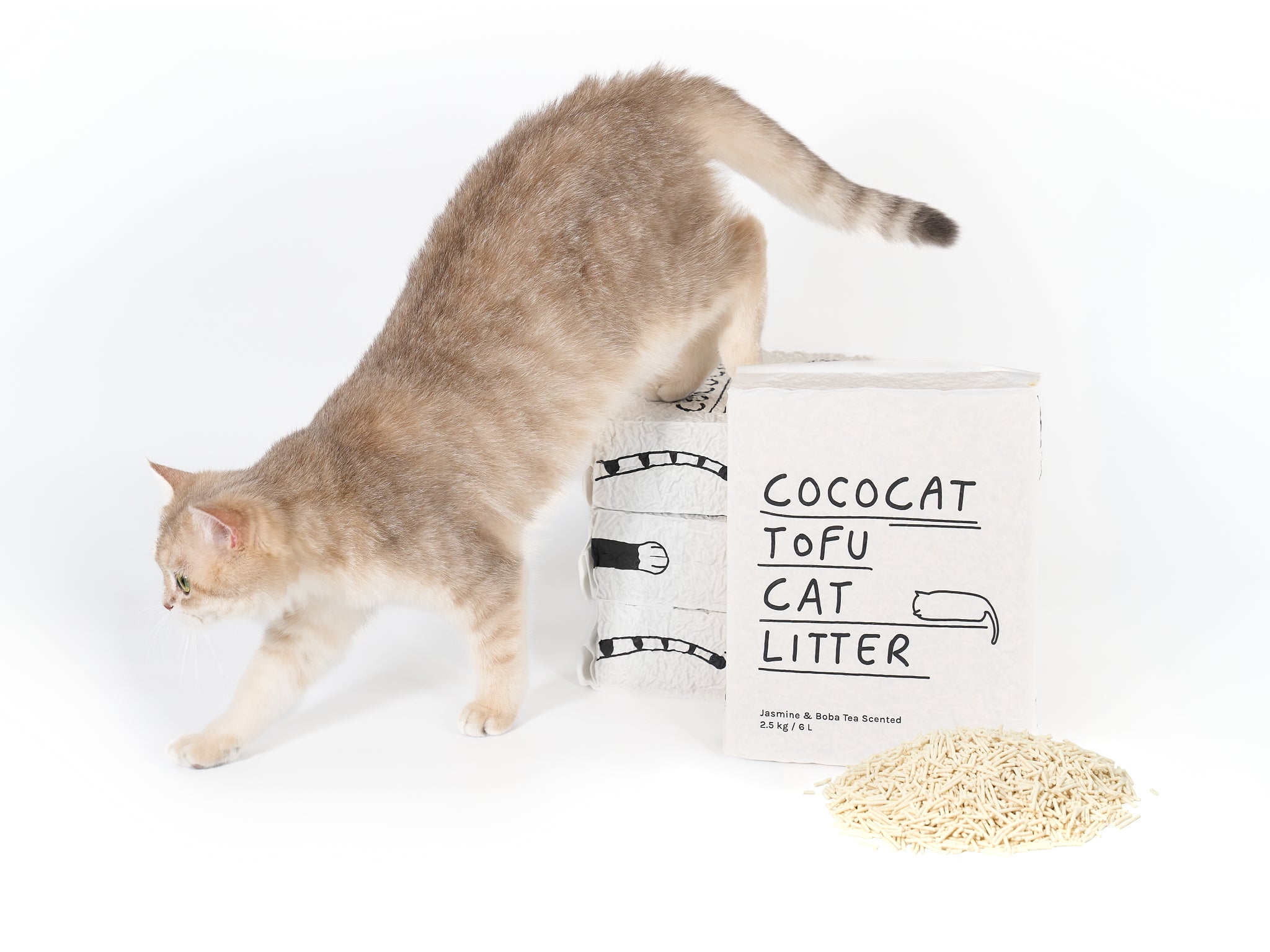
CocoCat tofu litter is pea fibre, corn starch, guar gum and plant-based enzymes, pressed into pellets about 1.5mm across. It clumps, so you scoop and top up, and the bag is put through a 99.9 per cent dust-filtration process, which is a figure about our production line and not about the air in your home. It has a Jasmine bubble tea scent. A light pellet rides out on fur, so it tracks, and on a Maine Coon it will. Three things keep that in hand: a textured mat under the tray, a fill of 5 to 7cm in an open tray so urine does not reach the base, and a dry sweep, because the pellets do not smear. In the Snow Dome the grated corridor does the mat's job. The disadvantages piece goes through tracking in more detail.

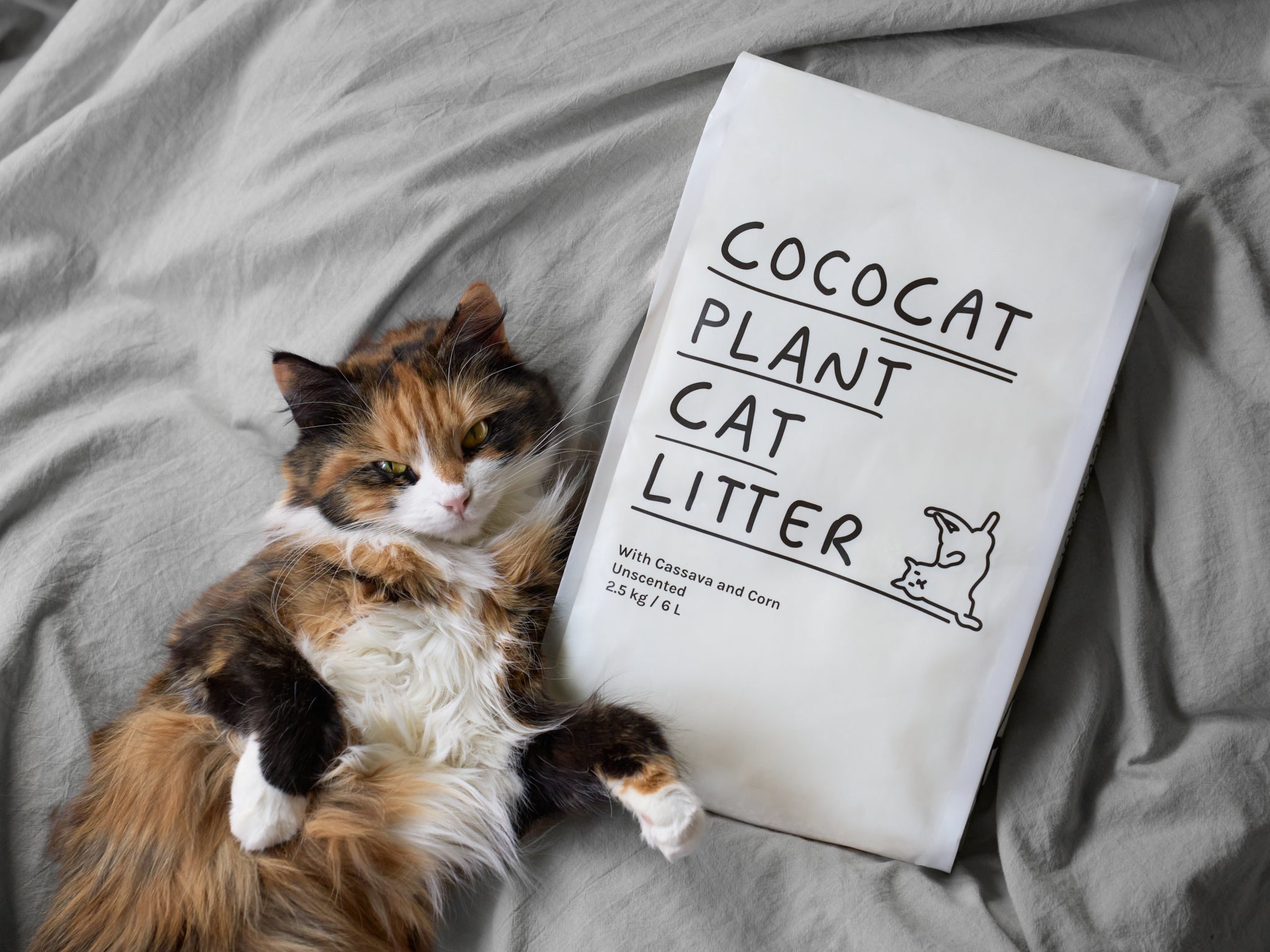
CocoCat cassava litter is the other one, made from cassava flour with corn starch, corn flour and guar gum, unscented, with a fine rounded grain. It suits a cat that dislikes any scent, and the same mat and fill apply. For a big tray, how often to change it has the routine. Both bags are in the cat litter collection.
The scratching post
A scratching post works when the cat can reach up, plant both front paws and pull down at full stretch. In the largest owner survey on the subject, cats used posts most when they stood at least 90cm tall. I have not found a measured full-stretch height for the Maine Coon. My judgement is that a grown male reaches past 90cm, so a Maine Coon needs a post at the top end of that range or a tree.
The tallest single posts I sell are the zeze Shy Tulip, large, 85cm of jute on a 39cm weighted base, the zeze Trophy post, 85cm on a 43cm base, and the zeze ACE Tennis post, 86cm of jute rope on a 40cm base. All three sit just under the 90cm line. They suit a Maine Coon kitten growing into it, or a smaller female.
For a grown Maine Coon, a tree. The zeze Farmhouse tree is the one I would put in front of one: 138cm tall on a 70 by 60cm base, four levels with a solid wood house on top, jute-wound uprights the cat climbs and scratches at once, and a parcel weight of 13.45kg, so it stays put when 9kg lands on it. Where the ceiling or the floor says smaller, the zeze Deluxe 3-in-1 is 118cm on a 68 by 65cm base with rope-wrapped posts, and the zeze Happy Farm tree is 105cm on 60 by 53cm. The zeze Cream Cake tree, 110cm on a 55cm base with three hideaways, is covered in plush rather than rope, so it is a perch and a den and needs a post beside it. None of these carries a maximum cat weight, and a cat is not going to be too heavy for them; the height and the base are what decide it. Choosing a cat scratcher has the survey behind the 90cm line, and the full range is in scratchers and trees and beds.

The carrier
A carrier has to be rated for the cat's weight and long enough for it to turn round, and a grown male Maine Coon at 8 to 9kg is past the rating on one of my two carriers and has no rating to go by on the other.
The pidan Expandable Travel Habitat is a backpack, 38 by 28.5 by 40.5cm, that unzips to 38 by 38 by 58cm so a cat can lie down on a long journey. It is rated for pets under 7.5kg, which makes it the carrier for a Maine Coon kitten or a female under 7.5kg, but not for a grown male. The zeze Cloud shoulder bag is a padded sling that clips to a harness and gives no weight rating, and I would not carry a Maine Coon in it.
For a grown male I have nothing to sell you: look for a hard-sided carrier whose stated maximum is above 9kg and whose base is long enough for the cat to turn round. The carrier collection is where the kitten's first carrier is.
Which household suits a Maine Coon
A Maine Coon suits a household with floor space for a tree well over a metre tall and a tray the size of a storage box, someone who will comb it weekly, and a budget that runs to insurance for a breed with known heart and hip risks. It makes a good family cat, gets on with other cats and a calm dog, does not demand constant attention, and stays playful for years. It does well in a flat if the flat has height in it.
It is not the cat for an allergic household, for anyone hoping for a lap cat by default, or for a home where the largest tray that fits is a standard one. And it is a long wait to find out how big your particular cat will get. The kitten that arrives this winter will need the 138cm tree, the jumbo tray and a carrier rated above 9kg in about three years' time, so it is worth measuring the hallway before choosing the kitten.
The tree, the tray and the carrier above are in trees and beds, litter boxes and carriers. If you would like the next breed guide when it is written, the newsletter box is at the foot of this page.
Related posts
- Sisal, cardboard or carpet: choosing a scratcher your cat will use
- Keeping a cat in a flat: the tray, the smell and the space
- The disadvantages of tofu cat litter, and what to do about each
Sources
- Governing Council of the Cat Fancy: Maine Coon
- Journal of Feline Medicine and Surgery, 2024: Life tables of annual life expectancy and risk factors for mortality in cats in the UK
- Journal of Veterinary Internal Medicine, 2013: Myosin-binding protein C DNA variants in domestic cats (A31P, A74T, R820W) and their association with hypertrophic cardiomyopathy
- Allergologie Select, 2024: Hypoallergenic animals: A promise of hope for allergic patients?
- Vicky Halls RVN, The Cat (Cats Protection), Autumn 2013: To pee, or not to pee